WELCOME !


WELCOME! CrossCurrents aims to provoke thought and enrich faith by interpreting current events in the light of Catholic tradition. I hope you find these columns both entertaining and clarifying. Your feedback and comments are welcome! See more about me and my work at http://home.comcast.net/~bfmswain/onlinestorage/index.html or contact me directly at bfswain@juno.com NOTE: TO READ OR WRITE COMMENTS, CLICK ON THE TITLE OF A POST.

Showing posts with label Holy Spirit. Show all posts

Friday, February 19, 2016

#447: Why Justice Scalia’s “Original” Genius Is a Bad Guide for Catholics

The death of Supreme Court Justice Antonin Scalia reminds us that how we interpret the past also guides us into the future—but his method is less helpful for the Church’s future. 

Any official document that guides a people must be interpreted, so that people know what it means.  And once the authors die, the task of interpreting falls to others. That is why we have the U.S. Supreme Court: to interpret the charter we call the U.S. Constitution. And the tributes following the sudden death of Justice Antonin Scalia make it clear that, for his contribution to how the Supreme Court functions, Scalia can arguably be ranked the most important Italian-Catholic in American history (with all due respect to Columbus and Frank Sinatra).

Scalia’s famous method for interpreting the Constitution was labeled either “originalism” or “textualism.” Either way, the strategy was to detect the true meaning of the Constitution in the words of the text itself, the legislation, without the “legislative history” (ideas, influences, sources, historical conditions or developments).

This strategy grew from Scalia‘s broader convictions.  Son of an academic, graduate of a Jesuit high school and college, trained in philosophy and theology and classical western culture, he developed deep respect for the rule of law, and a healthy suspicion that human nature often seeks to avoid or rationalize the demands of law into something more to our liking.

For Scalia, law reflects the agreements people reach to achieve a consensus about the basic question “How shall we live together?” Laws answer the question with standards of conduct, rules for proper procedure, and boundaries of what was acceptable behavior.  The law is thus a kind of fundamental social compact: it embodies agreement in the text--the very words--of any law.  Respect for such law, for such texts, is thus the foundation for the social solidarity of a people, guiding our unity against the whims and prejudices and disputes of the moment.  And thus the “rule of law” is superior to the “rule of man.”

Scalia knew that, in American Life, such rule is even more fundamental.  Our social solidarity does not come naturally to Americans.  We trace our roots to too many places; we emerge from too different cultures; we belong to too diverse races; we speak too many languages.  Even our shared national memories go back only a few generations.  Our nation of immigrants must find unity elsewhere then culture, or language, or race, or history.  And so we find it in the law, in the Constitution, which unites us by establishing the principals, the institutions, and the rights that we all share.  It is the Constitution which provides the unifying force that trumps (you should pardon the expression) all our differences.

This unifying function, Scalia knew, makes the Constitution our most sacred text--our “American scriptures.”  And that makes interpreting it a solemn responsibility.  In his view, that responsibility required a method of interpretation focused above all--or even only--on the text itself.  The aim was to determine “what did this text’s authors mean?” Any other meanings were either secondary or irrelevant.

But of course the practical result of this approach was to make Scalia one of the Supreme Court’s most conservative justices.  And it strikes me that many conservative Catholics find his approach equally attractive for interpreting things in Catholic life as well as American Life.  They prefer to stick to the texts of things, often taking them quite literally without reference to outside sources.

This is especially true when it comes to the documents of Vatican Council II (1962-1965).  Once the Council’s 16 documents were published in 1966, Catholics at all levels devoted untold hours to examining their texts.  And the impact of the Council has generally been determined by how the documents have been interpreted and explained.

Naturally those interpretations vary, and for 50 years three generations of Catholics have read the documents and come away with different meanings.  No wonder!  Compared to the U.S. Constitution, the documents of Vatican II are a dramatically more difficult interpretive challenge.  They cover hundreds of pages, they are translated from Latin originals into hundreds of languages, they draw on 20 centuries of thinking and practical experience, and they address not only constitutional workings of the world’s largest organization, but also its historical development, political system, practical procedures, and its priorities for the future.

This textual complexity was unavoidable, even necessary--but the results have been troubling.  Even 50 years later, no interpretation enjoys consensus.  Some Catholics view Vatican II calling for revolutionary change, while others see it affirming tradition.  Some find warrant for wide experimenting in liturgy, but others find a call to preserve Latin.  Some see justification for every for new moral teachings, but others find only permission to employ new wording for the old teachings.  Some see a historical watershed, others detect a call for continuity.

In most of these debates, all sides have invoked the Council’s texts to prove their case.  But this has not led to consensus, for the Council’s documents are so vast they provide--like the Bible itself--fuel for almost any position.

Personally, I have long believed that we cannot fully understand the work of Vatican II by focusing solely on the documents themselves. And Scalia’s death has forced me to clarify why.

Let’s began with an analogy: Vatican II is to its 16 documents as the Constitutional Convention is to the Constitution

In both cases, the texts we need to interpret are the products of a deliberative body--they were both “composed by committee” and then voted on.  Scalia argued that, once the members of the Constitutional Convention had committed their intentions to paper, our interpretation must be limited to what the text says.  Whether we agree or not, it is a reasonable position--and it has proven influential.  Even liberal justices have said of Scalia’s impact, “We are all textualists now.”

But this analogy limps, because the two cases are not exactly alike.  Here is the difference: for 50 years, Catholics have not quit talking (and debating) about “Vatican II”--meaning Vatican Council II.  But what is the last time you heard any one debate about the Constitutional Convention?  You see, Americans have always focused on the document, not the event that produced it.  But Catholics have always focused on the event, even if they never read the documents.

There are two reasons for this.  One is common sense: the Council was the biggest meeting in history: 2000 men gathering for four years in the glare of constant global publicity.  The second reason is more complicated, and has to do with how authority works in the Catholic Church.

The Roman Catholic Church is a hierarchical structure, with fairly centralized authority under the pope and Bishops.  But for Catholics, this authority is not supposed to be blind or arbitrary, for we believe that it enjoys the inspiring guidance of the Holy Spirit.  Thus, the Church’s authority always depends on the greater authority behind it: the will of God.

Now the highest ranking office is the pope, but even the pope’s authority is not as great as a general council, where the pope presides over the world’s bishops and they act together.  There have only been 21 such councils in Catholicism’s 20 centuries. By definition they are extraordinary events—events where, Catholics believe, the Spirit’s guidance is especially powerful.

For Catholics, what is sacred about Vatican II is not the documents themselves, but rather the Spirit’s presence, guiding the Church at that precise moment in history. In other words, it is in Vatican II as an event that we expect to find the Spirit working.  And this event was much greater than the documents it produced.  It began the moment Pope John XXIII conceived the idea of the Council within weeks of his election in 1958.  It continued through several years of preparations before the Council convened in October 1962.  It includes what John said about his intentions for the Council in speeches, interviews, and letters.  It includes the work of many commissions, the hundreds of speeches by the Council Fathers, the decision after John’s death to elect Paul VI, the working relationship between John and Paul, and Paul’s own statements during and after the council.

In short, we cannot interpret Vatican II’s meaning by looking only at its official texts.  To discern the divine guidance of the Spirit--to discover the sacred truth of the Council expressing the will of God--we must consider the entire event. Such consideration, far from complicating our interpretations, can actually clarify and simplify. 

For example, John XXIII more than once (including his speech opening the Council) called Vatican II “A New Pentecost” or even “A Second Pentecost.” Moreover, when John died and Paul VI was elected, he opened the Council’s next session (in October 1963) by quoting John about “The New Pentecost”! Since Pentecost marked the birth of the Church, John (and Paul) clearly intended Vatican II to bring about the rebirth of the Church.

 This was a lofty, historic, even heroic expectation--and no interpretation of Vatican II can leave it out. John’s vision, clearly grasped and embraced by his successor, must frame every interpretation of every text the Council produced.

 If the Catholic Church has not been “Reborn” in the last 50 years, then either we have failed to achieve the Council’s purpose, or we have never really understood (or accepted) it.

In sum, Antonin Scalia’s “textualism” is a plausible theory for interpreting the U.S. Constitution, for that document grounds our national unity even though we may not believe the Founding Fathers were divinely inspired.  But when Catholics interpret Vatican II, we affirm that the Council Fathers were divinely inspired, and so all their work--and not just the Texts they produced--demand our attention.

Thus we may say “Long Live the Constitution!” (meaning the text) but we also say “Long Live Vatican II” (meaning the event). In secular terms, we must honor not just the Council’s “legislation” but also its “legislative history.” After all, America is a nation of laws, but Catholics worship the God of history.

   © Bernard F. Swain PhD 2015

Friday, April 5, 2013

#388: Are the Pope’s Hands “Dirty”?

Pope Francis is the target of some backlash to his generally favorable media coverage.

Over the years I have criticized Catholic bishops repeatedly for lacking prudence.  Long dubbed the queen of all virtues, prudence knows when insisting on the right principle can do more harm than good.  Too often the hierarchy becomes preoccupied with crusading for some particular cause in a way that, by displaying a strident or even arrogant tone, diminishes their influence.

But the hierarchy has no monopoly on such failings.

Some progressive Catholics become so possessed of their own agenda they become blind to all else.  Like some bishops, they push their point so aggressively they lose much of their potential audience.  They end up, like the bishops, preaching to the choir.

A wise Jesuit once offered me constructive criticism: “You are very convincing,” he told me, “but you are not very persuasive.” He meant I was good at making a strong case for my point of view, but not good at making people want to agree with me.  He meant I lacked prudence.  This distressed me, and I’ve spent 25 years trying to fix that.  It also distresses me when progressives commit the same error, because I often agree with them at the beginning but end up not wanting to be their ally.

My inbox recently contained an example of this.  The email contained theologian Mary Hunt’s critique of Pope Francis I from her website (http://www.waterwomensalliance.org/ ). On many issues we have common ground, but her argument does not do them justice.

She describes calling a friend in Buenos Aires “to join in that country’s pride” in the election of their archbishop, yet in the next paragraph makes it clear that she already judged the entire papal election fraudulent:

 The process was flawed on the face of it by the lack of women, young people, and lay people. It was flawed by a dearth of democracy. Not even the seagull that sat on the chimney awaiting the decision was enough to persuade that the Holy Spirit was really in charge.

There is no basis here for “pride,” so her earlier remark rings contrived and disingenuous.

She follows by calling for “structural changes in the kyriarchal model of the church” rather than “cosmetic” or “symbolic” changes.  She argues that the conclave elected a Latin American as a “good business decision,” since European Catholicism has “lost market share”--but then notes that mass attendance in Argentina is as bad as in France!


Perez Esquivel Receiving the Nobel Prize , 1980
She says she “got an education about social justice” working with Nobel Peace laureate Adolfo Pérez Esquivel in Buenos Aires, then devotes 1/3 of her article to linking Francis (Jorge Bergoglio) to Argentina’s brutal “dirty war” even though Pérez Esquivel himself has dismissed such slander:

Adolfo Pérez Esquivel assured today that elected pope Jorge Bergoglio "had no links with the dictatorship” that ruled Argentina between the years 1976-1983.
Francis and Perez Esquivel, 2013
 Speaking to BBC News, Perez Esquivel said that “there were bishops who were accomplices of the dictatorship, but it was not the case of Bergoglio.”

Hunt employs a classic “red herring” tactic that echoes McCarthyism. Alluding to the case of two Jesuits kidnapped in 1976 by the military junta, she asks:

Did the Jesuit superior-now-Pope Francis call the military dictators and agree to their kidnapping? No one is accusing him of this.

Then why does she ask, if “no one” is making the accusation? But of course Bergoglio HAS been accused of this, and Hunt’s question dredges up the slander once more. Then she adds that “Padre Jorge [Bergoglio] is alleged to have intervened with military leaders for the release of the two Jesuits.”

I confess, this is the first time I have ever seen anyone “alleged” to have done something good!  All my dictionaries link “alleged” with either bad things (murder, rape, burglary, conspiracy) or doubtful outcomes (a cure, a miracle)--never with a past good deed.  Hunt’s cynicism is thinly veiled by such language, and anyhow it ignores the known facts.

The evidence is that Bergoglio (then Jesuit provincial, not a bishop) judged the two Jesuits to be in danger, and acted to protect their safety.  When they ignored him and were kidnapped, he acted on their behalf, as he described to biographer Sergio Rubin:

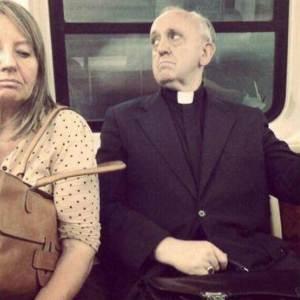
Bergoglio Rides Transit in Buenos Aires
“Because of their work with some priests in the slums they were exposed to the paranoia of the witch hunt…That same night when I heard of the kidnappings I started to move. I saw [dictator] Videla twice and I saw [dictator] Massera.

 The Associated Press adds more details:

Both men were freed after Bergoglio took extraordinary, behind-the-scenes action to save them, including persuading dictator Jorge Videla's family priest to call in sick so that Bergoglio could say Mass in the junta leader's home, where he privately appealed for mercy. His intervention likely saved their lives, but Bergoglio never shared the details until Rubin interviewed him for the 2010 biography.  Bergoglio told Rubin that he regularly hid people on church property during the dictatorship, and once gave his identity papers to a man with similar features, enabling him to escape across the border. But all this was done in secret, at a time when church leaders publicly endorsed the junta and called on Catholics to restore their "love for country" despite the terror in the streets.

Following Bergoglio’s election, journalists located the surviving kidnap victim Franz Jalics, and he provided these statements:
Franz Jalics Today

With the permission of Archbishop Aramburu and the then-Provincial Fr. Jorge Mario Bergoglio I moved together with a confrere into a “Favela,” one of the city’s slums. From there we continued our teaching at the university….In the civil-war-like situation back then…the two of us in the slum had contact neither with the junta nor with the guerrillas. Partly due to the lack of information and through targeted misinformation our situation was also misunderstood within the church.…

 These are the facts: Orlando Yorio and I were not reported by Father Bergoglio…It is thus wrong to claim that our capture was initiated by Father Bergoglio…Before, I too tended to believe that we were the victims of having been reported. By the late ’90s, however, it became clear to me after many conversations that this assumption was unfounded…”

It was only years later that we had the opportunity to talk with Father Bergoglio…to discuss the events. Following that, we celebrated Mass publicly together and hugged solemnly. I am reconciled to the events and consider the matter to be closed. I wish Pope Francis God's rich blessings for his office.

At that time, Burgoglio was Jesuit provincial.  Nevertheless, Hunt compares the Argentine bishops’ dirty war behavior to the U.S. Bishops in the sex-abuse scandal, and compares Bergoglio to Bernard Law.  Thus she paints Burgoglio with a wide brush of guilt by association, much like the Argentine journalist Gabriel Pasquini, who attacked Burgoglio with this critique:

Never, in the years he headed the Catholic Church in Argentina, did he acknowledge its complicity in the dictatorship, much less ask for forgiveness. Will he do so now, from the Vatican?

But Pasquini is wrong. Bergoglio became Archbishop of Buenos Aires 1998, and in 2000 was party to this statement from the Bishops conference of Argentina:

We want to confess before God everything we have done badly…We share everyone’s pain and once again ask the forgiveness of everyone we failed or didn’t support as we should have.

Apparently Hunt believes such guilt by association is relevant because it links Bergoglio’s refusal to support liberation theology with the past and current plight of Latin American society.  The premise is that only liberation theology is acceptable; other theological positions “deepen and entrench social injustice.” Specifically, she decries Burgoglio’s opposition to “divorce, abortion, contraception, same-sex marriage,” and then claims:

He shows no evidence from his Argentina actions that he will be any more responsive than his predecessor to changing policies and structures that oppress the world’s poor.

This line of attack troubles me on several grounds.  First, Hunt’s list of social justice issues focuses narrowly on the sex-related issues of our U.S. “culture wars.”

Second, she ignores the “theological positions” entrenched in the social encyclicals of the past 50 years, which (as I’ve detailed many times before) include positions on human rights, health, income inequality, immigration, trade, and arms that are well to the left of the Democratic Party. 

Third, as prominent a liberation theologian as Leonardo Boff (himself once silenced by the Vatican) has expressed support for Francis despite their theological differences:

With Pope Francis, a Church of the third millennium is being inaugurated--far from the palaces and in the midst of the peoples and their cultures.

Asked about the “dirty war,” Boff got more specific:

I'm wondering what interest some groups have in raising this question and not talking about the serious crisis in the Church and its meaning in the face of the crisis of humankind.

Leonardo Boff
Maybe -- this I'll concede -- he could have been more prophetic, like Bishop Hélder Câmara and Cardinal Paulo Evaristo Arns were in Brazil.…The question is political and for me, it's which side the person is on--the side of the poor, of those who suffer evil inequality? Or of the status quo that wants unlimited growth and a culture of consumption?...Bergoglio took the side of those victims and demanded social justice. If we don't understand this, we're getting away from the main point.


Finally, Hunt’s attack backfires by betraying the very fault she decries.  You might have wondered, earlier in this article, what “kyriarchal” means.  It’s a recent coinage from the Greek word for “Lord,” referring to lordly behavior that anyone uses to impose their views or will on others. Feminist theologians use the term to suggest that unjust treatment is not just limited to sexism, or even to men.  Anyone can abuse their relationships with others in this way.  Indeed, even feminists can be prone to “kyriarchal” behavior, as one feminist blogger explained [http://myecdysis.blogspot.com/]:

Let's not pretend that just because there are not many propertied males mucking around the fem blogosphere, there aren't queen bees and wanna bees exercising the same kind of behavior.  So when we talk about woman asserting power over other womyn, we're talking kyriarchy.  When you witness woman trying to dominate, define, outline the "movement" or even what an ally should be - that's the kyriarchal ethos strong at work. 

For me, Hunt’s case suffers precisely from this problem.  So sure is she that only her “theological positions” can serve justice, she feels free to impose her perspective with  a version of events designed to convince us that anyone who differs with her views at best unwittingly promotes injustice, or at worst is complicit in it. 

She does not persuade. She plays with facts. She asserts, “The controversy over Bergoglio’s role in the kidnapping of two Jesuits during this period is instructive”—but only instructs us that character assassination is alive and well.

Hunt decries “papal theatrics” which “keep the focus on the personal and spiritual, off the political and theological”--as if Catholic Social Teaching does not focus on both, and as if Bergoglio himself has not spoken of them both together:

Bergoglio as Archbishop
We live in the most unequal part of the world, which has grown the most yet reduced misery the least. The unjust distribution of goods persists, creating a situation of social sin that cries out to Heaven and limits the possibilities of a fuller life for so many…..
[To a gathering of Latin American bishops in 2007]

Hunt opens her final paragraph this way: “It is early to opine about the pontificate of Pope Francis”--but of course that is exactly what she has already done!  Her devotion to her agenda is so blinkered she cannot see how transparent it is--and how her credibility suffers
  © Bernard F. Swain PhD 2013

Monday, February 11, 2013

#119 Vatican II: Legacy and Hope

   With the resignation of Benedict XVI, and the prospect of a new Pope within a few weeks, it is more urgent than ever that we make the 50th anniversary of Vatican II a time of renewed clarity about and commitment to its legacy. The following is the second part of my postings from Vatican II's 40th anniversary:

   In my last post, I suggested we risk losing the legacy of Second Vatican Council (1962–1965) unless the “Vatican II Generation” convinces Catholics too young to remember the Council that Vatican II is too important to forget.  
Pope Paul VI Addresses the United Nations, October 1965
   But why do we risk forgetting Vatican II? And why is it so important to remember?
The most obvious reason for forgetting Vatican II is that 21st century Catholicism presents a troublingly negative image for younger Catholics, especially in America. The clergy sex abuse crisis has scandalized and depressed many Catholics, and provided others with a convenient excuse to disengage from Church life. The hypocritical and dishonest leadership of Bishops caused even wider damage than the abusive behavior of priests. The result: a self-inflicted crisis of credibility that leaves church authorities powerless to command the respect and compliance of their flock—and obstructs our view of Vatican II’s great accomplishment.
But there is a larger shadow obscuring the memory of Vatican II: the papacy of John-Paul II. This is ironic, because in many respects John-Paul II’s papacy was a product of the Council, impossible to imagine except in the post-Conciliar era. But the cult of his personality has obscured the Council’s importance. For millions of younger Catholics, JP II is their Vatican II – which is to say their Catholic identity is not as “post-Vatican II Catholics” but as “John-Paul II” Catholics.
For example: it has become commonplace in the media, both Catholic and secular, to treat the history of late 20th century Catholicism as though John-Paul II was its most important feature. As I argued last week, both John XXIII and Paul VI regarded Vatican II as nothing less than the rebirth of the Catholic Church 20 centuries after its founding—an event of much greater importance than any one man’s reign as Pope.
But assuming I am correct that (1) Vatican II is too important to forget and (2) recent events may make us forget –what exactly is the legacy that we risk losing?
Unfortunately, Catholics have floundered for the answer for 40 years. Too often Catholics have sought answers in the overwhelming volume of the sixteen documents of Vatican II. In my own view, those documents provide clear messages
about Vatican II’s reforms, but they do not send a clear, unambiguous, uncluttered message about the purpose of the Council as a whole! Beyond the reforms, everyone seems to know that Vatican II was about “Renewal” – but we have been arguing about what that means for 40 years.
For me, the most direct way to understand what “Renewal” means (and therefore understand Vatican II’s real purpose and legacy) is to listen carefully to the eloquence and unmistakable clarity of Vatican II’s chief architect, Pope Paul VI.
On October 8, 1965, Paul became the first “Pilgrim Pope” when he traveled to the New World to address the UN in New York. Vatican II would end just eight weeks later, but until now it had remained a distant blip on most Americans’ radar. Paul used this speech to announce the Council’s agenda in the most public way imaginable:
We here celebrate the epilogue of a weary pilgrimage in search of a conversation with the entire world, ever since the command was given to us: Go and bring the good news to all peoples…The hour has struck for our "conversion," for personal transformation, for interior renewal. We must get used to thinking of humanity in a new way...With a new manner, too, of conceiving the paths of history and the destiny of the world...The edifice of modern civilization must be built upon spiritual principles which alone can, not only support it, but even illuminate and animate it.
Listen to this man. He is speaking to the whole world, not just to Catholics. He says the Church has been seeking “a conversation” with that world. He says our new moment in history demands a new understanding of humanity and the human future. He says that will only happen through an inner, “personal transformation” in which spiritual principles animate the whole of our civilized life together.
This agenda goes ‘way beyond turning altars around or shifting rituals from Latin to English. It is about a new relationship between the Church and the world.
Over the last 25 years, the Church has implemented Vatican II’s call to reach out to the world – how else to explain John Paul II’s constant globetrotting? But even while reaching out, the Church in recent years has often seemed fearful and hostile, rather than charitable and sympathetic.
It’s understandable that many Catholics are disturbed by developments since Vatican II: the spread of legal abortion, the declining numbers of churchgoers, priests, brothers, and sisters; the growing secularization and consumerization of modern society; the rise of terrorism; the decline of “traditional moral values.”
Any of these might be reasons to abandon the positive, open, optimistic attitude, except for one thing: all the troubling developments since Vatican II pale before the horrific developments before Vatican II. Think of WWI (60,000 dead the first day at Verdun). Think of WW II, (over 30 million dead, a majority women and children). Think of the Holocaust, and its systematic attempt to wipe out a people. Think of the Cold War and the global terror it spawned while condemning most of the world to abject poverty.
Here’s the bottom line: if those horrors did not stop John XXIII and Paul VI from proclaiming their vision of a friendly, optimistic partnership between a “reborn” Church and a “transformed” world, why should we, 40 years later, fall prey to pessimism, fear, and hostility? Granted, these 40 years have not produced the kind of spiritually “illuminated” civilization that Paul envisioned at the U.N. But was anyone naïve enough to think that kind of renewal could be accomplished in a single generation?
Paul VI proposed a “conversation with the entire world” to make that vision real. Forty years later, we must ask: are we, as Church, still speaking to the world? And is the world still listening? If the answer is yes, then the conversation continues, the legacy is intact, and Renewal is still our hope for the future.
But if the answer is no, we should not be surprised if the future is bleak, and we have only ourselves to blame if we fail to retrieve the vision of Vatican II and convince the next generation to pick up that conversation anew.
© Bernard F. Swain PhD 2005

Wednesday, February 6, 2013

#118: Does Life Begin at 40?

As part of my ongoing observance of the 50th anniversary of Vatican II,  I am reprising two posts from the 40th anniversary! Here is the first:

Most of my parish presentations on the Second Vatican Council II (1962-1965) begin with two images. The first image is from an event that happened 40 years ago this past week, in December 1965, when Pope Paul VI rose to announce the end of the council before 2000 bishops in St. Peter’s Basilica. His speech is especially significant 40 years later, after so much conflict and debate about Vatican II’s legacy.


For Pope Paul, the key question was, “What is the religious value of this Council?”—and in his mind, the answer was very clear:

 Never before, perhaps, so much as on this occasion, has the Church felt the need to know, to draw near to, to understand, to penetrate, serve and evangelize the society in which she lives; and to get to grips with it, almost to run after it, in its rapid and continuous change. 

I have always felt that, aside from all the documents produced by the council, and all the literature of all those documents, and all the arguments about that literature, the public pronouncements of two men set the gold standard for understanding the council: John XXIII (whose personal vision the council was) and Paul VI (who brought that vision to life).

How can anyone claim to discover the “true meaning” of the council if that meaning conflicts with the stated intentions of the council’s founder and chief architect? Neither the concrete texts of the council documents nor any elusive “spirit” behind the council can be invoked to justify an interpretation that conflicts with the stated intentions of John and Paul.

Those intentions were clear at the opening of the council in October of 1962, when John XXIII referred to the council fathers meeting “as if in a new Cenacle.” The Cenacle, of course, was the upper room where the Church was born on Pentecost. On another occasion, John made his point even more explicit, calling the council “a second Pentecost.”

Three months later, as the Council’s first session ended, the Pope concluded by imagining what the Council’s outcome would be, and he repeated his opening day imagery:

“It will be a new Pentecost indeed, which will cause the Church to renew her interior riches and to extend her material care in every sphere of human activity.” 

 The next autumn, after John’s death and the election of Paul VI, the new Pope re-opened the council by quite deliberately quoting John’s “new Pentecost”.

What did this mean?

It meant that both men saw the council coming in a moment in history that required nothing less than the rebirth of the church. Though there had been 20 ecumenical councils in the 20 proceedings entries, they did not refer simply to “another Pentecost,” let alone “a 20th Pentecost.” This, for them, was to be the Second Birth of the Church. In my mind, there can be no doubt about what this means.
First, it means that Vatican Council II must rank among the very most important events in the entire 20 centuries of Catholic history. I would personally rank it as one of the two or three greatest of all Church councils and would also rank it among the half dozen most important events in Church history.

Second, the notion that the Church in 1962 needed to be reborn begs the question “Why?”
Why, after 20 centuries of living off the legacy of the First Pentecost, was it now necessary to have a Second? What challenge was the Church facing that it had not faced over those 20 centuries? And how was the council supposed to meet that challenge? No explanation of Vatican II is credible unless it answers these questions.

Third, Paul VI picked up the baton dropped by John XXIII with the same visionary zeal that John himself had shown. In particular Paul expressed the same optimism about the council’s work and legacy. Neither man succumbed to fear, hostility, or pessimism in looking at the Church’s challenge and future—and this optimism extended beyond the Church to the world outside.

The Second Image I use actually comes from 1963, just after Paul VI had assumed the reins of Vatican II:

The little boy, bare-headed in his winter coat and short pants, stands saluting his fallen father. Next to him stands his widowed mother, the grief engraved on her face just barely visible behind the black veil. A nation and world watches as his father’s casket passes by.

For any American born before 1960, the classic image is as close as our memories. For younger readers, it is an icon emblazoned on our culture. One need look no farther to see the great gap separating not only today’s Catholics from the Catholicism of the past, but also a “generation gap” among today’s Catholics.

Kennedy’s funeral was the first globally televised event in world history—and the most widely viewed Latin Mass in history. Countless millions watched the procession of black-clad figures rising in Washington’s Saint Matthew’s Cathedral as Richard Cardinal Cushing intoned the first Latin phrases of the Requiem Mass for the Dead. It was a ceremony full of long solemn silences between the woeful singing of the Dies Irae (“Day of Wrath”) and the deathly echoes of chanted Latin lifting into the church’s incense-filled arches—with Walter Cronkite and other TV commentators explaining what was happening as the aging Boston cardinal recited the Latin with his back turned to us all.
For many, the Kennedy funeral remains an archetypal image, but for me the telling image is the little boy himself. For some of us, JFK Jr. is the little boy we saw saluting live on TV. But for others, that little boy is but a photograph in a history book. For them, the real JFK Jr. is the most eligible bachelor of his generation, himself the victim of a tragic and early death.

Why does this matter? Because those who saw the boy live can remember Vatican II, and those who did not, cannot.

That boy’s father, in his 1960 inaugural address, spoke of the torch being passed to a new generation. He meant it was time for the nation’s fate to become the responsibility of those born after 1900.
The same is true of Vatican II. After 40 years, the time has come: the council’s fate, its legacy, must become the responsibility of those born after 1965. Anyone who believes the work of Vatican II is complete is dead wrong. But if a new generation cannot be persuaded to take up the cause of Renewal, the council’s promise may be dead too.

If Vatican II is to live on, then its life must begin now, at 40 years into its history. But I fear the challenge will not be met, not because it is insurmountable, but because it has gone unrecognized until now. Is it too late, after 40 years, to breathe new life into Vatican II?

Next week: Why Vatican II needs a second wind, and how to get it.
© Bernard F. Swain PhD 2005

Friday, August 17, 2012

#365: Here’s Julia, Here’s “Jaws”--Where’s Johnnie Walker?


We should not fail to take this golden opportunity to honor Blessed Pope John XXIII.

I began writing this piece on Julia Child’s 100th birthday.  At least in Boston, home of her TV show, it has been an occasion for massive celebration.  Local media put Julia’s face on front pages and lead stories, chefs and food critics published memoirs of their encounters with her, PBS stations ran “French Chef” marathons while hawking Julia’s books and DVDs.  PBS websites offered photographs, recipes, and more TV episodes.


Boston University’s culinary arts program (founded by Julia and Jacques Pepin) announced special Julia-inspired dinners prepared by celebrity chefs.  Publisher Alfred A. Knopf released a new tablet app of Julia recipes, to complement its “JC 100” Facebook page.  Many restaurants sponsored Julia Child weeks.  At least three new books about Julia appeared.


All this came in the fresh wake of another anniversary taking place. To mark Universal Studios 100th  anniversary, Martha’s Vineyard (where “Jaws” was shot, casting the island as “Amity Island”) revived its annual “Jawsfest.” 

Like the Julia celebration, “Jaws” festivities filled the local calendar.  Martha’s Vineyard hosted seminars with cast, families, through, and local residents involved in the making of Jaws, a multimedia tribute to the writer and cast members who have since died, a museum-like display of private collections of memorabilia from the film, live reenactments of favorite scenes, a treasure hunt, a movie-themed festival in a public park, and a big-screen outdoor screening of the movie under the stars. 

Thousands of tourists flocked to see the movie sites, review the movie itself, and stock up on Jaws T shirts, mugs, and other memorabilia. And when real life sharks appeared off Cape Cod beaches and actually bit one man’s leg, crowds flocked rather than fled to spy the spectacle and swarmed souvenir shops for shark staff.

All of which had me asking myself: If there is this much attention for these anniversaries, what can we expect for the really big anniversary coming in October?

October 11, 2012 is, in fact, two commemorative dates in one.  It is the 50th  anniversary of the opening of Vatican Council II in 1962, and it is also--not by accident--the feast day of Angelo Roncalli: Pope John XXIII.

By any objective standard, that makes this October 11 a very big date indeed.  Vatican II was arguably the largest deliberative meeting in history, and it reset the course of the world’s largest organization: the Roman Catholic Church.  And John XXIII was the man who made it happen--which is why the Church placed his feastday on October 11, rather than follow tradition by using the date of his death.

Because of John’s initiative, 2000 Bishops from five continents gathered during four consecutive autumn sessions (1962, 1963, 1964, 1965) to craft 16 documents shaping the future of Catholicism.

On opening day, October 11, 1962, he compared the gathering to the ancient Pentecost day when Jesus’ disciples, gathered in the upper room, experienced the outpouring of the Holy Spirit that launched them as leaders of the Jesus movement, and he proclaimed his intention to make the Council a “Second Pentecost”--that is, a rebirth of the Church nearly 20 centuries after its original birth.

50 years later, Vatican II’s stands as a watershed event in Catholic history and the most important religious event of the 20th   century.

But as with many transformative events in history, Vatican II’s real significance has emerged slowly and with difficulty.  Although its reforms were implemented rapidly (perhaps too rapidly) between 1965 in 1975, its long-term legacy is still in limbo.  Among rank and file Catholics, clergy, church officials, Bishops, and theologians we still lack consensus answers to the most basic questions about Vatican II.

Why was the Council called?  What was its purpose?  What did John (and his successor Paul VI) intend?  What really happened at the Council?  What did its document really mean?  What actions did they invoke?  What have they achieved?  How much of the Council’s renewal was about going “back to the sources,” and how much about “updating” Catholic life?  Is Vatican II a success, a failure-- or is it still unfinished?  What is the Council’s future?

These questions alone make October’s 50th  anniversary a big deal.  If we believe that the world’s bishops gathered in council with the pope constitute the surest, most solemn forum for discerning the divine wisdom of the Holy Spirit, than we cannot afford to squander the graces and guidance of Vatican II by letting its memory die. Nor can we accept a permanent feud over its legacy.

So October 11--and the four-year 50th  anniversary window that it opens--presents our people and our parishes with a golden opportunity to reflect on and build our solidarity around the Council’s vision and works.  Celebrating the Council’s renewal is an opportunity to renew ourselves.

But besides the Council there is the man.  For many Catholics, especially younger Catholics, John XXIII’s image and memory are obscured by the shadows of John-Paul II and now Benedict XVI.  But the blunt fact is this: the papacies of John-Paul II and Benedict XVI would be impossible, indeed would be unimaginable, if John XXIII had not been pope.

For John XXIII  not only led Vatican II--he also transformed the papacy itself.

Angelo Roncalli was elected at 78 to keep the papal throne warm until a younger man was ready to be elected.  His electors were correct to assume that his reign would be short (less than five years), but they were wrong to assume he would sit quietly on the throne and not rock the Barque of Peter.

By 1960 the Catholic Church had been in “siege” mode for nearly a century, its guard up to defend itself against a hostile and toxic world lurking outside the fortress of Catholic life.  And the pope himself was the “Prisoner of the Vatican,” literally cloistered from the world in self-imposed retreat.

Angelo Roncalli had carved his career in church diplomacy as the perfect “company man,” never making waves and always as reliable and docile as he was affable.  He lived by his episcopal motto “Obedience and Peace.” But a hero lurked within, as evidenced by his actions when, as the Vatican’s apostolic delegate to Turkey and Greece during world war II, he engineered the escape of as many as 200,000 Hungarian Jews (mostly children) from Nazi clutches by issuing them baptismal certificates—for which the Holocaust Museum of Israel bestowed upon him the rare honorary title “Righteous Among the Nations” in 2004.

Once elected pope in 1958, John XXIII had no one to obey but himself and his God, and he knew that the future would require more of Catholicism then a besieged, fortress Church and a prisoner pope.

So even before announcing the Council, he began to break with the status quo.  Feeling confined within Vatican City, he developed the habit of quietly slipping outside its walls at night so he could wander the streets of Rome.  This earned him an affectionate nickname among the Swiss guards and Vatican personnel who were privy to his nocturnal strolls.  They called him “Johnnie Walker.”


These walks now stand as a metaphor for how John XXIII changed the papacy forever. Through his vision and the Council’s actions, the Church dropped its guard and reached out to the world. 

This could not happen, of course, unless the pope himself took the lead.  So, even before the Council’s end, Paul VI (John’s successor) became “the Pilgrim Pope,” visiting the Holy Land, the US, and later nine other countries. After him, John Paul II became “pope as globetrotter,” visiting more than 100 countries.  And now Benedict XVI, despite his age, has followed suit.

The result: the papacy is now more visible than at any time in history, and by personifying the Catholic Church the papacy has made Catholicism’s public presence felt around the globe.

All this--the historic renewal of Catholicism and the dramatic transformation of the papacy--started with John XXIII.

So now that “Jaws” and Julia Child have been duly honored, what will we Catholics do over the next four years beginning October 11 to honor of the memory, the heroic vision, and the lasting legacy of our own “Johnnie Walker” and his Second Pentecost?
© Bernard F. Swain PhD 2011