WELCOME !


WELCOME! CrossCurrents aims to provoke thought and enrich faith by interpreting current events in the light of Catholic tradition. I hope you find these columns both entertaining and clarifying. Your feedback and comments are welcome! See more about me and my work at http://home.comcast.net/~bfmswain/onlinestorage/index.html or contact me directly at bfswain@juno.com NOTE: TO READ OR WRITE COMMENTS, CLICK ON THE TITLE OF A POST.

Showing posts with label Catholic Social Doctrine. Show all posts

Tuesday, January 13, 2015

#425: Francis’ New Way Out of the Wilderness

We are beginning to see what actual changes the new pope can make.

When Jorge Bergoglio was elected Pope Francis, his unique style was immediately apparent to all.  But many questioned whether that style could translate into substance--whether, in addition to inspiring people, he could actually implement practical changes.  In the last few months of 2014, the contour of those changes has become clearer, as he has taken practical steps consistent with his rhetoric. 
He convened a Synod on the Family that could make Catholicism more welcoming to divorced people, gays, and alienated Catholics everywhere. He has delivered a blunt critique of his own Vatican bureaucracy, the Curia, which makes a change of the Vatican’s culture (and probably the rolling of some of its heads) inevitable.  He has named bishops who share his vision to new posts, and expelled some with conflicting vision.  He was instrumental in convincing President Obama to make his diplomatic opening to Cuba.  And he is supporting the move to make Bishop Oscar Romero an official martyr of the church, emblematic of the Church’s fight for social justice for the oppressed and the poor.

In my view all these moves put to rest the question of whether Francis offers big rhetoric but little action.  And so, less than two years into his reign, we can begin to see not only how he is leading the church with his unique style, but where he is leading it with his decisions.  But to grasp what this means, we must see his actions in their full context--in fact, in four different contexts. 

BEFORE: The Regal Papacy of Pius XII
1. The Context Before Francis. To understand what is really going on, it is important to see how the office Francis holds has been transformed even before he was elected.  I often tell listeners that, since the death of Pius XII in 1958, every single subsequent pope has changed the office in a visible and important way.  The result: today’s papacy looks and acts dramatically different from the 1950s papacy.  In fact, I would argue that no public office on the planet has changed as much as the papacy.

Of course, this transformation all started with John XXIII, who convened Vatican Council II (1962-1965).  And the 50 years since then have been marked by the continuing, chronic, so far unresolved struggle over the meaning and impact of Vatican II.  Francis is, of course, the first pope since John who did not participate at Vatican II.  He experienced it as we all (who are old enough) did, from the outside looking in. Thus he brings a fresh view that may yet finally cement Vatican II’s legacy for the Catholic world and beyond. 

At the same time, Catholicism has witnessed an enormous demographic shift: now 2/3 of all Catholics live south of the equator.  Francis is, of course the first pope from the southern hemisphere, so he brings yet another new perspective. 

The last 20 years have also witnessed a rash of scandals, crises, and closings that have heavily damaged both Catholic life and Catholicism’s public image.  Indeed, in America the Catholic Church is hemorrhaging members faster than any other religion.  And despite his academic brilliance, Pope Benedict XVI seemed incapable of keeping his foot out of his mouth. 

The net result of these recent developments has been a reversal of the incredibly positive PR Catholicism gained from Vatican II.  One may argue that, prior to the election of Francis, the public image of Catholicism had never been worse in our lifetime.

2. The Context of Francis. That public image shifted dramatically almost at the moment of Francis’ election.  As the first southern hemisphere pope, as the first Jesuit pope, as the first Francis, he signaled a shift in papal leadership in the first 10 minutes of his first public appearance, when he asked the assembled crowd to bless him before he blessed them. This show of “Franciscan” humility has marked his papacy ever since.  But when, soon after his election, he accepted an Italian editor’s open invitation for an interview, he went beyond humility to indicate a new, ambitious direction:

Our goal is not to proselytize but to listen to needs, desires and disappointments, despair, hope. We must restore hope to young people, help the old, be open to the future, spread love. Be poor among the poor. We need to include the excluded and preach peace. Vatican II, inspired by Pope Paul VI and John, decided to look to the future with a modern spirit and to be open to modern culture. The Council Fathers knew that being open to modern culture meant religious ecumenism and dialogue with non-believers. But afterwards very little was done in that direction. I have the humility and ambition to want to do something.

AFTER: The "Cool" Papacy of Francis
Notice the way Francis linked humility and ambition--and linked both to a retrieval of Vatican II’s lost legacy. This combination of humility and ambition quickly made Francis a huge PR success, reflected by Time magazine selecting him as 2013’s “Person of the Year.”  And when his smiling face appeared on the cover of Rolling Stone magazine, it was clear that he had become the first “cool pope” in history! 

But this stunning reversal of the Church’s appalling public image--which is no small matter, for it led millions to abandon the Church--was not the whole story.  Instead, Francis has emerged not only as an inspiring figure but as an agent of reform, whose course correction for the Church includes battling corruption, careerism, obsessive preoccupation with the culture wars, and also battling the trickle-down theory that dominates the wider culture and economy.

(On this last point, note that a new book by La Stampa's Vatican watchers, Andrea Tornielli and Giacomo Galeazzi, titled Pope Francis: This Economy Kills, is being released this week in Italy.)

3. The Context of Mercy. Francis is not the first pope to put mercy at the center of his agenda.  In fact, this was a hallmark of John XXIII on the very day that he opened Vatican II:

We see, in fact, as one age succeeds another, that the opinions of men follow one another and exclude each other. And often errors vanish as quickly as they arise, like fog before the sun. The Church has always opposed these errors. Frequently she has condemned them with the greatest severity. Nowadays however, the Spouse of Christ prefers to make use of the medicine of mercy rather than that of severity. She consider that she meets the needs of the present day by demonstrating the validity of her teaching rather than by condemnations…the Catholic Church…desires to show herself to be the loving mother of all, benign, patient, full of mercy and goodness toward the brethren who are separated from her

There’s nothing new about an emphasis on mercy, of course. Catholics have long subscribed to (though perhaps many of today’s Catholics are not aware of) the action-steps known as the “Corporal Works of Mercy” and the “Spiritual Works of Mercy.” (http://en.wikipedia.org/wiki/Works_of_mercy)

For Francis, Mercy lies at the center of the Church’s mission:

Throughout history, some have been tempted to say that the Church is the Church of only the pure and perfectly consistent, and it expels all the rest.  This is not true!  This is heresy!  The Church, which is holy, does not reject sinners; she does not reject us all; she does not reject us because she calls everyone, welcomes them, is open even to those furthest from her; she calls everyone to allow themselves to be enfolded by the mercy, the tenderness, and the forgiveness of the Father…

But besides quoting the pope on mercy; we must also ask: what does he mean?  The question matters because the English word “mercy” badly translates the pope’s words.  “Mercy” comes from a Latin word meaning “wages.” It referred to God’s reward gives for those who do good works. 

But centuries ago, that word was replaced in the Latin languages for another word, which English never adopted.  The new word, “Miserecordia,” means almost the opposite of the English word.  Instead of the reward we get after doing good, it is the big-heartedness that impels us to do good in the first place.  Like the English word “compassion,” which means to suffer with another, Miserecordia refers to a heart that goes out to those in distress.  This is the word Francis uses, whether he speaks or writes in Latin, or Italian, or Spanish (it is the same word in French and Portuguese as well).

So while “mercy” in today’s English often means “pity” or “leniency,” we would do better to think of it as the impulse to help that comes from “big-hearted compassion”--as if it comes from the heart of God.

With this understanding, we can see why Francis might be regarded by some as a troublemaker, and why “mercy” might even seem a dangerous word.

For the pope’s emphasis on mercy pits him against an introverted Church in favor of a Church that reaches out to the poor.  It pits him against a Church committed to the “counter-culture,” in favor of a Church that promotes an “encounter-culture.” It pits him against any hostility to other religions, including Islam. It pits him against inequality, which makes peace impossible, and in favor of a restructured economy that redistributes wealth and honors solidarity. 

It commits him to a Church that “steps outside” itself, and thus to a Church whose mission is, above all, evangelization.  It commits him to a Church in which doing good is more urgent than arguing over doctrine. Indeed, he has criticized theologically-minded people who dispute doctrine endlessly, saying that we will not live long enough to see these disputes resolved but must act in the meantime.

In sum, Francis wants a new way for us to be Church:

The Lord wants us to belong to a Church that knows how to open her arms and welcome everyone, that is not a house for the few, but a house for everyone, where all can be renewed.

4. The Context of Our Lives. This new pope’s agenda touches us all as individuals, as families, and as communities.  For him, the dynamic is an active one that leads from the big-hearted impulse of God’s infinite  mercy, to the joy that brings us, to our mission to bring that mercy to the world.  For him, the works of mercy are like the beating of a heart, the systolic and diastolic rhythms of compassion and action. 

It is no surprise that among his favorite images from the gospel is the story of the prodigal son, of the father who watches endlessly for his son’s return and rushes out in joy when that return finally occurs.:

In the church, the God we encounter is not a merciless judge but is like the father in the gospel parable.  You may be like the son who left home, who sank to the depths…God is always waiting for you.  God embraces you, kisses you, and celebrates.  That is how the Lord is. 

For us, observing and listening to this man in action, the choice is clear. As he shows a way out of the wilderness that has lost Catholicism both its members and its impact, how do we respond? Do we identify with the Father who continues to reach out to embrace those who’ve been lost? Or are we more like the “good son” who stayed behind, resentful that others get the attention we might deserve, unhappy to hear that relieving their suffering is not only more urgent, but more important,  than our continued comfort? The choice is ours. But he is already showing us the way.

   © Bernard   F. Swain PhD 2015

Saturday, December 13, 2014

#253 (Reprised): Holy War Crimes

This week's news about CIA torture resurfaces a topic I've written about many times. The posting below surveys the core Catholic viewpoint:
Godard's Le Petit Soldat (1963)
 The uproar about US torture reminds me of the fortified medieval city Carcassonne. In 1998, I spent two hours wandering its double-wall ramparts, its slot-window towers, its cathedral (where St. Dominic preached against the heretical Cathars in Lent 1205). But my one souvenir is the illustrated brochure from the Museum of Torture.
I knew that Joan of Arc’s prosecutors had shown her the "instruments of torture," hoping to terrorize her into confessing and recanting her heresy, but I had never seen them myself. The brochure shows them all: rack, chair of nails, leg press, pincers, iron cage, wheel, spiked helmet. All were weapons in the Crusade to stamp out the Cathars in southern France.
We Catholics inherit a tarnished moral track record. Over the centuries our Church has justified slavery, locked Jews in ghettos, promised crusaders a heavenly prize for fighting infidels, denied non-Catholics freedom of religion, forced Baptisms, and even condemned saints to be burnt at the stake.
But one saving grace of Catholicism is its ability to learn from the errors of its ways. Over time the Church finally condemned slavery, repented its anti-Semitism, embraced religious liberty for all, and rejected holy wars. Along the way, Catholicism also renounced all torture as an offense against the dignity of human life.
 For me, this history imposes a special moral obligation. The world manifests many evils to oppose, but Catholics bear a special responsibility for evils that our own Church once promoted. Part of our penance for evils we have renounced, it seems to me, is the obligation to champion their elimination.
It turns out this applies especially to waterboarding.
 As a movie-nut and child of the 1960s, I am especially sensitive to torture, since few evils have been more powerfully portrayed on screen. First I saw the "Chinese brainwashing" scenes in the Manchurian Candidate, then the Russian roulette in Deer Hunter, the electrocutions in Day of the Jackal and State of Siege. And despite my dislike for Mel Gibson's The Passion of the Christ, I admit it bore powerful witness to this fact: the founder of our faith was himself a victim of "legal torture "!
But the images most imbedded in my brain come from Pontecorvo’s The Battle of Algiers (1965) and Godard’s Le Petit Soldat (1963). Both treat the Algerian war, and both have terrifying scenes of waterboarding. And while most movies portray torture as a villain’s tool, Godard showed that even "good guys" do evil when they torture:
I thought the honest thing was to show friends, people for whom I would go and fight if necessary -- the Algerians I mean -- to show them torturing. I thought that torture could be more persuasively condemned if one saw one's own friends practicing it.
At the time I may have known that the Vatican had specifically denounced torture in all forms, but I had no idea  about waterboarding's history. 
I did not know Cambodia’s Khmer Rouge (1975-1979) had waterboarded its victims. I did not know a US soldier had been court martialed for waterboarding a captured North Vietnamese soldier in 1968. I did not know the US prosecuted Japanese waterboarders after World War II. I did not know American soldiers had waterboarded Filipinos in the Philippine-American war (1899-1902). Above all, I did not know waterboarding’s Catholic roots in the Spanish Inquisition (1478-1574) and the Flemish Inquisition (1556-1559).
Professor William Schweiker of the University of Chicago argues that waterboarding began, not merely as an effective torture technique, but as a religious symbol:
Water as a form of torture is an inversion of the waters of baptism under the (grotesque) belief that it can deliver the heretic from his or her sins...Because of the broad symbolic meaning of 'water' in the Christian and Jewish traditions (e.g., creation, the great flood, the parting of the Red Sea in the Exodus and drowning of the Egyptians (!), and baptism as a symbolic death that gives life) the practice takes on profound religious meanings. Torture has many forms and meanings, of course, but torture by water as it arose in the Roman Catholic and Protestant Reformations drew some of its power and inspiration from theological convictions about repentance and salvation. It was, we must surely say, a horrific inversion of the best spirit of Christian faith and symbolism.( http://www3.interscience.wiley.com/cgi-bin/fulltext/121394529/HTMLSTART   )
In other words, not only does waterboarding have Catholic roots—it began as an attempt to “weaponize" Baptism itself! Thank God Catholicism eventually came to its senses.
I can understand the temptation to torture, since this particular evil is often wrapped in the camouflage of good content. 
After all, torture’s victims are nearly always "the enemy," and may themselves be perpetrators of evil deeds. Generally, they are tortured on the belief they possess knowledge we need lest our enemies do us further harm. It may seem that only torture will gain us that knowledge, that only torture can avoid that harm.
Moreover, many people believe that "anything goes" in war. They are convinced that, once war breaks out, it is futile and dangerous to quibble over techniques used to defeat the enemy.
This "anything goes" ethic is not unknown in Catholic history -- it is precisely what made crusades distinct. Crusades were not "just wars" according to Catholic teaching, for just wars have strict rules of conduct. Crusades were “Holy Wars," where one fought not merely for a good cause, but to enact God's will.
The ruins of Bézier, not far from Carcassonne, remind us that when “anything goes,” mass atrocity is not far behind torture.
Crusaders besieged this small town in July 1209. When the Catholics refused to surrender their heretical Cathar neighbors for inquisition and torture, the crusaders began a mass slaughter of 10,000 to 20,000, Catholics and Cathars alike. It is said the religious commander of the crusade, Arnaud-Amaury, declared "Kill them all! God will recognize His own!"  The massacre frightened many other towns to surrender without resistance.
We have long since renounced such “anything goes” warfare. There are Catholic pacifists, and Catholics who embrace the "just war" tradition -- but the "anything goes" of Holy War is no longer a moral option for Catholics. Catholic moral teaching has firmly established this main ethics principle: the end never justifies immoral means.
For us, then, it does not matter if defeating the enemy is our noble intention. It does not matter if we seek information that will save lives. It does not even matter if torture is proven effective at acquiring such information. If torture is a crime under US law and international treaties, then good intentions or widespread political support do not make it less criminal. If torture is rationalized because "we are at war," that does not make it less crime—that makes it a war crime.
The clinching case for war crimes was, of course, the Nuremberg trials that convicted many who were "just following orders" in committing atrocities in World War II. From now on, both the international community and the Church agree, "anything goes" no longer goes. A crime is a crime is a crime. In time of war, a crime simply becomes a war crime. And even if we think our cause is God's will, the crime simply becomes a holy war crime. 
The idea of US war crimes rooted in Catholicism’s own perversion of the sacrament of Baptism appalls me. As Prof. Schweiker writes:
Baptism is the sacrament and practice of new life. In this practice the dignity of human beings as active agents of love in the world is both announced and enacted. The act of waterboarding, conversely, is a practice of death-dealing where the victim is violently deprived of his or her power to be an active force, a responsible agent, in the world. This practice is meant to induce fear and dread to the point that the victim is rendered passive, subservient, to the torturer's power…In this respect, the practice of waterboarding, despite it roots in Christian history, is, in fact, an affront to the very nature of Christian faith.
We Catholics have disavowed the very torture that some public figures now defend. It should shame Catholics that we gave waterboarding to the world, and that shame should fuel our resolve to end the shame of American torture forever.
        © Bernard F. Swain PhD 2009

Monday, April 15, 2013

#389: Getting 3 Issues Back Into Focus

Recent weeks have seen three events provide strong evidence that Americans, and especially American Catholics, need to focus on some key issues that have gotten badly out of focus for too long.

Faith Beyond the Rule Book.  On Holy Thursday Pope Francis washed the feet of 12 people, including non-Christians and women, in a Rome detention center.  But his willingness to do this sends an important message.

In my work, I continue to meet people who are still haunted by a Catholic upbringing that treated Catholicism as a set of rules (especially, and often, rules about sex).  In recent years the US Bishops have often reinforced that old notion with major campaigns against same-sex marriage, contraception funding, and by their juridical behavior in covering up for priests guilty of sex abuse.

But the pope’s foot-washing gesture was “beyond the rule book” in three ways. First, it was not the customary location for the Holy Thursday service.  Second, by including non-Christians he reminded us that Jesus’s own act (washing the feet of his 12 apostles) was not merely a literal service to them; it was also a symbolic act demonstrating his ministry and mission of service, sacrifice, and love—which was destined for all people.  Third, by including women, Francis was breaking a liturgical rule. In all this, he sent the message that our faith is much more than a set of rules, and that sometimes those rules are trumped by more important things, like the symbolic value of including all people in the pope’s own ministry of service.

Recovering “The Common Good.”  Jim Wallis, longtime leader of Sojourners magazine and organization, the flagship of progressive evangelism in the US, has returned from his 2012 sabbatical with a new book: On God's Side: What Religion Forgets and Politics Hasn't Learned about Serving the Common Good. Catholics need to know this book and Wallis’ argument.

Wallis is promoting his book with an extensive media campaign and a nationwide tour of "Common Good Forums."

Inevitably, interviewers begin discussing the book by asking Wallis to define what he means by “the common good,” and just as routinely Wallis answers this way: He quotes from the 4th century saint John Chrysostom, an early father of the Church.

This is the rule of the most perfect Christianity, Its most exact definition, its highest point—namely the seeking of the common good. For nothing can so make a person an imitator of Christ as caring for his neighbors.

And then Wallis often cites a more modern source:

“I love…Catholic social teaching on the common good: ‘The common good is the whole network of social conditions which enable human individuals and groups to flourish and live a fully genuinely human life. Otherwise described as integral human development, all are responsible for all.’ ”

It just so happens that Wallis is paraphrasing  language from the social encyclicals of both Pope Paul VI and Pope Benedict XVI.

CrossCurrents readers have long known that Catholic social teaching is centered on the common good.  Now a prominent Protestant activist has spotlighted how Catholicism’s social vision can offer a powerful and wise antidote to the current political deadlock.

As Catholic Americans, we need to applaud and support Wallis’ effort and concentrate on educating our own people and those around us to the central importance of honoring the common good in building a just society.

Afraid of the Dark.  Last Friday night, CNN finally devoted a lengthy program-segment to the scandal surrounding Kermit Gosnell’s Philadelphia abortion clinic, but host Anderson Cooper admitted it was the first time CNN had covered the story.  CNN is not alone, for this man’s trial went on for more than a month without significant coverage from mainstream media (as noted in this commentary  http://www.usatoday.com/story/opinion/2013/04/10/philadelphia-abortion-clinic-horror-column/2072577/ ).

In retrospect, the horrific story of an alleged murderous abortionist in Philadelphia has acquired three dimensions: (1) the alleged criminal behavior itself and the plight of its victims; (2) the failure of both Philadelphia and Pennsylvania to take any action against the alleged crimes; (3) the failure of US mainstream media to cover the story.

Two questions loom large: 1. Why did no government agency act?  2. Why did media ignore the story?  In both cases one disturbing possibility is this: abortion has become so delicate and controversial an issue that neither public officials nor professional journalists have the requisite courage to face a story that disturbs the conventional wisdom about abortion.

For this story exposes the dark side of the Roe v. Wade era.  For more than 40 years we have lived with the myth that legalized abortion ends gruesome “back alley” horrors and serves women so safely that we can simply relax about the moral and medical risks that are inherent in abortion itself.

Polls showed that while Americans are generally unenthusiastic about abortion itself, they remain split about whether and how to regulate it.  But too many Americans have come to regard abortion lightly, and prefer not to face the real possibility that abortion’s “collateral damage” is (at least sometimes, if not always) the killing of babies.

U.S. Society needs to look long and hard at all three of these issues.  We can no longer afford to think that the Christian faith is accomplished merely by obeying rules.  We can no longer afford to let the mantra of individual “freedom” trump all concerns about the common good.  And we can no longer afford to pretend that abortion, even when legal, is a casual matter that poses no danger to public safety or human rights.

  © Bernard F. Swain PhD 2013

Friday, April 5, 2013

#388: Are the Pope’s Hands “Dirty”?

Pope Francis is the target of some backlash to his generally favorable media coverage.

Over the years I have criticized Catholic bishops repeatedly for lacking prudence.  Long dubbed the queen of all virtues, prudence knows when insisting on the right principle can do more harm than good.  Too often the hierarchy becomes preoccupied with crusading for some particular cause in a way that, by displaying a strident or even arrogant tone, diminishes their influence.

But the hierarchy has no monopoly on such failings.

Some progressive Catholics become so possessed of their own agenda they become blind to all else.  Like some bishops, they push their point so aggressively they lose much of their potential audience.  They end up, like the bishops, preaching to the choir.

A wise Jesuit once offered me constructive criticism: “You are very convincing,” he told me, “but you are not very persuasive.” He meant I was good at making a strong case for my point of view, but not good at making people want to agree with me.  He meant I lacked prudence.  This distressed me, and I’ve spent 25 years trying to fix that.  It also distresses me when progressives commit the same error, because I often agree with them at the beginning but end up not wanting to be their ally.

My inbox recently contained an example of this.  The email contained theologian Mary Hunt’s critique of Pope Francis I from her website (http://www.waterwomensalliance.org/ ). On many issues we have common ground, but her argument does not do them justice.

She describes calling a friend in Buenos Aires “to join in that country’s pride” in the election of their archbishop, yet in the next paragraph makes it clear that she already judged the entire papal election fraudulent:

 The process was flawed on the face of it by the lack of women, young people, and lay people. It was flawed by a dearth of democracy. Not even the seagull that sat on the chimney awaiting the decision was enough to persuade that the Holy Spirit was really in charge.

There is no basis here for “pride,” so her earlier remark rings contrived and disingenuous.

She follows by calling for “structural changes in the kyriarchal model of the church” rather than “cosmetic” or “symbolic” changes.  She argues that the conclave elected a Latin American as a “good business decision,” since European Catholicism has “lost market share”--but then notes that mass attendance in Argentina is as bad as in France!


Perez Esquivel Receiving the Nobel Prize , 1980
She says she “got an education about social justice” working with Nobel Peace laureate Adolfo Pérez Esquivel in Buenos Aires, then devotes 1/3 of her article to linking Francis (Jorge Bergoglio) to Argentina’s brutal “dirty war” even though Pérez Esquivel himself has dismissed such slander:

Adolfo Pérez Esquivel assured today that elected pope Jorge Bergoglio "had no links with the dictatorship” that ruled Argentina between the years 1976-1983.
Francis and Perez Esquivel, 2013
 Speaking to BBC News, Perez Esquivel said that “there were bishops who were accomplices of the dictatorship, but it was not the case of Bergoglio.”

Hunt employs a classic “red herring” tactic that echoes McCarthyism. Alluding to the case of two Jesuits kidnapped in 1976 by the military junta, she asks:

Did the Jesuit superior-now-Pope Francis call the military dictators and agree to their kidnapping? No one is accusing him of this.

Then why does she ask, if “no one” is making the accusation? But of course Bergoglio HAS been accused of this, and Hunt’s question dredges up the slander once more. Then she adds that “Padre Jorge [Bergoglio] is alleged to have intervened with military leaders for the release of the two Jesuits.”

I confess, this is the first time I have ever seen anyone “alleged” to have done something good!  All my dictionaries link “alleged” with either bad things (murder, rape, burglary, conspiracy) or doubtful outcomes (a cure, a miracle)--never with a past good deed.  Hunt’s cynicism is thinly veiled by such language, and anyhow it ignores the known facts.

The evidence is that Bergoglio (then Jesuit provincial, not a bishop) judged the two Jesuits to be in danger, and acted to protect their safety.  When they ignored him and were kidnapped, he acted on their behalf, as he described to biographer Sergio Rubin:

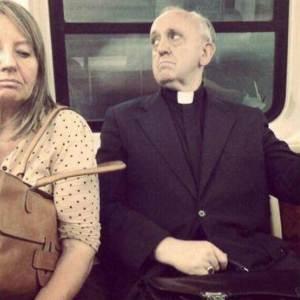
Bergoglio Rides Transit in Buenos Aires
“Because of their work with some priests in the slums they were exposed to the paranoia of the witch hunt…That same night when I heard of the kidnappings I started to move. I saw [dictator] Videla twice and I saw [dictator] Massera.

 The Associated Press adds more details:

Both men were freed after Bergoglio took extraordinary, behind-the-scenes action to save them, including persuading dictator Jorge Videla's family priest to call in sick so that Bergoglio could say Mass in the junta leader's home, where he privately appealed for mercy. His intervention likely saved their lives, but Bergoglio never shared the details until Rubin interviewed him for the 2010 biography.  Bergoglio told Rubin that he regularly hid people on church property during the dictatorship, and once gave his identity papers to a man with similar features, enabling him to escape across the border. But all this was done in secret, at a time when church leaders publicly endorsed the junta and called on Catholics to restore their "love for country" despite the terror in the streets.

Following Bergoglio’s election, journalists located the surviving kidnap victim Franz Jalics, and he provided these statements:
Franz Jalics Today

With the permission of Archbishop Aramburu and the then-Provincial Fr. Jorge Mario Bergoglio I moved together with a confrere into a “Favela,” one of the city’s slums. From there we continued our teaching at the university….In the civil-war-like situation back then…the two of us in the slum had contact neither with the junta nor with the guerrillas. Partly due to the lack of information and through targeted misinformation our situation was also misunderstood within the church.…

 These are the facts: Orlando Yorio and I were not reported by Father Bergoglio…It is thus wrong to claim that our capture was initiated by Father Bergoglio…Before, I too tended to believe that we were the victims of having been reported. By the late ’90s, however, it became clear to me after many conversations that this assumption was unfounded…”

It was only years later that we had the opportunity to talk with Father Bergoglio…to discuss the events. Following that, we celebrated Mass publicly together and hugged solemnly. I am reconciled to the events and consider the matter to be closed. I wish Pope Francis God's rich blessings for his office.

At that time, Burgoglio was Jesuit provincial.  Nevertheless, Hunt compares the Argentine bishops’ dirty war behavior to the U.S. Bishops in the sex-abuse scandal, and compares Bergoglio to Bernard Law.  Thus she paints Burgoglio with a wide brush of guilt by association, much like the Argentine journalist Gabriel Pasquini, who attacked Burgoglio with this critique:

Never, in the years he headed the Catholic Church in Argentina, did he acknowledge its complicity in the dictatorship, much less ask for forgiveness. Will he do so now, from the Vatican?

But Pasquini is wrong. Bergoglio became Archbishop of Buenos Aires 1998, and in 2000 was party to this statement from the Bishops conference of Argentina:

We want to confess before God everything we have done badly…We share everyone’s pain and once again ask the forgiveness of everyone we failed or didn’t support as we should have.

Apparently Hunt believes such guilt by association is relevant because it links Bergoglio’s refusal to support liberation theology with the past and current plight of Latin American society.  The premise is that only liberation theology is acceptable; other theological positions “deepen and entrench social injustice.” Specifically, she decries Burgoglio’s opposition to “divorce, abortion, contraception, same-sex marriage,” and then claims:

He shows no evidence from his Argentina actions that he will be any more responsive than his predecessor to changing policies and structures that oppress the world’s poor.

This line of attack troubles me on several grounds.  First, Hunt’s list of social justice issues focuses narrowly on the sex-related issues of our U.S. “culture wars.”

Second, she ignores the “theological positions” entrenched in the social encyclicals of the past 50 years, which (as I’ve detailed many times before) include positions on human rights, health, income inequality, immigration, trade, and arms that are well to the left of the Democratic Party. 

Third, as prominent a liberation theologian as Leonardo Boff (himself once silenced by the Vatican) has expressed support for Francis despite their theological differences:

With Pope Francis, a Church of the third millennium is being inaugurated--far from the palaces and in the midst of the peoples and their cultures.

Asked about the “dirty war,” Boff got more specific:

I'm wondering what interest some groups have in raising this question and not talking about the serious crisis in the Church and its meaning in the face of the crisis of humankind.

Leonardo Boff
Maybe -- this I'll concede -- he could have been more prophetic, like Bishop Hélder Câmara and Cardinal Paulo Evaristo Arns were in Brazil.…The question is political and for me, it's which side the person is on--the side of the poor, of those who suffer evil inequality? Or of the status quo that wants unlimited growth and a culture of consumption?...Bergoglio took the side of those victims and demanded social justice. If we don't understand this, we're getting away from the main point.


Finally, Hunt’s attack backfires by betraying the very fault she decries.  You might have wondered, earlier in this article, what “kyriarchal” means.  It’s a recent coinage from the Greek word for “Lord,” referring to lordly behavior that anyone uses to impose their views or will on others. Feminist theologians use the term to suggest that unjust treatment is not just limited to sexism, or even to men.  Anyone can abuse their relationships with others in this way.  Indeed, even feminists can be prone to “kyriarchal” behavior, as one feminist blogger explained [http://myecdysis.blogspot.com/]:

Let's not pretend that just because there are not many propertied males mucking around the fem blogosphere, there aren't queen bees and wanna bees exercising the same kind of behavior.  So when we talk about woman asserting power over other womyn, we're talking kyriarchy.  When you witness woman trying to dominate, define, outline the "movement" or even what an ally should be - that's the kyriarchal ethos strong at work. 

For me, Hunt’s case suffers precisely from this problem.  So sure is she that only her “theological positions” can serve justice, she feels free to impose her perspective with  a version of events designed to convince us that anyone who differs with her views at best unwittingly promotes injustice, or at worst is complicit in it. 

She does not persuade. She plays with facts. She asserts, “The controversy over Bergoglio’s role in the kidnapping of two Jesuits during this period is instructive”—but only instructs us that character assassination is alive and well.

Hunt decries “papal theatrics” which “keep the focus on the personal and spiritual, off the political and theological”--as if Catholic Social Teaching does not focus on both, and as if Bergoglio himself has not spoken of them both together:

Bergoglio as Archbishop
We live in the most unequal part of the world, which has grown the most yet reduced misery the least. The unjust distribution of goods persists, creating a situation of social sin that cries out to Heaven and limits the possibilities of a fuller life for so many…..
[To a gathering of Latin American bishops in 2007]

Hunt opens her final paragraph this way: “It is early to opine about the pontificate of Pope Francis”--but of course that is exactly what she has already done!  Her devotion to her agenda is so blinkered she cannot see how transparent it is--and how her credibility suffers
  © Bernard F. Swain PhD 2013

Saturday, September 8, 2012

# 83 Freedom’s Façade is Not Enough

A Selection From CrossCurrents Archives to Prepare for Election Day...

We’ve all been duped, from time to time, by Hollywood’s magic. We sit mesmerized by palaces and monuments, spaceships and ships at sea, ancient villages and frontier towns, and even places that exist only on another planet. Sometimes they’re only background pictures, or miniature models—but often they’re full-size sets, mere facades of buildings propped up from behind, beautiful balconies that beckon the hero through an elaborate doorway leading nowhere.
Falling for such facades is part of the make-believe pleasure movies give us, but real life is different. In life, we need to know if an attractive image has any inner life beyond the entryway.
Lately we’ve been hearing “freedom” ringing over our airwaves as repeatedly and rhythmically as the “Hail Mary” at a Rosary meeting. For Americans the word has the sound of sacred truth—who can be against freedom? And when “freedom” is linked to "democracy,” another sacred sound, the call to arms can be irresistible.
So maybe it’s time for some straight talk about freedom. It is an idea that was at the core of Christian faith from the very start. Its meaning and importance have evolved and expanded enormously over the course of Christian history. That history involves Christian theology, ancient and Christian and modern philosophy, varied moral theories, as well as a wide range of political philosophies emerging in recent centuries. That’s all too much to sort through here, but several key points should help get past the rhetoric to the reality:
Freedom is Not an Absolute Value. If everyone does whatever they want, they may be free—but chaos and anarchy are the result. As the old saying goes, my freedom to swing my arms ends at the tip of your nose. Total freedom may be impossible if people are to live together, so restraints are always needed. Iraq offers the perfect current example: until native police can ensure civil order, the freedom people have to commit mayhem and murder will collide with other values: the security and stability Iraq needs.

Freedom is not the Only Value. The American tradition links freedom to the Bill of Rights. But our founders aimed at more than freedom: their slogan “Life, Liberty, and the Pursuit of Happiness” reminds us that securing the rights of all is a balancing act among several sacred values.
The French Revolution touted freedom too, which is why the Statue of Liberty stands in New York Harbor as our oldest ally’s gift to us. But the French balanced “Liberté” with “Egalité” and "Fraternité,” and for more than 200 years the world has acknowledged that all of these, not just liberty, are the “passwords to democracy.” And sometimes those passwords conflict, and then freedom must be compromised. That’s why the pro-life movement knows “freedom to choose” cannot be the only value, if life is thereby jeopardized.
Elections do not produce Freedom. People choosing their own leaders is a good thing, but freedom requires more than that. After all, Nazi Germany and the Soviet Union and Iraq under Saddam all had elections too. If democratic freedom lies in “the consent of the governed,” then people are free only to the extent that they have a voice in all the decisions that govern them: in public policy, in corporate decisions, in the workplace and schools and social organizations and the family and even in the Church.
Choosing which leaders to hire is only a first step toward a real voice in all these areas. Even in America, we have a long way to go before we extend freedom to all areas of our lives—and we’ve been choosing our leaders for a long time (though male landowners have been voting much longer than other males, or females, or blacks).
“Freedom” Can Isolate Us. Often our modern secular culture has redefined “freedom” as a synonym for individual autonomy. To be “free” in this sense means to be left alone, to be unrestrained, to be independent of any obligations, to be subject to no authority except my own. To be “free” means to escape all outside interference—it’s what people mean when they talk about “getting government off our backs.” Carried to the extreme, of course, a “free world” would be a world full of unencumbered individuals who submit to no outside authority and owe each other nothing. This may be “rugged individualism” in its purest form, but it is a far cry from the Christian vision of a world where the golden rule binds us all together as our brothers’ and sisters’ keepers.
Freedom is not just a right.  The rise of modern democratic politics (since England’s Glorious Revolution in 1689) has tended to reduce “Freedom” down to the idea of a human right—the right not to be oppressed. Such “freedom” is merely an external condition that can be legislated by public declarations, and constitutions, and Bills of Rights. In Christian history, this external condition has often been called “formal freedom.”
But Christians have traditionally believed in another kind of freedom, often called “real freedom.” Real freedom isn’t just an external condition or right that can be formally declared, it is a capacity we find within us. Specifically, it is the power to act for the good—not only our own good, but also the good of others.
This goes way beyond freedom from oppression to define a freedom for facing up to life’s tough choices. The very idea of “sin” depends on the recognition that we don’t always make the right choices, even though we are free to do so. Christians have generally believed, in fact, that we humans are incapable of consistently doing the right thing without the help of God. On our own, we haven’t the power, the “freedom for” the choices we should make. But God’s grace is, in Christian faith, the force in our lives that supplies the power we need to do good. That’s why St. Paul says, “For freedom Christ has set us free,” and “where the Spirit of the Lord is, there is freedom.”
All this means two things. First, true freedom is much more than we’re led to believe by public leaders. It’s not just something you can produce, like a rabbit from a hat, simply by holding an election or writing a constitution or winning a war. Freedom is not merely a social and political condition we humans create by public acts. It is a moral and spiritual capacity that god creates within each of us.
Second, as people of faith, we cannot sell freedom short, even if others do. Our first instincts are right—freedom is a sacred truth. But God doesn’t offer us freedom for nothing, or just so we can be independent from others. God expects us to respond to his grace, to cooperate with the power he’s given us, to use our power to do his will. If we treat freedom as mere independence or autonomy, we squander that gift and insult its divine giver.
How do we honor the giver? By seeing past the political facade of freedom to its spiritual interior. Popes Leo XIII and Pius XII taught that our mission to re-form the world according to God's plan relies on three spiritual forces: truth, justice, and love. In the early 1960s, John XXIII added a fourth spiritual force: freedom.
So, as Americans we should see freedom as the partner of “Life” and “The Pursuit of Happiness.” As democratic people, we should set Freedom alongside “Equality” and “Fraternity.” And as people of faith, we should embrace freedom as one of the forces the world needs—along with Truth, Justice, and above all Love—if we are to make our world the kind of place God wills it to become. Then we’ve found the fullness of freedom, well beyond its façade.
© Bernard F. Swain PhD 2005

Tuesday, March 15, 2011

#320: Catholic Solidarity, Part II

EXCERPT:
it is now more than a century that the Catholic Church has been on record supporting the notion that unionism, and the collective bargaining that goes with it, are basic rights which, in modern capitalist societies, are often the only protection workers have against corporate power.

Here is what Catholics need to know about this teaching, which has been established and developed by five different popes, as well as by the US Catholic Conference of Bishops:
1.Unions are indispensable in pursuing the common good of all.
2.Unions are rooted in the right to free association –that is, the right to unite with others to protect common interests.
3.Unions foster solidarity through participation and collaboration.
4.Unions have a duty to seek cooperative relationships with employers.

None of this teaching justifies union corruption; none of it justifies the failure of unions to seek the common good of all; none of it justifies intransigence or an unwillingness to bargain. When unions fail, like any other human organization, they must be reformed.

But challenging them to fulfill their duties cannot include revoking their rights. That is why Bishop Stephen E. Blaire of Stockton, California, chairman of the US Conference of Catholic Bishops’ Committee on Domestic Justice and Human Development, said the following in a recent public letter to the Archbishop of Milwaukee:

These are not just political conflicts or economic choices; they are moral choices with enormous human dimensions…The debates over worker representation and collective bargaining are not simply matters of ideology or power, but involve principles of justice, participation and how workers can have a voice in the workplace and economy.

No surprise then that the Archbishop of Milwaukee himself, Jerome E. Listecki, acting as president of the Wisconsin Catholic Conference released the following statement [emphasis mine]:

The Church is well aware that difficult economic times call for hard choices and financial responsibility to further the common good…But hard times do not nullify the moral obligation each of us has to respect the legitimate rights of workers. As Pope Benedict wrote in his 2009 encyclical, Caritas in Veritate: “Governments, for reasons of economic utility, often limit the freedom or the negotiating capacity of labor unions. Hence traditional networks of solidarity have more and more obstacles to overcome. The repeated calls issued within the Church's social doctrine…for the promotion of workers' associations that can defend their rights must therefore be honored today even more than in the past…”

Perhaps the strongest statement applicable to the current situation was made by the US Bishops in their 1986 pastoral letter “Economic Justice for All”:

The Church fully supports the right of workers to form unions or other associations to secure their rights to fair wages and working conditions…No one may deny the right to organize without attacking human dignity itself.

Saturday, July 10, 2010

#299: The Culture Clash Within Our Walls

EXCERPT:
The New York Times has published a Watergate-style investigative report revealing a secret Vatican meeting in April 2000, more than a year before Boston broke, where alarmed Bishops from twelve countries challenged Vatican officials to confront the sex abuse problem.

The Vatican has so far claimed that its Congregation for the Doctrine of Faith (CDF) only received the mandate to investigate abuse cases in 2001, when authorized by Pope John Paul II. But the Times reported that Philip Wilson, Archbishop of Adelaide, notified the 2000 gathering of an authorization already in force since 1922, one which he had confirmed in the 1990s with then-CDF head cardinal Joseph Ratzinger -- now Pope Benedict XVI...

It now appears that John Paul II's hesitancy to acknowledge the crisis inhibited Ratzinger from exercising his own authority before 2001…Thus the Times charges that “the future pope, it is now clear, was also part of a culture of non-responsibility, denial, legalistic foot-dragging and outright obstruction.”

For me, that word "culture" jumps out. It suggests this scandal cuts deeper than I had previously realized.

I have always known that the sex abuse crisis operated on two levels. First was the immoral, even criminal behavior of the priests. Second was the mishandling of those priests by bishops...

I have always considered the cover-up to be the bigger scandal, which had the graver consequences on millions of Catholics (especially younger adults) who lost all faith in the institutional church’s credibility and moral authority.
And now I fear the spreading crisis has revealed a third level: an ecclesiastical culture of non-accountability – of immunity from scrutiny or questioning -- that borders on a totalitarian hoarding of power.

Of course, the scandal itself has always been about power rather than sex: the predatory power of priests over children and adolescents, and the paternalistic power that bishops (obsessed with protecting priests) exercised over victims and their families.

But this third level is not about personal power to prey on others, nor about official power to favor priests over people. It is about absolute power (the kind Lord Acton said corrupts absolutely) to do and say whatever one wants -- no matter how stupid or harmful -- while remaining immune to any check or balance...

This culture of immunity, with its disconnect from reality and its blindness to power’s abuse, may well cause more harm to the Church than either the abuse itself or its mishandling by Bishops. In this day and age, such a culture repels almost everyone except those who benefit from its privileges -- and that number shrinks daily.

To the extent that such a culture pervades Catholic life, we will alienate younger generations far into the foreseeable future. They will leave ashamed of their own Church and heritage…

The sad irony is that Catholicism moved to establish a radically different culture of accountability almost 50 years ago…Vatican II (1962-1965) …called for a wide variety of gatherings -- synods, conferences, and councils -- on all levels of church life.

The idea was to disseminate decision-making so the challenges were addressed as locally as possible...Vatican II’s vision for collective decision making at all levels offered precisely the kind of participatory culture that builds confidence among members of any institution. It ensures that authorities at all levels must answer to others for their actions.

But that vision has faded to the degree that the Roman Curia has restored its pre-conciliar role as the all-purpose arbiter, often pre-empting the proper role of bishops, pastors, and even laity. This restoration of a culture without accountability clearly clashes with the cultural program of Vatican II.

Benedict XVI has said that the real threat to the Church now comes, not from outside, but from within. He’s right, but the threat is not primarily priestly misbehavior, or even the bishops’ cover-up, but an entire institutional culture of immunity...

I now fear that this cultural clash within the Church, along with the scandal itself, has become the main story of the post-Vatican II era. Unless this clash is resolved, it may be a long time indeed before people regain confidence in their Church.

How long, O Lord?

Tuesday, April 20, 2010

#290 The Missing Antidote

On most social issues, Catholics’ opinions today reflect the rest of the population. In an age when Catholicism struggles to sustain its distinct identity, we have largely failed to establish a distinctive social platform among our people. I suspect that on many issues vital to America’s social and moral well-being, the problem is not that Catholics have rejected Catholic Social Teaching (CST). The problem is, they never knew what CST was.

Did most Catholics know their bishops, their pope, and virtually all the world’s bishops opposed the invasion of Iraq – and did they know why?

Did most Catholics test George bush’s assertion that Iraq was a “just war” by using the Catholic criteria for a just war?

When Catholics hear attacks on illegal immigrants, do they know CST calls migration a human right?

When Catholics here that healthcare is “a privilege, not a right” – do they know CST says the opposite?

When a mine disaster pits management against its critics, do Catholics know that CST always favors people over profits?

When policy critics attack “redistributing wealth” as “socialism,” do Catholics know that, in the face of income inequalities, CST labels redistributing wealth “justice,” not “socialism”?

Do Catholics know CST defends the right to private property – but says owners must always use property to serve the common good?

When America cuts back its nuclear arsenal, do Catholics know CST unconditionally condemns the use of nuclear weapons?

When America renounces “first use” of its nukes, do Catholics know CST forbids even the threat of nuclear attack?

When Catholics hear about “family values” do they know CST regards the human race as a single family – so that racism, anti-Semitism, anti-Islamic and anti-immigrant attitudes all violate true family values?

Do Catholics know CST does not recognize “success” in war (whether in Iraq, Afghanistan, or anywhere else) as a moral justification?

Facing venomous debates about “Big” versus “Small” government, do Catholics know CST says size does not matter, but favors government that promotes the common good and a just social order?

I’m afraid that there is a yawning chasm between the vision of CST and the world view of many Catholics. Too many of them get their social values from secular society – from party politics, or media “pundits,” possibly from friends and family. If I’m right, on most social issues, millions of Catholics do not know their own faith.