WELCOME !


WELCOME! CrossCurrents aims to provoke thought and enrich faith by interpreting current events in the light of Catholic tradition. I hope you find these columns both entertaining and clarifying. Your feedback and comments are welcome! See more about me and my work at http://home.comcast.net/~bfmswain/onlinestorage/index.html or contact me directly at bfswain@juno.com NOTE: TO READ OR WRITE COMMENTS, CLICK ON THE TITLE OF A POST.

Wednesday, September 23, 2015

#437: It Took Pope Francis Less Than One Hour To Change the Game


How good a messenger is Pope Francis?  He is so good that even the media gets the message! 
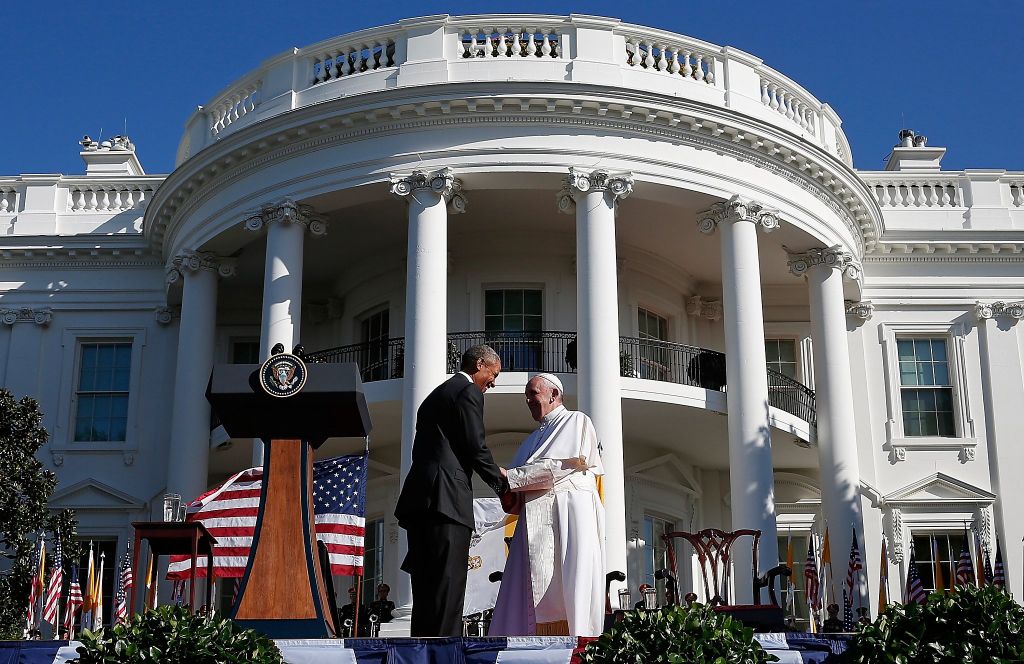

As the news networks provided wall to wall coverage of the pope’s arrival at the White House, his parade along the National Mall, and his prayer service at Saint Matthew’s Cathedral, commentator after commentator spoke facts that seem foreign to American ears: 

This pope is not a politician, he is a pastor. 

His interest is not power, but people. 

He offers a view that is neither conservative nor liberal, but a view rooted in the gospel message. 

He aims to promote no party, no program, no politician--but the common good of all people. 

He speaks not only to Catholics, but to the human race. 

He sees the world, not as a collection of allies fighting enemies, but as “our common home.”

He is interested less in judging who is right and who is wrong than in getting all of us to work together. 

His response to power is neither to fear or fight it, but to offer us the wisdom to use power well. 

He is not a reformer, but a radical in the original sense of going to the root of things.  For rather than changing the tradition he represents, he is presenting it in a new light as a comprehensive worldview that the 21st century badly needs. 

And his personal authenticity makes it nearly impossible to simply ignore him, no matter how uncomfortable listening to him might make us.  He is showing us that the leadership we need must embody a moral authority that few officeholders have.

He will challenge us, and those who are not too cowardly to listen will listen at our own peril.  As president Obama said, Francis will “awaken us from our complacence.”
 Bernard F. Swain PhD 201

Sunday, September 13, 2015

The Integral Ecology of Pope Francis-26

NOTE: THIS IS THE FINAL EXCERPT !

As Pope Francis' September visit to the US approaches, I have decided to post excerpts from his recent encyclical letter--which one "traditionalist" wag has dubbed Francis' "Summa Ecologica." It is a long document (40,000 words) more easily absorbed in piecemeal fashion. But these excerpts appear in their original order, to give some sense of the "Flow" of this ground-breaking document. The entire letter is available from many sources, including the Vatican itself at http://w2.vatican.va/content/francesco/en/encyclicals/documents/papa-francesco_20150524_enciclica-laudato-si.html   We can expect its themes to be echoed when Francis addresses the US Congress and the General Assembly of the UN.
ENCYCLICAL LETTER
“LAUDATO SI” 
OF THE HOLY FATHER 
FRANCIS
ON CARE FOR OUR COMMON HOME
 
VIII. QUEEN OF ALL CREATION
241. Mary, the Mother who cared for Jesus, now cares with maternal affection and pain for this wounded world. Just as her pierced heart mourned the death of Jesus, so now she grieves for the sufferings of the crucified poor and for the creatures of this world laid waste by human power. Completely transfigured, she now lives with Jesus, and all creatures sing of her fairness...She treasures the entire life of Jesus in her heart (cf. Lk 2:19,51), and now understands the meaning of all things. Hence, we can ask her to enable us to look at this world with eyes of wisdom.


242...The Gospel presents Joseph as a just man, hard-working and strong. But he also shows great tenderness, which is not a mark of the weak but of those who are genuinely strong, fully aware of reality and ready to love and serve in humility. That is why he was proclaimed custodian of the universal Church. He too can teach us how to show care; he can inspire us to work with generosity and tenderness in protecting this world which God has entrusted to us.


IX. BEYOND THE SUN

243. At the end, we will find ourselves face to face with the infinite beauty of God (cf. 1 Cor 13:12), and be able to read with admiration and happiness the mystery of the universe, which with us will share in unending plenitude...Eternal life will be a shared experience of awe, in which each creature, resplendently transfigured, will take its rightful place and have something to give those poor men and women who will have been liberated once and for all.


244. In the meantime, we come together to take charge of this home which has been entrusted to us...In union with all creatures, we journey through this land seeking God ...Let us sing as we go. May our struggles and our concern for this planet never take away the joy of our hope.


245. God, who calls us to generous commitment and to give him our all, offers us the light and the strength needed to continue on our way. In the heart of this world, the Lord of life, who loves us so much, is always present. He does not abandon us, he does not leave us alone, for he has united himself definitively to our earth, and his love constantly impels us to find new ways forward. Praise be to him!
* * * * *
246. At the conclusion of this lengthy reflection which has been both joyful and troubling, I propose that we offer two prayers. The first we can share with all who believe in a God who is the all-powerful Creator, while in the other we Christians ask for inspiration to take up the commitment to creation set before us by the Gospel of Jesus.

A prayer for our earth
All-powerful God, you are present in the whole universe
and in the smallest of your creatures.
You embrace with your tenderness all that exists.
Pour out upon us the power of your love,
that we may protect life and beauty.
Fill us with peace, that we may live
as brothers and sisters, harming no one.
O God of the poor,
help us to rescue the abandoned and forgotten of this earth,
so precious in your eyes.
Bring healing to our lives,
that we may protect the world and not prey on it,
that we may sow beauty, not pollution and destruction.
Touch the hearts
of those who look only for gain
at the expense of the poor and the earth.
Teach us to discover the worth of each thing,
to be filled with awe and contemplation,
to recognize that we are profoundly united
with every creature
as we journey towards your infinite light.
We thank you for being with us each day.
Encourage us, we pray, in our struggle
for justice, love and peace.

A Christian prayer in union with creation
Father, we praise you with all your creatures.
They came forth from your all-powerful hand;
they are yours, filled with your presence and your tender love.
Praise be to you!
Son of God, Jesus,
through you all things were made.
You were formed in the womb of Mary our Mother,
you became part of this earth,
and you gazed upon this world with human eyes.
Today you are alive in every creature
in your risen glory.
Praise be to you!
Holy Spirit, by your light
you guide this world towards the Father’s love
and accompany creation as it groans in travail.
You also dwell in our hearts
and you inspire us to do what is good.
Praise be to you!
Triune Lord, wondrous community of infinite love,
teach us to contemplate you
in the beauty of the universe,
for all things speak of you.
Awaken our praise and thankfulness
for every being that you have made.
Give us the grace to feel profoundly joined
to everything that is.
God of love, show us our place in this world
as channels of your love
for all the creatures of this earth,
for not one of them is forgotten in your sight.
Enlighten those who possess power and money
that they may avoid the sin of indifference,
that they may love the common good, advance the weak,
and care for this world in which we live.
The poor and the earth are crying out.
O Lord, seize us with your power and light,
help us to protect all life,
to prepare for a better future,
for the coming of your Kingdom
of justice, peace, love and beauty.
Praise be to you!
Amen.


Given in Rome at Saint Peter’s on 24 May, the Solemnity of Pentecost, in the year 2015, the third of my Pontificate.
 

Saturday, September 12, 2015

The Integral Ecology of Pope Francis-25

As Pope Francis' September visit to the US approaches, I have decided to post excerpts from his recent encyclical letter--which one "traditionalist" wag has dubbed Francis' "Summa Ecologica." 
It is a long document (40,000 words) more easily absorbed in piecemeal fashion. But these excerpts appear in their original order, to give some sense of the "Flow" of this ground-breaking document. The entire letter is available from many sources, including the Vatican itself at http://w2.vatican.va/content/francesco/en/encyclicals/documents/papa-francesco_20150524_enciclica-laudato-si.html   We can expect its themes to be echoed when Francis addresses the US Congress and the General Assembly of the UN.


ENCYCLICAL LETTER
“LAUDATO SI” 
OF THE HOLY FATHER 
FRANCIS
ON CARE FOR OUR COMMON HOME

IV. JOY AND PEACE

222. Christian spirituality proposes an alternative understanding of the quality of life, and encourages a prophetic and contemplative lifestyle, one capable of deep enjoyment free of the obsession with consumption. We need to take up an ancient lesson, found in different religious traditions and also in the Bible. It is the conviction that “less is more.” 

A constant flood of new consumer goods can baffle the heart and prevent us from cherishing each thing and each moment. To be serenely present to each reality, however small it may be, opens us to much greater horizons of understanding and personal fulfillment.

Christian spirituality proposes a growth marked by moderation and the capacity to be happy with little. It is a return to that simplicity which allows us to stop and appreciate the small things, to be grateful for the opportunities which life affords us, to be spiritually detached from what we possess, and not to succumb to sadness for what we lack. This implies avoiding the dynamic of dominion and the mere accumulation of pleasures.


223. Such sobriety, when lived freely and consciously, is liberating. It is not a lesser life or one lived with less intensity. On the contrary, it is a way of living life to the full. In reality, those who enjoy more and live better each moment are those who have given up dipping here and there, always on the look-out for what they do not have. They experience what it means to appreciate each person and each thing, learning familiarity with the simplest things and how to enjoy them. 

So they are able to shed unsatisfied needs, reducing their obsessiveness and weariness. Even living on little, they can live a lot, above all when they cultivate other pleasures and find satisfaction in fraternal encounters, in service, in developing their gifts, in music and art, in contact with nature, in prayer. Happiness means knowing how to limit some needs which only diminish us, and being open to the many different possibilities which life can offer.


224. Sobriety and humility were not favourably regarded in the last century. And yet, when there is a general breakdown in the exercise of a certain virtue in personal and social life, it ends up causing a number of imbalances, including environmental ones. That is why it is no longer enough to speak only of the integrity of ecosystems. We have to dare to speak of the integrity of human life, of the need to promote and unify all the great values. Once we lose our humility, and become enthralled with the possibility of limitless mastery over everything, we inevitably end up harming society and the environment. It is not easy to promote this kind of healthy humility or happy sobriety when we consider ourselves autonomous, when we exclude God from our lives or replace him with our own ego, and think that our subjective feelings can define what is right and what is wrong.


225. On the other hand, no one can cultivate a sober and satisfying life without being at peace with him or herself. An adequate understanding of spirituality consists in filling out what we mean by peace, which is much more than the absence of war. 

Inner peace is closely related to care for ecology and for the common good because, lived out authentically, it is reflected in a balanced lifestyle together with a capacity for wonder which takes us to a deeper understanding of life. 

Nature is filled with words of love, but how can we listen to them amid constant noise, interminable and nerve-wracking distractions, or the cult of appearances? Many people today sense a profound imbalance which drives them to frenetic activity and makes them feel busy, in a constant hurry which in turn leads them to ride rough-shod over everything around them. This too affects how they treat the environment. An integral ecology includes taking time to recover a serene harmony with creation, reflecting on our lifestyle and our ideals, and contemplating the Creator who lives among us and surrounds us, whose presence “must not be contrived but found, uncovered”.[155]....

V. CIVIC AND POLITICAL LOVE

228. Care for nature is part of a lifestyle which includes the capacity for living together and communion. Jesus reminded us that we have God as our common Father and that this makes us brothers and sisters. Fraternal love can only be gratuitous; it can never be a means of repaying others for what they have done or will do for us. That is why it is possible to love our enemies. This same gratuitousness inspires us to love and accept the wind, the sun and the clouds, even though we cannot control them. In this sense, we can speak of a “universal fraternity”.


229. We must regain the conviction that we need one another, that we have a shared responsibility for others and the world, and that being good and decent are worth it. We have had enough of immorality and the mockery of ethics, goodness, faith and honesty. It is time to acknowledge that light-hearted superficiality has done us no good. When the foundations of social life are corroded, what ensues are battles over conflicting interests, new forms of violence and brutality, and obstacles to the growth of a genuine culture of care for the environment. 


230. Saint Therese of Lisieux invites us to practise the little way of love, not to miss out on a kind word, a smile or any small gesture which sows peace and friendship. An integral ecology is also made up of simple daily gestures which break with the logic of violence, exploitation and selfishness. In the end, a world of exacerbated consumption is at the same time a world which mistreats life in all its forms. 


231. Love, overflowing with small gestures of mutual care, is also civic and political, and it makes itself felt in every action that seeks to build a better world. Love for society and commitment to the common good are outstanding expressions of a charity which affects not only relationships between individuals but also “macro-relationships, social, economic and political ones”.[156] That is why the Church set before the world the ideal of a “civilization of love”.[157] 

Social love is the key to authentic development: “In order to make society more human, more worthy of the human person, love in social life – political, economic and cultural – must be given renewed value, becoming the constant and highest norm for all activity”.[158] In this framework...social love moves us to devise larger strategies to halt environmental degradation and to encourage a “culture of care” which permeates all of society...


232. Not everyone is called to engage directly in political life. Society is also enriched by a countless array of organizations which work to promote the common good and to defend the environment, whether natural or urban. Some, for example, show concern for a public place (a building, a fountain, an abandoned monument, a landscape, a square), and strive to protect, restore, improve or beautify it as something belonging to everyone. Around these community actions, relationships develop or are recovered and a new social fabric emerges. Thus, a community can break out of the indifference induced by consumerism. These actions cultivate a shared identity, with a story which can be remembered and handed on. In this way, the world, and the quality of life of the poorest, are cared for, with a sense of solidarity which is at the same time aware that we live in a common home which God has entrusted to us. These community actions, when they express self-giving love, can also become intense spiritual experiences. 


Thursday, September 10, 2015

The Integral Ecology of Pope Francis-24

As Pope Francis' September visit to the US approaches, I have decided to post excerpts from his recent encyclical letter--which one "traditionalist" wag has dubbed Francis' "Summa Ecologica." 
It is a long document (40,000 words) more easily absorbed in piecemeal fashion. But these excerpts appear in their original order, to give some sense of the "Flow" of this ground-breaking document. The entire letter is available from many sources, including the Vatican itself at http://w2.vatican.va/content/francesco/en/encyclicals/documents/papa-francesco_20150524_enciclica-laudato-si.html   We can expect its themes to be echoed when Francis addresses the US Congress and the General Assembly of the UN.


ENCYCLICAL LETTER
“LAUDATO SI” 
OF THE HOLY FATHER 
FRANCIS
ON CARE FOR OUR COMMON HOME
 
III. ECOLOGICAL CONVERSION
216. The rich heritage of Christian spirituality, the fruit of twenty centuries of personal and communal experience, has a precious contribution to make to the renewal of humanity. Here, I would like to offer Christians a few suggestions for an ecological spirituality grounded in the convictions of our faith, since the teachings of the Gospel have direct consequences for our way of thinking, feeling and living. More than in ideas or concepts as such, I am interested in how such a spirituality can motivate us to a more passionate concern for the protection of our world. 

A commitment this lofty cannot be sustained by doctrine alone, without a spirituality capable of inspiring us, without an “interior impulse which encourages, motivates, nourishes and gives meaning to our individual and communal activity”.[151] 

Admittedly, Christians have not always appropriated and developed the spiritual treasures bestowed by God upon the Church, where the life of the spirit is not dissociated from the body or from nature or from worldly realities, but lived in and with them, in communion with all that surrounds us...
 
It must be said that some committed and prayerful Christians, with the excuse of realism and pragmatism, tend to ridicule expressions of concern for the environment. Others are passive; they choose not to change their habits and thus become inconsistent. So what they all need is an “ecological conversion”, whereby the effects of their encounter with Jesus Christ become evident in their relationship with the world around them. Living our vocation to be protectors of God’s handiwork is essential to a life of virtue; it is not an optional or a secondary aspect of our Christian experience.


218. In calling to mind the figure of Saint Francis of Assisi, we come to realize that a healthy relationship with creation is one dimension of overall personal conversion, which entails the recognition of our errors, sins, faults and failures, and leads to heartfelt repentance and desire to change....


219. Nevertheless, self-improvement on the part of individuals will not by itself remedy the extremely complex situation facing our world today. Isolated individuals can lose their ability and freedom to escape the utilitarian mindset, and end up prey to an unethical consumerism bereft of social or ecological awareness. Social problems must be addressed by community networks and not simply by the sum of individual good deeds...The ecological conversion needed to bring about lasting change is also a community conversion.


220. This conversion calls for a number of attitudes which together foster a spirit of generous care, full of tenderness. First, it entails gratitude and gratuitousness, a recognition that the world is God’s loving gift, and that we are called quietly to imitate his generosity in self-sacrifice and good works...It also entails a loving awareness that we are not disconnected from the rest of creatures, but joined in a splendid universal communion. 

As believers, we do not look at the world from without but from within, conscious of the bonds with which the Father has linked us to all beings. By developing our individual, God-given capacities, an ecological conversion can inspire us to greater creativity and enthusiasm in resolving the world’s problems and in offering ourselves to God “as a living sacrifice, holy and acceptable” (Rom 12:1)....


221. Various convictions of our faith, developed at the beginning of this Encyclical can help us to enrich the meaning of this conversion. These include the awareness that each creature reflects something of God and has a message to convey to us, and the security that Christ has taken unto himself this material world and now, risen, is intimately present to each being, surrounding it with his affection and penetrating it with his light. Then too, there is the recognition that God created the world, writing into it an order and a dynamism that human beings have no right to ignore. We read in the Gospel that Jesus says of the birds of the air that “not one of them is forgotten before God” (Lk 12:6). How then can we possibly mistreat them or cause them harm? 
 
I ask all Christians to recognize and to live fully this dimension of their conversion. May the power and the light of the grace we have received also be evident in our relationship to other creatures and to the world around us. In this way, we will help nurture that sublime fraternity with all creation which Saint Francis of Assisi so radiantly embodied.