WELCOME !


WELCOME! CrossCurrents aims to provoke thought and enrich faith by interpreting current events in the light of Catholic tradition. I hope you find these columns both entertaining and clarifying. Your feedback and comments are welcome! See more about me and my work at http://home.comcast.net/~bfmswain/onlinestorage/index.html or contact me directly at bfswain@juno.com NOTE: TO READ OR WRITE COMMENTS, CLICK ON THE TITLE OF A POST.

Showing posts with label poverty. Show all posts

Monday, June 15, 2020

#480: Is this, finally, our nation’s Great Awakening?

In this moment of national crisis, the popular uprising triggered by George Floyd’s killing raises the question: Is America finally ready to acknowledge and repair the systemic racism embedded in our culture? 
William Bratton is the former police commissioner in Boston, New York city, and Los Angeles.  When interviewed recently about George Floyd’s killing, he referred to slavery and racism as “America’s original sin--the scar that never heals.” My own awakening to that scar’s depth took many years, but I was fortunate to have many opportunities.
In December 1969, during my senior year at Holy Cross, all the Black students packed their bags and left campus, vowing never to return unless a group of expelled Black students received amnesty.  During a recent student sit-down protesting a campus visit by GE recruiters considered “scabs” (since GE was on strike), a disproportionate number of the protestors punished were Black.  A college administrator offered the excuse that, in a big mostly white crowd, those students were easier to spot!
In response, we white students went on strike in solidarity with the Black students.  Eventually amnesty was granted, and all the Black students returned to a campus newly awakened to their plight.
I spent the summer of 1971 as a research assistant for a doctoral thesis on “Racial Stratification in the US in the 20th century.” My job was collecting data for the chapter on lynching.  I constructed tallies of the lynchings in each state for each year since 1900.  Such tallies were rarely published in mainstream (white) periodicals, so I spent two months digging through obscure, often defunct Black journals that printed monthly totals of lynchings.
One day a Black reference librarian confronted me.  Why, she asked, was a white boy like me searching through these Black journals?  Why wasn’t this job given to a Black student?  What was I trying to prove?
Our encounter, perhaps 20 minutes long, ended with me (1) getting access to the archives I sought and (2) realizing that the burden of proof was on me to both acknowledge my privileged state and to persuade her of my bona fides.
My research left me appalled. I learned that thousands of Blacks were lynched not only without trials but also often without being charged, and even without any crime at all being committed.  Blacks were often lynched to cover the crimes—or simply the embarrassing behavior—of whites (as when a white girl flirted with a Black who was then lynched for rape after she was, in fact, beaten by her white boyfriend).  Blacks were lynched singly and in groups.  Blacks were not just lynched by hanging: Blacks were shot, drawn and quartered, tarred and feathered, buried alive, burnt at the stake, blowtorched, skinned alive. Pregnant Black girls were lynched after their babies were ripped from their wombs.
And blacks were lynched in frighteningly large numbers throughout the 20th century, well into the 1950s— right into my own lifetime.
It became clear to me that lynching was a cultural institution aimed not at justice, nor at crime, not even at individual conflicts. Lynching was often disguised as vigilanteeism, but in reality it aimed at terror--terror to frighten the Black population into continued submission.  In short, lynching replaced slavery to keep Blacks in their place during the Jim Crow era. And I saw that, as lynching finally faded away, the states with the most lynching became the states that executed the most Blacks.
My work that summer made me aware that terror against Black people had “evolved” from one institution to another: from slavery to lynching to the death penalty to mass incarceration to police brutality.  These different forms of terror all aimed to keep Blacks in “their place.”  Whites thus aimed to maintain supreme control.
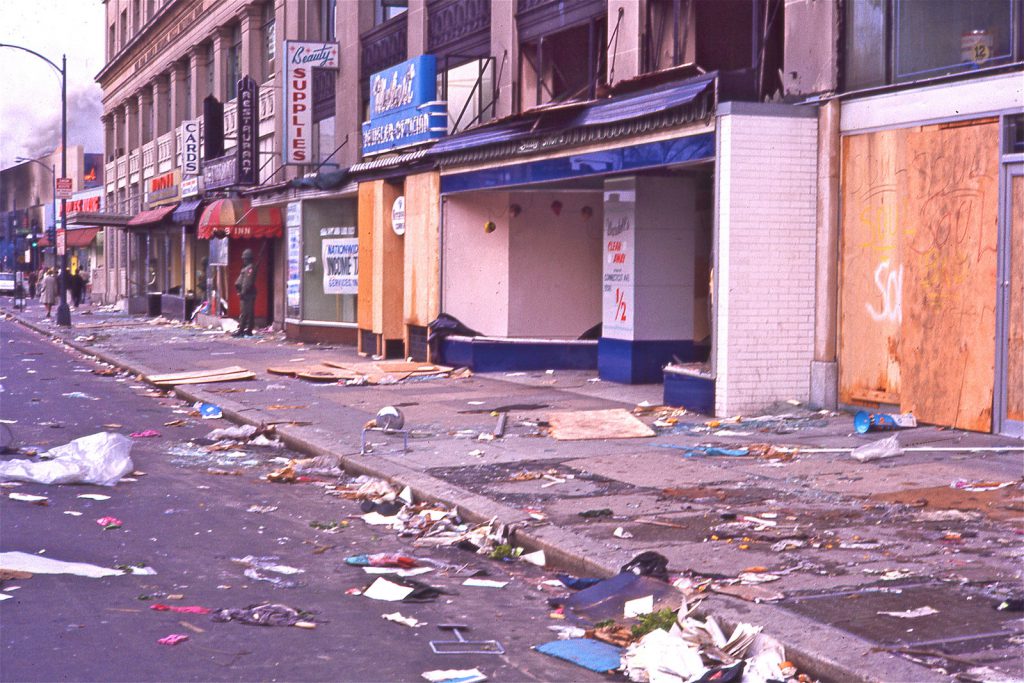
In 1972 I moved to Washington, DC for work, and barely three miles away whole city blocks still lay in ruins from the riots that followed Martin Luther King’s assassination four years before.  My job was in a comfortably white suburb, but there was nothing comfortable about those burnt-out Black neighborhoods.
In April 1973 I flew to Chicago to scout the University of Chicago for my doctoral studies.  Riding the elevated train south from the Loop would bring me west of the campus, so I planned to catch a bus east to the school.  I soon realized I was the only white person on the train, and every station stop simply added more Black passengers.  Finally an older Black woman got up and approach.
“Do you know where you’re going, young man?” she asked.
I told her my plan to reach the campus.
“Well, it’s best if you get off this train as soon as possible.  This is not a safe train for you.”
I thanked her, thinking that I was still not fully aware just how deeply divided our culture was--and had been for generations.
That fall my wife and I move to Hyde Park, the university enclave on Chicago’s South Side. We soon learned that none of our neighbors dared to venture into the “ghetto” neighborhoods to our north, west, and south.
 The following summer my parents visited and I offered to drive them to see the house they had lived in when my father was in the navy in the 1940s.  Thirty years later, it was an all-Black neighborhood, and when we parked across the street the Black gentleman rocking on the porch was clearly frightened by this car full of white people staring at his house--and we were too frightened even to explain our presence.  We simply drove off. To this day I regret I did not talk to the man.
In 1977 we moved to Dorchester, a rapidly changing inner-city Boston neighborhood with its historic Irish and Italian population fleeing as Black families moved in.  We found our apartment by word of mouth: it  had been off the market for two years for fear of Black tenants. Our suburban relatives were often reluctant to visit our “tenement” home, but we stayed.
Our children eventually enrolled in the Raphael Hernandez Bilingual School, where they acquired a unique education as members of a white minority in a multiethnic student body.  This was, of course, fresh in the wake of Boston’s busing crisis over segregated schools, and as we persisted we witnessed most of our white neighbors moving away rather than subject their kids to Boston’s public schools.  Citywide, schools became increasingly Black as white families abandoned a school system they could no longer dominate.
We still live in Dorchester, and our once lily-white neighborhood now includes a stable mix of Black families, Vietnamese, Cambodians, Haitians, gay couples, and a remnant of the Irish and Italians.  But as late as the late 1990s, my daughter’s Holy Cross classmates were often not allowed by their parents to spend weekends at our “inner city” home.
By now our own family includes people of color on both sides: my brother’s wife is Chinese-American, and our nephew’s wife is African-American. Their wonderful bi-racial kids are now our beloved kin.
Through all this time I’ve met my share of overtly racist people, but for every person who spouted racist sentiments there have been many more who were simply blind to, or even in denial of, racism’s pervasive grip on American Life.  Perhaps they have not benefited from experiences like my own, which awakened me to the reality depicted by the evocative imagery of Kareem Abdul-Jabbar:
African Americans have been living in a burning building for many years, choking on the smoke as the flames burn closer and closer. Racism in America is like dust in the air. It seems invisible — even if you’re choking on it — until you let the sun in. Then you see it’s everywhere. As long as we keep shining that light, we have a chance of cleaning it wherever it lands. But we have to stay vigilant, because it’s always still in the air.
For me, the basic truth is that slavery’s impact has never been eradicated.  And this brings me back to the notion of slavery as our Original Sin.
Most people’s worldview is shaped by their view of human nature. People who think human nature is simply good expect a world of happy human relations, and seek to blame any distress or injustice on external forces. People who see human nature as basically evil expect the worst of others, and seek to shield themselves from all threats.  But Christians have a more complex view.  For us, human nature is essentially good but factually flawed and wounded. We therefore hope for the best but expect that humans, unaided by divine grace, will typically fall into evil ways, not because of external forces alone, but because there is a moral misery within us.
This idea is usually applied to the whole human race.  But what if we apply it to a nation?  Is it possible that our national character is so rooted in our original enslavement of others that we as a people are fatally wounded and permanently incapable of goodness?
My own experience since 1969 until now has made me think so.  Yes, we have witnessed great gains since the civil rights movement of the 1960s.  Since the 1968 assassination of Martin Luther king, we have seen Blacks take leading roles in movies, television, sports, business, and politics at all levels--including the presidency itself.  Mixed-race couples and families and now more widely accepted, and there are broad legal protections for Blacks in housing, folding, employment, voting, and education. 
But the Covid-19 crisis has exposed how superficial some of these gains have been.  Black Americans are harder hit by the pandemic because Black Americans still lacked the privileges white Americans enjoy in housing, health care, wealth, and education. It was Dr. King himself who believed that America’s wounded nature would require more change than mere civil rights:
The Black revolution is much more than a struggle for civil rights of the Negroes. It is forcing America to face all its interrelated flaws--racism, poverty, militarism, and materialism. It is exposing evils that are rooted deeply in the whole structure of our society.  It reveals systemic rather than superficial flaws and suggests that radical reconstruction of society itself is the real issue to be faced.
The moral ills King decried in 1968 remain deep flaws in American Life.  One might even think that their persistence, despite all the activism and progress of the past 50 years, proves that no treatment will ever heal our national scar, so deep is the wound.  We might fear that slavery and racism comprise not only our Original Sin but even our permanent moral defect.

But now the perfect storm of pandemic and police killing has unleashed fresh healing forces.  People pent up from confinement take to the streets, unmindful of the health risks, to decry the death toll that both police and pandemic have taken on Black America.  We now see both the spread of virus and the blight of brutality as symptoms of our deeper moral malady.
And now come polls suggesting that, for the first time ever, a majority of Americans are finally awakening to the historic reality of systemic racism.

So against all odds, amid all the sickness and chaos, all the failed national leadership and the heroism of frontline workers, all the patience of those staying home and the persistence of protesters marching and kneeling and even lying in our streets--amid all this rises the hope that now, at long last, we might be ready to shed our past, to rip off that ancient scar and find true healing of our deep national wound and, with God’s grace, get to our nation’s promised land where we can, finally all together, breathe freedom’s fresh air
© Bernard F. Swain PhD 2020

Thursday, March 2, 2017

#462: How to Judge Trump? By His Fruits You Will Know Him


Pope Francis on Trump: "Wait and see"

Everyone knows we are divided, and no one thinks that’s good. But we seem at a loss for a solution. Can the Catholic Vision help? How?

 Sometimes teachers learn more than they teach!

Recently I conducted a session for adults preparing to join the Roman Catholic Church.  An important question surfaced: are Catholic Social Teachings just general principles without much practical direction, or do they include specific actions to implement those principles--or are they someplace in between?

The question would be important anytime, since the answer determines how relevant Catholic Social Teaching  (CST) is to our daily experience of the society and the culture we inhabit.  But the question is especially urgent now, when Americans are divided into two equally unhappy camps.

One camp is convinced that America is in grave danger from terrorists, illegal immigrants, refugees, rampant crime, lost jobs, unfair trade deals, the media, and the power of establishment elites.  The other camp is equally convinced that America is endangered by a dishonest, incompetent, paranoid administration that is bent on conning the public and curtailing our rights and protections to achieve its mission of self-aggrandizement and self-enrichment.

Observing these two unhappy camps locked in a power struggle, I recall a key theme from Vatican II (1962-1965): that the Catholic Church must position itself as a public source of wisdom, to help steer power away from evil and toward good.

This begs the question: can Catholic Social Teaching do that job? Can it provide the wisdom we need to steer this current power struggle in the US toward good results?

Pope Francis has been speaking to this question quite a lot recently. His comments focus on two notions of great practical value for people of faith.

Notion #1: “Wait and See.” One thing both unhappy camps share is inflated rhetoric.  One side invents its own facts: immigrants are pouring in, refugees import terror, crime is soaring, joblessness stems from free trade and regulation.  The other side spins hypothetical horror scenes of mass deportations, treasonous collusion, police state tactics.  Such rhetoric fuels the conflict but provides little basis for resolving it.

Francis prefers to wait for concrete facts.  In his January 22 interview with the Spanish newspaper  El Pais, when asked about of his own opinion of the new American president, Pope Francis avoided both alarmism and cheerleading.  He suggested, rightly I think, the prudence of basing any response on actual events rather than invented fears or anticipated outrages:

I think that we must wait and see. I don't like to get ahead of myself nor judge people prematurely. We will see how he acts, what he does, and then I will have an opinion. But being afraid or rejoicing beforehand because of something that might happen is, in my view, quite unwise. It would be like prophets predicting calamities or windfalls that will not be either. We will see. We will see what he does and will judge. Christianity always rests on the specific, either a position is specific or it is not Christianity.

…We need specifics. And from the specific we can draw consequences. We lose sense of the concrete. The other day, a thinker was telling me that this world is so upside down that it needs a fixed point. And those fixed points stem from the concrete. What did you do, what did you decide, how do you move. That is what I prefer to wait and see.

The public response to Trump’s travel ban is a perfect illustration of “specific” action.  The very day the government began detaining immigrants, green card holders, even those with visas, protesters thronged airports, vast crowds filled city squares, and the courts acted swiftly to halt the ban. This fits rather neatly with Francis’ advice.  Rather than jump to conclusions, we should respond to results. 

But this leaves open the question: on what basis do we judge the results?

Notion #2: The Relevance of Catholic Social Teaching.  Of course, specific responses presume preparation.  They require the ability to mobilize people who are ready to act and who know when the time for action has arrived.  Pope Benedict XVI famously said that the Church cannot stand on the sidelines in the fight for justice--but to arbitrate any contest, one must master the rules. So in many recent statements, Pope Francis has been demonstrating how Catholic Social Teaching (CST) can provide practical rules for the conflicts we face.

Such practical teaching must avoid two extremes.  If CST offers only general principles, arguing about how they apply might lead to endless debate that frustrates rather than promotes action.  But if CST attempts to dictate specific policies or actions, people may argue that the Church is stepping beyond its expertise into technical areas where its competence is suspect.  In short, if the Church wants CST to provide practical wisdom, then it must go beyond theoretical platitudes but avoid technical solutions.

And here Francis guides us, for in comment after comment he makes it clear that CST offers something different.  CST offers neither mere principles nor specific solutions; instead, it offers concrete criteria for judging actions that we or others take to solve problems.

This makes CST highly pragmatic.  Instead of obsessing over hypotheticals, it focuses on actual results.  Instead of claiming to provide concrete solutions, CST provides clear criteria for evaluating concrete solutions.  It’s not enough to take actions that achieve results; those results must fit CST criteria or be rejected. In this sense, the gospel message is radically pragmatic: we need not argue about rhetoric or theories, but ask rather which theories are working or not working. Thus CST cannot dictate solutions, but it can judge them.

And this helps us to prepare to act, because we can formulate the criteria in advance of any particular action.  Francis has demonstrated this over and over.  Examples abound:

Asked by El Pais about populism that carries a message of “xenophobia and hatred toward the foreigner,” the pope replied:

Crises provoke fear, alarm. In my opinion, the most obvious example of European populism is Germany in 1933. After (Paul von) Hindenburg, after the crisis of 1930, Germany is broken, it needs to get up, to find its identity, a leader, someone capable of restoring its character…“Let’s look for a savior who gives us back our identity and let’s defend ourselves with walls, barbed-wire, whatever, from other peoples who may rob us of our identity.” And that is a very serious thing…No country has the right to deprive its citizens of the possibility of talking with their neighbors.

The use of “savior” here is key, since it implies that for Christians such a politics is idolatry—as clear a criterion as any in our faith!

Asked about the treatment of refugees and other religion, the pope was equally concrete:
You cannot be a Christian without living like a Christian. You cannot be a Christian without practicing the Beatitudes. You cannot be a Christian without doing what Jesus teaches us in Matthew 25.

Matthew chapter 25 is Jesus’ injunction to help the needy by such works of mercy as feeding the hungry, clothing the naked and welcoming the stranger. The pope went on:

It’s hypocrisy to call yourself a Christian and chase away a refugee or someone seeking help, someone who is hungry or thirsty, toss out someone who is in need of my help…If I say I am Christian, but do these things, I’m a hypocrite.

So if criterion #1 is idolatry, #2 is hypocrisy.

In mid-February Francis sent a letter to a meeting of popular movements in California to express his view of popular resistance movements:
It makes me very happy to see you working together towards social justice…because it builds bridges between peoples and individuals. These are bridges that can overcome the walls of exclusion, indifference, racism, and intolerance…For some time, the crisis of the prevailing paradigm has confronted us. I am speaking of a system that causes enormous suffering to the human family, simultaneously assaulting people’s dignity and our Common Home in order to sustain the invisible tyranny of money that only guarantees the privileges of a few.

These are signs of the times that we need to recognise in order to act.…The grave danger is to disown our neighbours. When we do so, we deny their humanity and our own humanity without realising it; we deny ourselves, and we deny the most important Commandments of Jesus. Herein lies the danger, dehumanisation.

Criterion # 3: Disowning the neighbor leads to dehumanization.

Within the last two weeks some journals headlined the pope's opposition to the Dakota Access pipeline being constructed through US tribal lands. Actually, the pope never mentioned the pipeline. But he offered a clear criterion for addressing that case, when he told representatives of indigenous peoples at a U.N. agricultural meeting that the key issue facing them is how to reconcile the right to economic development with protecting their cultures and territories.
Francis at the Conference on indigenous peoples in Rome
Indigenous people, he said, have a right to their ancestral lands. And this provides a clear rule for action:

In this regard, the right to prior and informed consent should always prevail…Only then is it possible to guarantee peaceful cooperation between governing authorities and indigenous peoples, overcoming confrontation and conflict.

Finally, when Francis takes on the “Trickle Down Theory” for reducing economic inequality (see CrossCurrents #461), he does not talk about equality of OPPORTUNITY--he talks about the actual results of economic structures that, whatever the theory on paper, in practice LEAVE millions excluded from prosperity. We may argue about why this happens, and who is responsible, and how to solve the problem--but we may NOT deny that it is a problem that plagues most third-world countries as well as our own.

The preferential option for the poor is a matter of principle for Catholic Social Teaching, and no system that results in massive inequality can be justified by any theory. The pope believes the current model has had ample opportunity to prove itself, and has failed. So it is folly to expect suddenly better results if we cling to what Francis calls "the sacralized workings of the prevailing economic system." He believes it is time to give “equal opportunity” to another model.

Thus, on issue after issue, this pope advises that we “wait and see” but also prepare ourselves with clear standards for judging what actually happens. And for THAT job, Catholic Social Teaching provides a valuable legacy.

"By their fruits you will know them...."—and By His Fruits You Will know Him.
© Bernard F. Swain PhD 2017

Thursday, January 19, 2017

#461: Making our Future Great Again—2: Trump’s “Trickle Down” Is No Magic Solution


At 80, Francis remains one of the world’s most popular and dynamic leaders, the most visible spokesperson for a vision of the future unrivaled by any political party or organization. I’m surveying the priorities of the Catholic vision in light of a post-election season that has left me both dispirited and perplexed about our prospects as a people. The topic this time: Economic Justice.
Pope Francis Meeting With Workers

Economic Justice

The Trump campaign clearly exploited the discontent of many working class voters (especially white voters) who feel left behind by the globalizing and automation of our economy. 

The economic dislocations brought by globalization, deindustrialization, and automation have been a long time coming. The challenge was already a topic of my economics studies in the late 1960s. Early on, it also touched my own family.

My father worked at General Electric from 39 years, and by the early 1970s he was president of his local engineering union. America’s jet engine was invented at the River Works plant in Lynn Massachusetts, which since World War II had been producing aircraft engines 24 hours a day.

But as the Vietnam War wound down in the 1970s, defense contracts shrunk and GE began laying off workers—including many members of my father’s union.  As citizen, my father wanted the war to end, but as union president, he was concerned about the welfare of his fellow workers.

Years later, my younger brother also worked at the River Works but was eventually laid off, caught by the continuing general decline of GE’s manufacturing business. At one point, thanks largely to GE’s presence, the New England region as a whole had employed 33,675 jet engine workers--27.8 percent of total US aircraft engine employment. By the mid-1980s, the River Works employment stood at 13,000. But the 1990s brought a drastic downturn, and by 2016 the plant employed a mere 2,850.

Ironically, in 2016, GE decided to move its world headquarters to Boston’s Fort Point Channel, where it will continue to expand its operations in the “internet of things.”  Decades after Ronald Reagan promoted GE’s Manufacturing prowess in television ads (“We Bring Good Things To Life!”), GE’s future lies, not on the assembly line, but in the cloud.

GE’s journey echoes the general US trend away from manufacturing—a trend that has left middle-class incomes falling for 40 years and opened a massive wealth inequality gap.


Trump’s Solution

Now Trump promises to restore jobs and reduce inequality in four ways: (1) penalizing U.S. companies who attempt to outsource jobs, (2) penalizing foreign imports with new tariffs, (3) investing “trillions” on America’s badly degraded infrastructure, and (4) reducing taxes across the board to stimulate job-producing growth,

The first action (1) may protect some jobs, though I believe (along with many economists) that most such jobs are gone forever. Tariffs and protectionist policies (2) risk trade wars wall as international tensions in an era when all economics--markets, corporations, and government policies--have become increasingly international.  For example, the European Union, for all its flaws, made free trade the cornerstone of its vision to bring peace to Europe after generations of war by encouraging nations to become packers rather than rivals.  And for more than 60 years it has worked.  I doubt the U.S. can simply return to a more isolated posture.

Step (3) might happen two ways. We might use tax money to create public jobs as we did during the New Deal, when FDR crated public works projects that put people to work in massive numbers. Or, we might see tax money going to corporations and wait for them to create jobs. Trump proposes the latter, which is the point of step (4)--reducing taxes across the board, for rich and poor, to produce jobs.

This presumes the working of “trickle down economics”: money at the top builds business, so the economy grows, and the wealth produced trickles down to those at the bottom. But Catholic Social Teaching, and Pope Francis in particular, reject outright this theory as a fraud.


The Catholic View

As Francis wrote in his very first major document, the 2013 apostolic exhortation, “The Joy of the Gospel”:

Some people continue to defend trickle-down theories which assume that economic growth, encouraged by a free market, will inevitably succeed in bringing about greater justice and inclusiveness in the world. This opinion, which has never been confirmed by the facts, expresses a crude and naïve trust in the goodness of those wielding economic power and in the sacralized workings of the prevailing economic system.

Notice the term “sacralized,” which means “treated as something sacred.” Francis is saying we will fail to build economic justice if we turn the “prevailing economic system” (capitalist market economics) into something sacred—that is, into an idol. Francis even cites the classic Biblical image for idolatry:

The worship of the ancient golden calf has returned in a new and ruthless guise in the idolatry of money and the dictatorship of an impersonal economy lacking a truly human purpose. The worldwide crisis affecting finance and the economy lays bare their imbalances and, above all, their lack of real concern for human beings; man is reduced to one of his needs alone: consumption.

In a 2015 speech in Bogota, Colombia, Francis returned to the “idol” image:

Once capital becomes an idol and guides people’s decisions, once greed for money presides over the entire socioeconomic system, it ruins society, it condemns and enslaves men and women, it destroys human fraternity, it sets people against one another and, as we clearly see, it even puts at risk our common home.

Same people might claim that Francis is merely voicing a personal opinion, which Catholics can take or leave--or worse, he is spouting Marxist theories! But in an interview with an Italian newspaper, he rightly insisted that he speaks as the voice of Catholic Social Doctrine:

There is nothing in the Exhortation that cannot be found in the social Doctrine of the Church. I wasn’t speaking from a technical point of view, what I was trying to do was to give a picture of what is going on. The only specific quote I used was the one regarding the ‘trickle-down theories’ which assume that economic growth, encouraged by a free market, will inevitably succeed in bringing about greater justice and social inclusiveness in the world. The promise was that when the glass was full, it would overflow, benefitting the poor. But what happens instead, is that when the glass is full, it magically gets bigger nothing ever comes out for the poor. This was the only reference to a specific theory. I was not, I repeat, speaking from a technical point of view but according to the Church’s social doctrine. This does not mean being a Marxist.

In his 2015 encyclical on climate change, “Laudato Si,” Francis returned to the same theme, saying free  markets cannot work magic:

 Some circles maintain that current economics and technology will solve all environmental problems, and argue, in popular and non-technical terms, that the problems of global hunger and poverty will be resolved simply by market growth…Once more, we need to reject a magical conception of the market, which would suggest that problems can be solved simply by an increase in the profits of companies or individuals.

Some have tried to blunt the force of this critique, but even conservative Catholic commentators have conceded that Francis is setting a standard for all Catholics. Patrick Brennan made this clear while reviewing The Joy of the Gospel for National Review, the journal founded by the famous Catholic conservative William F. Buckley:

The pope’s discussion…is about how Catholics should respond to the overwhelming changes that have come to the world “in our time,” which have made many richer and more secure, but left many impoverished and suffering. Those…changes, as free marketeers would surely agree, are not the product of command-and-control economics, but of free markets. The pope is arguing that freer markets haven’t so far brought us a properly just, caring society, and “in our time,” society has in many ways grown coarser, crueler, and more violent — so Catholics cannot advocate free markets per se. Some proponents of free markets may take issue with that sentiment; most would not.

So here is where we stand: Our new president is proposing to “fix” our economy, produce jobs, reduce inequality, and repair our infrastructure--all by reducing taxes across the board, thus freeing the corporate sector to spend more in a way that will benefit all. Unless he proposes something else to accompany this policy, he is clearly counting on the free market to solve all our problems without major government efforts (aside from tax reform and reduction).

There is no escaping the obvious conclusion: Trump believes the very “magical view” of free markets that Pope Francis (and Catholic Social Doctrine with him) rejects. In my view, the outcome is predictable: as long as we continue to idolize free markets and reject public action to redistribute income, the economic division in our culture will continue to fester and grow. A better future requires us to recognize that inequality can only be solved by redistributing wealth, not by adding to wealth at all levels. And only those who idolize free markets believe that they alone can do that.
© Bernard F. Swain PhD 2017

Monday, January 9, 2017

#460: Making Our Future Great Again: Connecting the Climate Dots


Happy Birthday to our Planet's Protector.
The pope’s recent 80th birthday 
has left me thinking 
that our future may depend on his.


Shortly after Benedict XVI resigned in 2013 at the age of 80, I paid my (almost) annual visit to France to visit friends, among them Michel Pansard, who just happens to be the bishop of Chartres.  Over dinner he expressed his conviction that Benedict was setting a precedent: that future popes might no longer serve for life, but would retire--presumably as he did, at 80 (this happens to be the age at which cardinals become ineligible to vote for pope).

It so happens Pope Francis and I share the same December 17 birthday, and this time it made me very aware of two things.  First, at 80 he shows no signs of resigning his post.  Second, he makes me envy his energy and endurance, for, even at 80, he remains one of the world’s most popular and dynamic leaders, and he has made himself the most visible spokesperson for a vision of the future that, in my view, is unrivaled by any political party or organization. 

I can only hope to sustain his sort of enthusiasm when I am his age.  But I confess the last year or so has challenged me to retain the kind of youthful spark I see in him. For the post-election season has left me both despirited and perplexed about our prospects as a people.

As someone prone to filtering current events through the lens of Catholicism’s social vision, I have never been fond of the Republican-Democratic duopoly of “politics as usual.” And since that politics evolved into neo-conservatism in the 1980s and neo-liberalism in the 1990s, I’ve liked it even less. Now our deeply flawed electoral system has awarded the presidency to the less popular of the two least popular candidates in our lifetime.

It is clear that Donald Trump (like Bernie Sanders) offered an alternative to such politics.  But while “alternative” means “different,” it does not always mean “better.” And I admit that, as I survey the priorities of the Catholic vision in light of recent developments, I find myself not so much hoping for the best as fearing for our future.

I temper my judgments with the proviso that it is seldom clear if president-elect Trump means what he says.  Those who took him literally but not seriously during the campaign were badly wrong; yet those who took him seriously but not literally are hard pressed to do more than guess what he will do.  Since he has contradicted himself on nearly every public issue, he can only mean about half of what he says--but I seldom know which half.  Keeping in mind that predictions about Trump are therefore often unreliable, let me briefly survey some main priorities of Catholic Social Teaching which, I remain convinced, offers the wisest contemporary vision for a better future.  I’ll include climate change, economic justice, human rights, globalization, respect for life, and peace.

Climate Change

I was sadly disappointed that climate change received such scant attention in the electoral campaign.  Trump called it a hoax, while Clinton called it real and requiring action--but neither one gave it much detail or attention.  The topic never came up in the debates, and neither campaign sought to motivate voters over the issue.

Yet for me, this was the overriding issue--not just of the campaign, but of our time.

I say this not only because climate change can disastrously alter the future of our planet, but also because, as Pope Francis has brilliantly shown, climate change is the master key to unlocking most of our biggest social problems.  Once we see how Francis connects the dots, it becomes hard to imagine resolving any of our major problems unless we address the environment.  Let me number those dots:

Francis presents climate change as just one piece of a much bigger puzzle.  He roots the problem in (1) runaway emissions (especially carbon and methane), which are generated by (2) our unsustainable reliance on fuels needed to power (3) a runaway capitalist system that (4) treats self-interest and greed as our most important social virtues.  This system (5) despoils the global environment while generating not only (6) intolerable levels of pollution but also (7) intolerable levels of inequality.  The result, he says will be a (8) progressive degrading of earth’s ecological systems which, while caused by the world’s wealthy, will (9) disproportionately affect the world’s poor.  The effects include (10) mass migrations away from destitute and dangerous regions, especially those ravaged by violence, rising seas, or lack of fresh water.  Such migrations are already being triggered by (11) the persistent terrorism in a world where resentful millions feel victimized by the power dynamics of post-colonial market systems--what Francis calls “the globalization of indifference.”

Connecting the dots allows the “big picture” to emerge: our status quo is already generating deep conflicts the will only get worse as the planet becomes less and less habitable. In this big picture, most of our biggest problems--inequality, the environment, refugees, terror, war--threaten to become intractable unless we act to change the very things that threaten the planet as well.

The solution to this massively dysfunctional global system, says Francis, is nothing less than a planetary ethical revolution that dethrones runaway capitalism as we know it and replaces it with a system that reflects more authentically humane values. He calls for an “integral ecology” that enables global development to be both humane and sustainable.

Thus at 80 Francis has positioned himself (and with him, the papacy) as the world’s most visible protector of the planet.  This also makes the papacy the world’s strongest voice challenging us to face the future of humanity--and especially the future of humanity beyond the prevailing capitalist model.

The United States is the world’s #2 carbon emitting nation, and short of aggressive action our commitment to last year’s landmark Paris accord will falter, and our nation will remain a prime contributor to the degradation of what Francis calls “Our Common Home.”

In this light, dear reader, forgive me if I lament the early signs that the Trump administration may be unwilling to face this challenge.  Its failure on this issue will condemn us to the ripple effects that Francis has already noted. Because of him, we’ve been forewarned, and we ignore him at our own peril—as well as the planet’s.

Next: Economic justice
© Bernard F. Swain PhD 2017

Tuesday, August 2, 2016

#456: What Would a “Hillary America” Be Like?


Base on Hillary Clinton’s acceptance speech at the Democratic National Convention, it is possible to project the impact of her proposed policies on American Life.

I am repeating last week’s thought experiment, this time for Hillary Clinton.  Like last time, I’ll assume Clinton is a serious political leader. I will assume she wins November’s election.  I will assume she follows through on her acceptance speech agenda. I will even assume she is successful in implementing her proposed policies. These are all big “ifs,” but they allow us to imagine America under the leadership of Hillary Clinton, and to compare that image with Catholic Social Teaching (CST).

Based on Clinton’s own words, we can expect the following;

In Foreign Policy: We can expect continued war (especially air war and drone war) and occupation aimed at nation building and regime change.  We can also expect more war against ISIS and other terrorist organizations. We can expect support for allies, and special support for Israel, with no stated concern for the Palestinians or their supporters. We can expect continued tense relations with Russia. We can expect trade tensions with China.  But we can also expect strong efforts at diplomatic solutions, as with Iran. 

The first of these expectations is clearly out of step with Catholic Social Teaching, as almost all Catholic leaders opposed the invasion of Iraq and other similar attempts at regime change or nation building.  Most of the other elements are also more or less in conflict with CST too, except Clinton’s preference for diplomatic agreements over confrontation. 

Catholic Social Teaching has also long shown a major concern for the relation between the advanced industrial nations and the developing world. On this significant issue, Clinton (like Trump) was totally silent during her speech. Her concern about globalization’s impact focuses, not on developing nations, but on the US. We can expect her to fight for our middle class, but not against global poverty. In this respect, both Clinton and Trump talk about solving terror without solving poverty, as if terror has a military solution—a position Pope Francis has soundly rejected.

On Public Safety and Social Harmony: Here Clinton promised many things: no wall with Mexico, a path to citizenship for undocumented immigrants, reform of the criminal justice system to build trust in communities and defend rights, common sense gun reforms, no ban on any religion or religious group, comprehensive immigration reform, and protection for the right to choose abortion. Except for this last, most of Clinton’s promises match Catholic Social Teaching. On other “culture war” issues where we could expect more conflicts with CST, she was mostly silent.

Clinton’s promises on immigration are especially supportive of CST. The Church regards migration “for a better life” as a human right, a concept unknown to Trump based on his words.

On Economics.  Based on her words, we can expect many initiatives to reduce income inequality. Clinton called on Wall Street, corporations, and the very rich to begin “paying their fair share”—which sounds like higher taxes for the 1%. She also promised to end tax breaks and loopholes and collect taxes from corporations that outsource jobs. We can expect a “living wage” minimum wage. We can expect large government investments to create jobs (she promised the largest investment since World War II, which seemed to imply New Deal-style public works jobs). We can expect easier credit for small businesses.

All this fits (somewhat roughly) with Catholic Social Teaching’s long-standing critique of “unbridled capitalism,” its calls for income equality and even the redistribution of wealth (Pope Francis labels income inequality “the worst of all social ills”). This contrasts with Trump, who relied entirely on unchecked market forces to improve the economy, and promised to reduce taxes for the wealthy.

On Climate Change. Saying “I believe in science,” Clinton promised to fight climate change and in the process create many new jobs in clean energy. This contrasts with Trump’s total silence about climate change.  Clinton thus supports the same perspective as Catholic Social Teaching in general. But she failed to address the specific concerns of Pope Francis in his major encyclical “Laudato Si,” in which he linked climate change to nearly all global and social unrest, including global poverty and terror. In short, Clinton is against climate change while Trump ignores it—but neither of them connects the dots to our global situation they way Francis has.

On Social Welfare and the Safety Net: Based on Clinton’s words, we can expect more good paying jobs, good schools for all, tuition free college for middle class Americans and debt-free college for all, more training for people to learn trades, and an expansion of Social Security. This contrasts with Trump, who said almost nothing about policies regarding jobs, student debt, poverty, social security, etc. Rather, his speech implied that he expects the unbridled forces of the market to resolve all social problems. Catholic Social Teaching, meanwhile, has long rejected this idea, which Pope Francis himself has referred to as a fraud. So in this contrast Clinton’s positions on social welfare are a closer match with CST.

On the Supreme Court: Trump offered a generic promise to name more conservative justices to the Supreme Court, but Clinton was much more specific. With Clinton, we can expect justices prepared to defend Roe v Wade, expand voting rights, and reverse Citizens United—in short, the most “progressive” SCOTUS in a generation. From the point of view of Catholic Social Teaching, this would be a mixed blessing, raising the prospect of the reinforcing Roe v Wade, but at the same time holding the prospect of many decisions promoting the advancement of a freer, more just society.

In short, the America we can imagine under Clinton mixes many ideas congenial to Catholic Social Teaching (especially on issues like inequality, immigration, and social welfare), some other issues where she simply remains silent (like climate change’s global impact, and third world development), and some issues (like war and abortion) where her position conflicts implicitly or explicitly with Catholic Social Teaching. 

Compared to my Trump posting, I believe my assumptions this time are a bit less problematic.  While I do not find Trump a serious leader, I do find Clinton a potentially strong leader and I do expect her to win. But, given Washington’s gridlock, I doubt that she will succeed in achieving many of her goals, though she will undoubtedly pursue them vigorously. Yet it is still instructive to understand exactly what Clinton (and Trump) are proposing for our country, and how it fits--or does not fit--with the propositions of our faith. 
© Bernard F. Swain PhD 2016