WELCOME !


WELCOME! CrossCurrents aims to provoke thought and enrich faith by interpreting current events in the light of Catholic tradition. I hope you find these columns both entertaining and clarifying. Your feedback and comments are welcome! See more about me and my work at http://home.comcast.net/~bfmswain/onlinestorage/index.html or contact me directly at bfswain@juno.com NOTE: TO READ OR WRITE COMMENTS, CLICK ON THE TITLE OF A POST.

Showing posts with label Election. Show all posts

Monday, January 25, 2021

#480: What Stands Before Us

     “We are striving to forge our union with purpose.

To compose a country committed to all cultures, colors, characters and conditions of man.

And so we lift our gaze, not to what stands between us, but what stands before us.

We close the divide because we know to put our future first, we must first put our differences aside.”

--Amanda Gorman, The Hill We Climb, 1-20-21

Amid the optimistic pomp of Joe Biden’s inauguration lurked an undercurrent of realism--as when Biden himself referred to the “cascading crises” that we face. 

This new year brings us (1) the worst public health crisis since the 1918 “Spanish flu,” (2) the worst economic crisis since the 1930s great depression, and (3) the worst civil unrest since 1968.  This triple catastrophe is without precedent in our history.

Trying to process this reality, my mind reaches back to my own childhood to retrieve two keys to understanding what this moment means and why it matters.

Key #1: Peaceful transfer?

It is a 1959, and my sixth grade teacher Mr. Peirce conducts a current events quiz each morning.  It’s the height of the Cold War and Mr. Peirce indoctrinates us daily on the superiority of America over Russia.  Nikita Khrushchev has only recently emerged as the Russian leader, and we’re told that when Joseph Stalin died a few years earlier a vicious power struggle ensued to determine his successor.

But the U.S. is different, Mr. Peirce tells us.  In America we have elections, and no matter who wins, his rival concedes and power passes to the winner.  The process is routine, predictable, and free of struggle or conflict.  So Truman gave way to Ike (who would, in turn, give way to JFK). 

This, at age 10, is my first civics lesson: America is great because it has maintained the peaceful transfer of power since its founding.  In our way of life, no one is indispensable, we’re a government of laws not men, and no one may rise above that law.

The election of 2020 has changed all that.

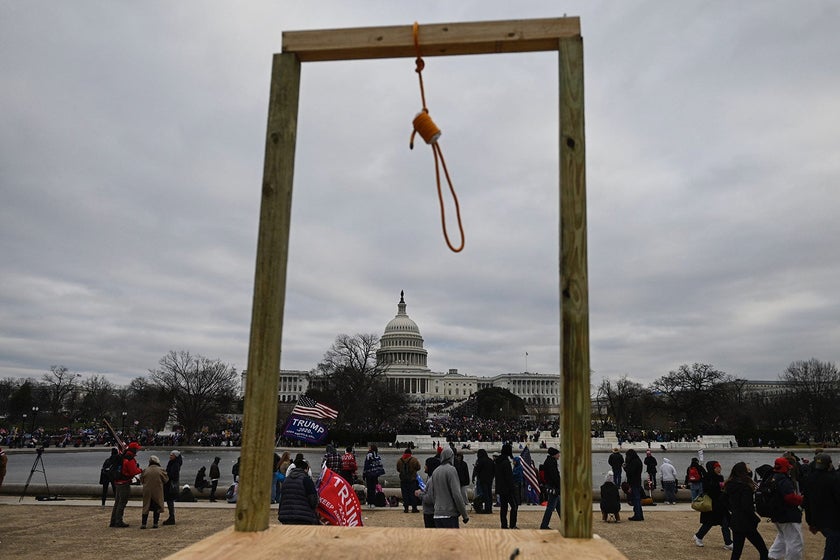
On September 11 2001, the terrorists attempting to attack the U.S. Capitol failed, as heroic passengers crashed the plane into a Pennsylvania field.  But on January 6 2021, homegrown terrorists succeeded where foreign terrorists had failed, halting the certification of an election by invading the Capitol during a joint session of Congress.  It took police and National Guard action to restore order. 

So the transfer of power to Joe Biden has not been peaceful--it required the suppression of an armed insurrection. Yes, “democracy prevailed”–but the unbroken string of peaceful transfers has been permanently broken.  Our system is more fragile than we believed. My boyhood civics lesson is now obsolete

Key #2: Fantasyland

It is 1953.  I sit watching our 10-inch black and white TV screen as Walt Disney introduces the very first broadcast of “Wonderful World of Disney.” Each week’s episode, he tells us, will visit a different world: “Frontierland,” “Adventureland,” “Tomorrowland,” and “Fantasyland.”

I love Fantasyland.  It’s a land where elephants fly, where broomsticks fetch water in buckets, where the gods still reign on Olympus, and where skeletons ride horses up from their graves.  It’s a land of dreams (and nightmares!) where anything can happen.  It’s a place where magic rules, untethered by facts.

I love it, but even at age five I know it is not real.  I don’t expect our cat to talk, or a magic wand to appear, or a genie or fairy to grant me my fondest wish.  However much I love the TV fantasies, I remain grounded in reality.  I love playing make-believe with my friends, I die hundreds of pretend deaths on make-believe battlefields.  But I know that real soldiers, shot dead, do not walk away.

But now, I fear, Fantasyland has taken hold of millions of Americans.  They seem possessed by magical thinking. They seem to be watching a movie in their own minds, a movie where a make-believe  world obeys their desires. 

In that magical land, Donald Trump did not lose the 2020 election. He won a landslide victory.

In that fantasyland, the Covid virus is not a terrible pandemic causing 400,000 American lives. It is no worse than the flu. It is not to be feared.

In that make-believe land, climate change is not real.

In that pretend realm, there is no systemic racism, no white privilege, no white supremacy movement.

In that alternate reality, Russians never interfered with the U.S. elections.

In that imaginary existence, vaccines do not protect us--they make us sick—or worse, they wire us for surveillance.

Such widespread magical thinking constitutes nothing short of a wholesale denial of facts.

It strikes me that these two phenomena - - the breakdown of peaceful transfer and the prevalence of Fantasyland thinking--are the two barriers we face in overcoming our cascading crises.  One threatens our constitutional order, while the other threatens our public discourse.  Both threaten our national unity.

Our Constitutional Order

The long stability of our constitutional system is no longer assured.  It took multiple recounts, 50 court cases, the Supreme Court, the suppression of a coup, and an impeachment to get us from President Trump to President Biden.  This was the very definition of a power struggle, not a peaceful transfer.

We might hope that this struggle was a one-off recurrence, and never to be repeated.  But the signs are ominous.  Since 2000, Americans have been increasingly ready to question the legitimacy of presidential elections.  In 2000, people questioned the Florida recount, which determined the overall outcome.  In 2008, Trump and others questioned Obama’s very birthright to the presidency.  In 2016, 33% of Democrats and 50% of young Democrats considered Trump’s victory “illegitimate.” In 2020, similar numbers of Republicans disputed the election results.

I submit that, unless we find a way to conduct elections acceptable to all, we’re in for trouble.  There already has been too much unrest--Biden called it our “uncivil war.”  Too many norms had been broken, making me wonder if norms are enough to maintain our fragile fractured system.  Disrespect for our institutions is now dangerously widespread.  And it appears that America’s celebrated “individualism” has metastasized to the point where any sense of “common good” maybe too weak to motivate Americans to set aside private interest for a unified future.

The last year has finally exposed how fragile our civil stability has become, and the trends of the last 20 years point to further breakdown. The growing, infectious willingness of millions of Americans to reject outcomes they do not like is the mark of a failed state.  That infection must be stopped.  But that depends on repairing public discourse.

 Public Discourse

An open society requires dialogue among people of differing views. But differing opinions are only constructive if they respond to the same facts.  Facts are the currency of public discourse: we must agree on facts before further discussion can proceed.  Thus the cliché: the “you have a right to your own opinion, but not to your own facts.”

If facts are devalued or even dismissed, dialogue breaks down. People begin to fabricate their own “alternative facts,” and they enter that fantasyland where the real and the imaginary merge and blend

“Conspiricism” poses a special threat. While conspiracy theorists merely concoct a scheme that explains to them the true meaning of a PARTICULAR event (say, the assassination of JFK or 9/11), people infected with conspricism believe that such schemes lurk behind ALL events. For them, ANY reportage of news is merely the smokescreen behind which reality lurks. The smokescreen is part of the conspiracy and the reality behind it is evil. Thus all of life’s events, all the facts presented, are mere distractions luring us into a hidden evil. Our lives come to depend on dismissing facts and replacing them with our own imagined schemes.

In such a fact-free country, public discourse withers. Different people form different opinions based on different sets of facts, some of which exist only in their minds.  They end up with nothing to say to each other beyond epithets, name-calling, insults, and threats.  Instead of helping to reduce our civil unrest, this reign of fantasy fuels discord, conflict.  In the end, people decide discourse is futile, and then, as we saw on January 6, “initiative becomes the privilege of violence.”

Our Task

The year 1968 also brought a parade of horrors: the Tet offensive, the student riots, the assassination of Martin Luther King, the riots burning up whole sections of our cities, the assassination of Robert Kennedy, the police riot in  Chicago, the Soviet tanks invading Prague, the election of Richard Nixon, the bombing of North Vietnam.  In the wake of that awful year, I quit my political science studies and my political career ambitions because I had lost faith in our political system’s ability to solve the nation’s real problems.  

It is possible that 2020 was as bad as, or worse than, 1968.  If so, my conviction is confirmed: more than 50 years later, we have still not resolved the issues that plagued us then. 

Martin Luther King named three great evils that threaten America’s greatness and threaten us still: racism, materialism, and militarism.  He knew civil rights alone could not solve these problems, so he called for a “revolution of values,” that would transform America’s culture.  He was calling, not for political reform, but for spiritual transformation.

We get the government we deserve, and since 1968 we have not deserved the best.  Our civic stability is fractured, our people too often choose fantasy over reality, and so we have brought the “cascading crises” of Disease, Depression, and Disorder upon ourselves.  “What Stands Before Us” now is the same vast task King named then: a revolution of values.

© Bernard F. Swain PhD 2021


Sunday, January 26, 2020

#478: Getting “The Two Popes” Right


By all means see the Netflix film “The Two Popes,”
 ---but see it for the wonderful thing it really is.
George Weigel takes pride presenting himself as someone who has known several popes, so he rightly claims to be “credentialed” for inside insight into recent papal history.
But a film critic he is not.
And even professional critics sometimes make the mistake he commits in his review of the movie “the Two Popes,” criticizing a film for what it is NOT rather than analyzing what it IS. Sadly, this leaves Weigel—and others like him—unable to appreciate the film before his eyes. He saw “baloney on steroids,” and missed what was actually on the screen: a delightfully plausible parable aimed at inspiring the viewer.
Weigel begins by saying the film claims to be “based on actual facts.” This is not true. The screen title at the movie's start reads “Inspired by true events”—which is an entirely different matter. Both the screenwriter and the director have explained that they wanted to make the movie because of their admiration for Pope Francis, combined with being intrigued by the events surrounding the resignation of Benedict XVI.  They asked themselves: “What if these two were to arrange something together?”
Weigel says the movie reveals more about the screenwriter and the director than about the historical figures. Well, duh—the whole point of film art is to express the creators’ vision. Weigel makes the common mistake of testing a film about historical figures for its historical accuracy. But this is not a documentary, or even a docudrama.
Could anyone really think that images of the College of Cardinals entering the conclave to the tune of Abba’s “Dancing Queen” could be about documenting events? Or that setting Benedict’s announcement of resignation to three different versions of the Beatles’ tune “Blackbird” aimed to serve historical accuracy?
The Filmmakers are exercising what is generally referred to as “artistic license”; typically they care less about veracity and more about verisimilitude. Yet they land on some verities.
So they contrive a two-day meeting in which both men change by coming to terms with their differences. My personal reaction: I left feeling, “Wouldn’t it be wonderful if this had happened—and even better if such things happened more often!” I took it as a parable for our time, a time in which people of differing views –in our Church, in our communities, in our nation, in our world--have stopped listening to each other. Imagine the Church as a public model inspiring people to resolve their differences!

Weigel is entitled to consider the film’s characters as “stick-figures,” despite the screenplay being nominated for both a Golden Globe and an Oscar. But his comparison of “one–dimensional portrayals of popes” with Xavier Rynne’s New Yorker coverage of  Vatican Council II is a simple category mistake—the proverbial “apples and oranges.” While Rynne claimed to be reporting, these filmmakers openly admit to inventing. One can search numerous sites detailing what is historical and what is apocryphal in the film.
Still, the characters' positions on issues are consistent with the public record. Weigel complains that the film misrepresents Benedict’s attachment to the papacy, quoting him that “I am not a man of governance.” And while it is true the film shows him urging cardinals to support him at the conclave in 2005, it also has him arguing for his own resignation by saying “I’m a scholar, not a manager.”
And while Weigel sees “self-knowledge, spiritual detachment, and churchmanship” in Benedict, he ignores how the film portrays precisely those qualities, thus humanizing a figure who has too often been stereotyped in the media as an ogre. Weigel writes as if the film were a hatchet job on Benedict. But every single viewer I’ve spoken with has come away finding Benedict a much warmer, more admirable character.
Weigel complains that the movie portrays the 2013 election of Francis as fueled by a desire for a reform movement, a course change from John-Paul II and Benedict back to engagement with the world. What motivated the voters is hard to prove, but there is ample evidence from Francis’ own public statements that he himself took his election as a mandate to make changes in the Church’s approach to the world—and that he took much of his inspiration from the two popes who preceded John-Paul II and Benedict:
Vatican II, inspired by Pope Paul VI and John, decided to look to the future with a modern spirit and to be open to modern culture. The Council Fathers knew that being open to modern culture meant religious ecumenism and dialogue with non-believers. But afterwards very little was done in that direction. I have the humility and ambition to want to do something.
Weigel further argues that the real motive behind Francis’ election was to choose “a tough minded, no-nonsense reformer who would quickly and decisively clean house"--that is, the Vatican itself, especially the curia. He implies the movie ignores this.
He seems to have missed the scenes when Benedict complains about the curia, pleads his inability to fix things (“I have lost,” he says) or when Cardinal Bergoglio (later Pope Francis) recounts how he had already cleaned up his ecclesiastical house in Argentina. When he expresses his intent to do the same in Rome, Benedict says "Well, good luck with that!"
Sadly, Weigel simply ignores a large part of the movie showing Bergoglio's own path to the priesthood, as well as his struggles as a leader. But viewers who saw the Oscar-winning films “City of God” and “The Constant Gardener” will recognize in these flashback scenes the world-engaging imagery of director Fernando Meirelles, full of vibrant third-world street scenes and the chaos of poor people’s lives. These scenes reveal that what inspired Meirelles to make this new film was precisely Francis’ career-long engagement with struggling people.
Finally Weigel calls the movie “fake news” and states his desire to “clarify the historical record.” But people who react to this movie as if it were (or claimed to be) a historical record of what actually happened have already failed to see the film on the screen. They just don’t get it. It’s their loss.
Oh, and I nearly forgot to mention the one point on which Weigel and I agree: the film is quite funny! In fact, several critics have called it a “buddy comedy”—and they are closer to the truth than Weigel.

The closing scene of the two popes watching the 2014 Argentina-Germany World Cup Final together may well be apocryphal, like most of the film—but the accompanying documentary footage of the Two Popes warmly embracing is not. When you see “the Two Pope” on Netflix, take it for what it really is: a hopeful fiction of how powerful but opposed leaders might come to see each other as (to quote Benedict's character) “only human”-- and even to become friends. 

© Bernard F. Swain PhD 2020

Thursday, May 4, 2017

#464: Is the Common Good the Enemy of Sovereignty—or Vice-Versa?


  A recent Harvard discovery suggests why this Sunday's French Presidential Elections French should interest Americans, and especially American Catholics.
"France for the French" vs. France, member of Europe
The French Election
Some observers have said the 2017 election for president of France is all about sovereignty, since Marine Le Pen wants to pull France out of the European Union and Emmanuel Macron wants to stay in the EU but reform it.
Le Pen’s supporters believe the EU Impinges on France's sovereignty as a nation; they want their country back, their money back, their borders closed, their industries protected, their immigrants expelled. They want “France for the French.”
Macron's supporters often do not actually support his politics or agenda, but they support France's continued membership in the EU. They know this means sacrificing some of the nation’s sovereignty: the Euro replaced the Franc, trade is subject to EU "free trade" regulations, the borders are open to anyone from the EU, even the traditional French license plates have been replaced by euro-style plates. But those prepared to vote for Macron believe that giving up some national sovereignty serves the common good of both the French people and Europe as a whole, especially in bringing peace to a chronically war-torn continent (see CrossCurrents # 463).
Catholic Social Teaching (CST) acknowledges the dilemma here. On the one hand, CST makes promoting the common good a top priority, which leaves little room for a self-serving agenda that ignores the effects on others. Pope Francis in particular has decried the “Exclusion” of others that occurs when policy is set to benefit some narrow part of any population.
On the other hand, CST also values “subsidiarity”—the principle of keeping decisions at the most local level possible, and solving problems by the participation of those closest to the problem.
The EU clearly aims to serve the common good of Europeans, but that means decisions get made, not at the local or regional or even national level, but at the international level which sometimes is far removed from the people affected. So common good and subsidiarity sometimes clash. How can this clash be addressed?
Some, like Julius Krein, editor of American Affairs, take a hard line view of sovereignty. He argues that internationalism of any kind cannot really achieve the common good: for him, the real common good comes only with national sovereignty:
“The only democratic institutions that we have are national institutions.  So if you get rid of the nation-state, what you’re really doing is getting rid of democracy.”
In other words, Krein considers that, to serve common good, all sovereignty must be national.  This is exactly what Le Pen is proposing in her campaign, and it is exactly what Macron is opposing.
Wednesday Night's Debate
But it strikes me that such a hard line is completely arbitrary and also completely contrary to our experience as Americans.  That’s why last week’s Harvard discovery is so interesting.
The Harvard Find
Two Harvard researchers, Danielle Allen and Emily Sneff, have recently reported the discovery of an early handwritten parchment copy of the Declaration of Independence--only the second such copy in existence.  They call it the “Sussex declaration” after the location of its discovery in England. 
The significance of the discovery is that this version is slightly different from the one in the national archives.  That original in 1775 reflected the practice of the Continental Congress of having state delegations sign official documents as a group, with state labels for each group.
But the Sussex declaration dates from the 1780s.  By then the War is over, and war debts have led to conflicts among the states, especially farming states vs. the coastal mercantile states.  Eventually these conflicts would lead to a constitutional convention, but already the clash was between federalists (who saw the new nation as a single united people) and anti-federalists (who saw it as a collection of states).  The issue here was whether sovereignty would belong to the nation as a whole, or whether each state would retain its own sovereignty. 
The Sussex Declaration
This newer version shows the balance shifting to the federalists. Allen points out the key difference:
“The Sussex Declaration scrambles the names so they are no longer grouped by state. It is the only version of the Declaration that does that…This is really a symbolic way of saying we are all one people.”
Of course, during the time between these two versions, the US was governed by the Articles of Confederation, adopted in 1777 and ratified in 1781.  The guiding principle here was to preserve the independence and sovereignty of each state.  It legalized the Continental Congress, but gave that Congress very little power. There was no president, no judiciary, no executive agencies, no tax base--which meant no way to pay off the war debts.  Even the Congress had only one body, comprised of state delegations.
Shifting Sovereignty
The Articles of Confederation failed, because the national government lacked enough power to perform its essential duties.  This provoked a Constitutional Convention and eventually led to the U.S. Constitution which governs us today.  The essential difference is that the U.S. Constitution shifted much of our sovereignty from individual states to the nation as a whole.  But the shift involve major compromises, including a Congress split into two houses; Senate representing the states, and the House of Representatives representing the people by proportional vote.
In other words, US history is rooted in a compromise which recognized that sovereignty needed to be shared between the nation and its member states.  When Krein says that our only democratic institutions are national institutions, he is simply ignoring our own history.
What is happening in Europe follows a direct analogy to U.S. history.  If we think of France as a member state of the European Union, we can see that the issue of sovereignty, and the conflict over how much sovereignty France should sacrifice to the common good of Europe, is precisely the same issue as the argument over States’ rights vs. Federal power in the US.
From the point of Catholic Social Teaching, this means that American history can help show us how the tension between the common good and the principle of subsidiarity can be resolved.
We don’t need to look into the distant past to observe this history.  Recent events provided ample examples.  These show that debates over shifts in sovereignty reflect a tension that still exists in American Life.
Current Examples
1. Death Penalty. When Dhzokar Tsarnaev was tried for his role in the Boston marathon bombings, his trial took place in Massachusetts, which rejects the death penalty—and yet he received a death sentence, because his crime was determined to be a violation of Federal law.  Thus Massachusetts could not control the judicial process because the authority of the Federal government prevailed. The state does not enjoy absolute sovereignty
2. Sanctuary Cities. When Donald Trump attacks the notion of sanctuary cities, he is pitting the rule of local law enforcement in preserving public safety against the interests of the immigration authorities to locate and detain illegal immigrants.  Most states that have sanctuary cities are claiming that their law enforcement officials cannot be forced by the Federal government.
3. Healthcare. The current struggle to repeal Obamacare involves the question of whether the U.S. government will continue to mandate coverage, or the states will have the option to seek alternative plans.  Obamacare relied on the sovereignty of the Federal government; the repeals are pushing for state sovereignty.
4. Border Wall. Donald Trump’s border wall involves the Federal government imposing construction in many border states that oppose a wall.  Here again, the common good becomes the rationale for overruling local decision-making.
5. Tribal Sovereignty. When the Wampanoag Tribe tries to establish a casino on Martha’s Vineyard, this pits the tribe as a sovereign nation vs. the power of the local community, and invokes both state and Federal power to resolve the issue.  In this case, the dispute is about sovereignty on four different levels.
6. Gay Marriage. In 2003, the Massachusetts Supreme Judicial Court legalized gay marriage, exercising its own authority to regulate marriage on the state level.  But when the US Supreme Court imposed its Federal authority over state laws and regulations, gay marriage became legal across the US. 
7. “Romneycare.” Obamacare’s rules for health care were remarkably similar to the rules that already existed in Massachusetts under the program supported by a Republican Governor Mitt Romney. Romneycare reflected the state’s sovereignty, Obamacare reflected the federal government’s sovereignty
The Moral of the Story
In all of these cases, the question of sovereignty has been resolved on a case-by-case basis.  It is true that some people would prefer the Federal government to always impose its will over states, while others would prefer that states always get to decide all matters for themselves without any Federal interference.  But the vast majority of Americans accept a constant balancing act between two (or more) levels of legitimate authority.
Thus life in “these United States” involves a chronic but healthy tension between the sovereignty of the nation and the sovereignty of the states.  Neither sovereignty is absolute, so a Federal System like ours requires repeated negotiation to redefine the shifting limits of each sovereignty.
And that is exactly what Europe is going through today, especially if we think of each country as something like our states. 70 years after the Treaty of Rome established the idea of a united Europe, its federal system is still being formed.
The European Union has reached a moment much like the crisis caused by the Articles of Confederation.  In other words, its governing treaties are failing to provide the right mix of sovereignty between the European Union itself and the member states. 
It seems that, if Europe is to serve both the common good and honor the principle of subsidiarity, it will need to find ways to democratize its operations and reflect comment local and national interests and preferences rather than make all decisions by some remote process that does not reflect public will.
But the failure of the Articles of Confederation did not lead to the failure of the United States; it required instead a reformed federal system. Europe faces the same challenge, and France’s commitment to meeting that challenge (rather than quitting to protect its own sovereignty) will say much about Europe’s future prospects.
 © Bernard F. Swain PhD 2017

Sunday, March 6, 2016

#449: Can Americans Elect a Moral President?


Chagrined observers of the nastiness we call “Campaign 2016” have begun to inject the character question into their coverage of the candidates. 


Even before the KKK uproar, the below-the-belt debating, and Mitt Romney’s aspersions and allegations, commentators (especially on the conservative side) were denouncing mean-spirited tactics and schoolyard taunts as evidence off the candidates’ unethical roots. 

So evangelical talk show host Michael Brown derided the willingness of voters to support candidates who lack a “solid moral base.” He wondered how they can justify voting for “someone who has a long track record of being ruthless, cruel, unchristian, immoral, profane, full of pride, greedy, and double-minded.” He bemoans that people are not looking for “men [sic] of integrity.” This is because he believes that an American president must be “a moral and ethical leader, a leader who will make godly choices.”

On the Catholic side, columnist George Weigel has lamented the anger pervading the campaign, grouping supporters of Ted Cruz, Donald Trump, and Bernie Sanders under the same “glandular” label.  Such anger, he claims, cannot be righteous:

Anger is a glandular thing. An angry politics is a politics of the gut. A passionate politics, informed and disciplined by reason, can be a politics of the intelligence, a politics of great ideas: a politics, if you will, of sound moral judgment. And sound moral judgment is rarely, if ever, the child of anger.

(Note that George Weigel neglects the reverse possibility: that anger can often be the righteous child of sound moral judgment--witness Jesus with the money changers!). 

Catholic politics, he says, must always be moral politics:

Catholic political theory is an extension of Catholic moral theology; or to put it another way, Catholic political theory treats politics as an arena of moral reasoning and moral judgment. The Catholic citizen, as the Church understands these things, is obliged to think, not just to feel; to judge, not just to react; to exercise prudence in weighing options among usually-imperfect alternatives, not to indulge in fantasies about simplistic quick-fixes to all that ails us and the world.

I think both men are onto something—but they  fail to go far enough.  The truth is that asking for a “moral president” is really asking for two things.

A Moral Person.  First, it is asking if the president is a moral person, a person of integrity.  Given contemporary politics (perhaps politics in general), this is asking a lot: a public official who is consistently honest, humble, dignified, unselfish, kind-hearted, willing to sacrifice, acts with sound judgment rather than blind anger.  How many past presidents could pass that test?  How many public officials today? 

In my view it is fair to pose the “personal integrity” test, although we risk having no one to vote for.  And anyhow, it may be important to look for more.

A Moral Presidency. A presidential inauguration includes a solemn oath.  In it, the new president promises, not to be a good person, but to protect and defend the Constitution.  In other words, the oath of office pertains to the president’s official duties rather than his or her private life.  And as Weigel notes, political policies are (for Catholics, at least) rooted in moral principles—or should be.

Thus we voters must hope not just for a moral president, but also for a moral presidency.

The standards for this are not rocket science.  Catholic Social Teaching, rooted in the Gospels and shaped by papal teaching since 1891, provides clear criteria for moral policymaking.  And since 2013, Pope Francis has shrewdly employed his popularity to make these criteria the stuff of headlines.  During his U.S. visit, for example, both his White House speech and his address to Congress offered us clear guidelines for a moral presidency.

Thus we can list major current issues and compare the positions of any candidate with Catholic Social Teaching.  Here are some examples. 

Climate Change.  The official Catholic position, forcefully articulated in Pope Francis’ June 2015 encyclical letter, is clear: climate change is real, is fueled by runaway consumption which breeds economic inequality, widespread resentment, and terror.  Reversing this threat to “our common home” is a moral imperative of the highest order.

We should look for candidates, then, who make this position a key plank of their platform.

Economic Inequality.  Pope Francis has called inequality “the root of all social ills,” and concluded that peace remains impossible until the problem of inequality is solved.

Since 1970 the U.S. has emerged, under both parties, as the most unequal of all major nations.  And the gap between rich nations and poor nations has also grown wider.

Which candidates call us to break with this history? 

Open Immigration.  Catholic Social Teaching acknowledges the right of governments to regulate immigration in the interest of public safety--but it also proclaims migration to be a human right, which governments cannot violate.  Which candidates stand by this human right? 

Nuclear Weapons.  Since Vatican II, Catholicism considers the production, installation, distribution, sale, threat, or use of nuclear weapons to be an unconditional evil.  A moral presidency would include aggressive efforts to remove nuclear weapons from the planet.

Weapons Sales.  The U.S. is the world’s largest arms dealer, and Catholicism teaches that arms sales not only promote war, but they also prevent the poor from escaping poverty.  Which candidates name the arms industry as a scourge on the common good?

Defense of Life.  Before the U.S. Congress, Francis called for defending life at every stage--which means opposing both abortion and the death penalty.  A moral presidency would defend this “seamless garment” of life.

Human Rights.  The Catholic definition of human rights includes the right to Health Care, to Housing, to Migration, to a Living Wage, to Education, etc.  None of these are privileges to be reserved, inherited, or rewarded. They are everyone’s birthright. A moral presidency would be committed to the government’s responsibility for securing such rights for all citizens

This list ignores both parties and personalities.  It focuses only on moral principles.

As Americans prepare to choose a president, it makes perfect sense to seek a moral person.  It makes even more sense to seek a moral presidency.

This sets extraordinarily high standards for voters to consider.  I doubt we have a single candidate who meets them all.  Our responsibility is to get beyond the personalities and parties to determine this: which candidate measures up to these standards better than any other?

Given what I have seen of this campaign, I can only think: God help us all! 
   © Bernard F. Swain PhD 2015

Tuesday, March 12, 2013

#385: The New Pope's Challenges

Some thoughts on the as-yet unfinished papal election: 
Black Smoke From Ballot #1
       The conclave’s first day has produced only black smoke.  Wall-to-wall coverage will continue, and millions will watch, until white smoke announces the election of the new pope and he appears before the masses in Saint Peter’s Square and the world’s TV screens.
If nothing else, the Catholic Church is good theater, and the conclave’s very secrecy generates the ironic suspense that comes when the players know more than the audience.
Some alienated Catholics, especially in North America, remain immune to a spectacle that offers no choice of movement on issues like contraception, same-sex marriage, or women priests.  For them, the whole papal election--indeed the papacy itself--is largely irrelevant.  That cuts both ways, of course: their concerns are largely irrelevant to judging what difference the new pope might make.
Since all 115 electors were handpicked by either John-Paul II or Benedict XVI, we know in advance that on major church teachings, as well as on the most controversial minor ones (mostly about sex and gender), the next pope, no matter who he is, will bring continuity rather than change.
But within the mainstream of that continuity are several challenges facing whoever is elected, and we will measure his success based on (1) how he sets his priorities and (2) how the engages them.
CrossCurrents readers know my take on this: the new pope inherits a 50-year process that has transformed the papacy itself, and our current challenges call for further transformation.  For me, this means taking action on several fronts:
Corruption and hypocrisy.  The fallout of the sex-abuse scandal is a widespread (and still spreading) perception of the Catholic Church is an institution steeped in malfeasance and cover-ups.  We cannot expect the next generation to invest themselves or their children in the Church unless that perception changes.  This will take visible action at all levels, and could take an entire papacy—or more—to accomplish.  So from the start, the new pope must bring a forthright and upright presence to his role by establishing accountability at all levels of the hierarchy.
Housecleaning.  Fifty years ago John XXIII hung the renewal of Catholicism on three things: Vatican Council II (1962-1965), the revision of canon law (moderately revised in 1983), and the reform of the curia (Vatican bureaucracy).  Since then, the curia is more international and has fewer minor clerics holding too much authority, but it remains an isolated bureaucracy.  Too many of its bishops are too far (in place or time or both) from the experience of day-to-day church life.
At Vatican II the curia’s scheme for a quick, do-nothing rubber stamp council exploded when the world’s bishops balked at being bossed by bureaucrats and recreated a meaningful council agenda.  The result: Vatican II was truly the product of the Church’s shepherds, not its bureaucrats.
But 50 years later the bureaucrats are back in charge (and often committing grievous errors of governance).
The last two popes not only allowed the world’s bishops to languish (the occasionally convened Synod of Bishops became increasingly toothless under John-Paul II and Benedict XVI), they also neglected their own responsibility to manage the curia.
The new pope will need to reassert the right order of things: his place as the leader of all bishops, with the curia under their direction.
On pilgrimage.  Since Paul VI, the papacy has become a pilgrim post, no longer secluded away in the Vatican but traveling the world’s continents to make the Church’s presence and mission visible in human form. His successors followed his example, but lost control of day-to-day management.
 The challenge facing the new pope: how can he continue this global presence but keep control of what goes on in Rome?  It will help if he is truly a man of the world, a people’s pope, rather than a closeted cleric.
Evangelizing.  Worldwide Catholicism continues to grow, but not everywhere: it is losing relative ground in Latin America, it is losing absolute numbers in North America (and only avoids shrinking thanks to millions of immigrants), and is nearly moribund in much of Europe.
Vatican II aimed to enrich the secular the world with gospel values by reaching out, by engaging in what Paul VI called “a conversation with the entire world.” But in many places that conversation has broken down even among our own members.
My view is simple: since Vatican II, secular culture has outrun Catholic renewal, and we risk falling further behind unless the new pope can preserve and rekindle the flame of renewal.  If Vatican II sought to assert Catholicism as a world church, the new pope must solidify the papacy’s role in world leadership.
These four challenges are central to the new pope’s success.  My own conviction is that such challenges are too big for one man to tackle solo.  Upon his own election in 1958, John XXIII knew he needed help to face post-war modernity, so he called the world’s bishops to convene in council.  In so doing he dispelled a century-old myth that the pope could lead the church alone.  We should hope and pray that the new man thinks like John, and mobilizes his bishops to join him in leading the way ahead.
© Bernard F. Swain PhD 2013