WELCOME !


WELCOME! CrossCurrents aims to provoke thought and enrich faith by interpreting current events in the light of Catholic tradition. I hope you find these columns both entertaining and clarifying. Your feedback and comments are welcome! See more about me and my work at http://home.comcast.net/~bfmswain/onlinestorage/index.html or contact me directly at bfswain@juno.com NOTE: TO READ OR WRITE COMMENTS, CLICK ON THE TITLE OF A POST.

Showing posts with label Inauguration. Show all posts

Monday, January 25, 2021

#480: What Stands Before Us

     “We are striving to forge our union with purpose.

To compose a country committed to all cultures, colors, characters and conditions of man.

And so we lift our gaze, not to what stands between us, but what stands before us.

We close the divide because we know to put our future first, we must first put our differences aside.”

--Amanda Gorman, The Hill We Climb, 1-20-21

Amid the optimistic pomp of Joe Biden’s inauguration lurked an undercurrent of realism--as when Biden himself referred to the “cascading crises” that we face. 

This new year brings us (1) the worst public health crisis since the 1918 “Spanish flu,” (2) the worst economic crisis since the 1930s great depression, and (3) the worst civil unrest since 1968.  This triple catastrophe is without precedent in our history.

Trying to process this reality, my mind reaches back to my own childhood to retrieve two keys to understanding what this moment means and why it matters.

Key #1: Peaceful transfer?

It is a 1959, and my sixth grade teacher Mr. Peirce conducts a current events quiz each morning.  It’s the height of the Cold War and Mr. Peirce indoctrinates us daily on the superiority of America over Russia.  Nikita Khrushchev has only recently emerged as the Russian leader, and we’re told that when Joseph Stalin died a few years earlier a vicious power struggle ensued to determine his successor.

But the U.S. is different, Mr. Peirce tells us.  In America we have elections, and no matter who wins, his rival concedes and power passes to the winner.  The process is routine, predictable, and free of struggle or conflict.  So Truman gave way to Ike (who would, in turn, give way to JFK). 

This, at age 10, is my first civics lesson: America is great because it has maintained the peaceful transfer of power since its founding.  In our way of life, no one is indispensable, we’re a government of laws not men, and no one may rise above that law.

The election of 2020 has changed all that.

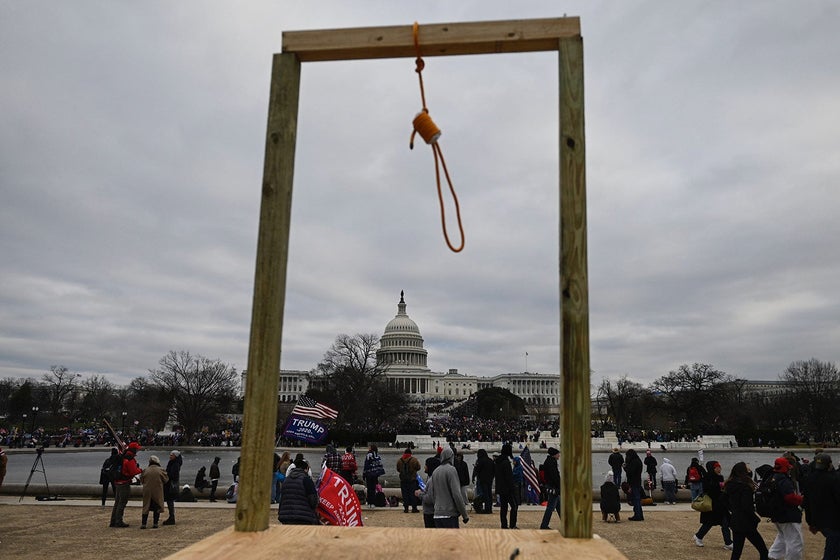
On September 11 2001, the terrorists attempting to attack the U.S. Capitol failed, as heroic passengers crashed the plane into a Pennsylvania field.  But on January 6 2021, homegrown terrorists succeeded where foreign terrorists had failed, halting the certification of an election by invading the Capitol during a joint session of Congress.  It took police and National Guard action to restore order. 

So the transfer of power to Joe Biden has not been peaceful--it required the suppression of an armed insurrection. Yes, “democracy prevailed”–but the unbroken string of peaceful transfers has been permanently broken.  Our system is more fragile than we believed. My boyhood civics lesson is now obsolete

Key #2: Fantasyland

It is 1953.  I sit watching our 10-inch black and white TV screen as Walt Disney introduces the very first broadcast of “Wonderful World of Disney.” Each week’s episode, he tells us, will visit a different world: “Frontierland,” “Adventureland,” “Tomorrowland,” and “Fantasyland.”

I love Fantasyland.  It’s a land where elephants fly, where broomsticks fetch water in buckets, where the gods still reign on Olympus, and where skeletons ride horses up from their graves.  It’s a land of dreams (and nightmares!) where anything can happen.  It’s a place where magic rules, untethered by facts.

I love it, but even at age five I know it is not real.  I don’t expect our cat to talk, or a magic wand to appear, or a genie or fairy to grant me my fondest wish.  However much I love the TV fantasies, I remain grounded in reality.  I love playing make-believe with my friends, I die hundreds of pretend deaths on make-believe battlefields.  But I know that real soldiers, shot dead, do not walk away.

But now, I fear, Fantasyland has taken hold of millions of Americans.  They seem possessed by magical thinking. They seem to be watching a movie in their own minds, a movie where a make-believe  world obeys their desires. 

In that magical land, Donald Trump did not lose the 2020 election. He won a landslide victory.

In that fantasyland, the Covid virus is not a terrible pandemic causing 400,000 American lives. It is no worse than the flu. It is not to be feared.

In that make-believe land, climate change is not real.

In that pretend realm, there is no systemic racism, no white privilege, no white supremacy movement.

In that alternate reality, Russians never interfered with the U.S. elections.

In that imaginary existence, vaccines do not protect us--they make us sick—or worse, they wire us for surveillance.

Such widespread magical thinking constitutes nothing short of a wholesale denial of facts.

It strikes me that these two phenomena - - the breakdown of peaceful transfer and the prevalence of Fantasyland thinking--are the two barriers we face in overcoming our cascading crises.  One threatens our constitutional order, while the other threatens our public discourse.  Both threaten our national unity.

Our Constitutional Order

The long stability of our constitutional system is no longer assured.  It took multiple recounts, 50 court cases, the Supreme Court, the suppression of a coup, and an impeachment to get us from President Trump to President Biden.  This was the very definition of a power struggle, not a peaceful transfer.

We might hope that this struggle was a one-off recurrence, and never to be repeated.  But the signs are ominous.  Since 2000, Americans have been increasingly ready to question the legitimacy of presidential elections.  In 2000, people questioned the Florida recount, which determined the overall outcome.  In 2008, Trump and others questioned Obama’s very birthright to the presidency.  In 2016, 33% of Democrats and 50% of young Democrats considered Trump’s victory “illegitimate.” In 2020, similar numbers of Republicans disputed the election results.

I submit that, unless we find a way to conduct elections acceptable to all, we’re in for trouble.  There already has been too much unrest--Biden called it our “uncivil war.”  Too many norms had been broken, making me wonder if norms are enough to maintain our fragile fractured system.  Disrespect for our institutions is now dangerously widespread.  And it appears that America’s celebrated “individualism” has metastasized to the point where any sense of “common good” maybe too weak to motivate Americans to set aside private interest for a unified future.

The last year has finally exposed how fragile our civil stability has become, and the trends of the last 20 years point to further breakdown. The growing, infectious willingness of millions of Americans to reject outcomes they do not like is the mark of a failed state.  That infection must be stopped.  But that depends on repairing public discourse.

 Public Discourse

An open society requires dialogue among people of differing views. But differing opinions are only constructive if they respond to the same facts.  Facts are the currency of public discourse: we must agree on facts before further discussion can proceed.  Thus the cliché: the “you have a right to your own opinion, but not to your own facts.”

If facts are devalued or even dismissed, dialogue breaks down. People begin to fabricate their own “alternative facts,” and they enter that fantasyland where the real and the imaginary merge and blend

“Conspiricism” poses a special threat. While conspiracy theorists merely concoct a scheme that explains to them the true meaning of a PARTICULAR event (say, the assassination of JFK or 9/11), people infected with conspricism believe that such schemes lurk behind ALL events. For them, ANY reportage of news is merely the smokescreen behind which reality lurks. The smokescreen is part of the conspiracy and the reality behind it is evil. Thus all of life’s events, all the facts presented, are mere distractions luring us into a hidden evil. Our lives come to depend on dismissing facts and replacing them with our own imagined schemes.

In such a fact-free country, public discourse withers. Different people form different opinions based on different sets of facts, some of which exist only in their minds.  They end up with nothing to say to each other beyond epithets, name-calling, insults, and threats.  Instead of helping to reduce our civil unrest, this reign of fantasy fuels discord, conflict.  In the end, people decide discourse is futile, and then, as we saw on January 6, “initiative becomes the privilege of violence.”

Our Task

The year 1968 also brought a parade of horrors: the Tet offensive, the student riots, the assassination of Martin Luther King, the riots burning up whole sections of our cities, the assassination of Robert Kennedy, the police riot in  Chicago, the Soviet tanks invading Prague, the election of Richard Nixon, the bombing of North Vietnam.  In the wake of that awful year, I quit my political science studies and my political career ambitions because I had lost faith in our political system’s ability to solve the nation’s real problems.  

It is possible that 2020 was as bad as, or worse than, 1968.  If so, my conviction is confirmed: more than 50 years later, we have still not resolved the issues that plagued us then. 

Martin Luther King named three great evils that threaten America’s greatness and threaten us still: racism, materialism, and militarism.  He knew civil rights alone could not solve these problems, so he called for a “revolution of values,” that would transform America’s culture.  He was calling, not for political reform, but for spiritual transformation.

We get the government we deserve, and since 1968 we have not deserved the best.  Our civic stability is fractured, our people too often choose fantasy over reality, and so we have brought the “cascading crises” of Disease, Depression, and Disorder upon ourselves.  “What Stands Before Us” now is the same vast task King named then: a revolution of values.

© Bernard F. Swain PhD 2021


Monday, January 21, 2013

America’s Moral Crossroads

On this Martin Luther King Day, during which the Inauguration festivities repeatedly linked freedom and war, I offer this reminder (written on King Day 2005):

In the years since King’s death, people who insist on reducing him to a “champion for racial justice,” period, have tamed his legacy. This dulls the true prophetic edge of a man who saw his own nation at odds with God’s will both at home and abroad.

       
For many Americans, Martin Luther King Day gets lost as one of those minor, even token observances like Labor Day and Veterans Day. Yet there are three important reasons to pay serious attention to this holiday.
(1) Since slavery was America’s "original sin,” and since we still struggle with its consequences, it makes sense to take this occasion to stop and reflect on our Christian responsibilities in promoting a racially just society.

(2) The second reason is somewhat broader: Dr. King was not a public official, nor even a professional politician. He was an ordained Christian minister, a preacher, a trained theologian. By the time of his assassination in April 1968, he had become widely regarded as the moral leader of America. Today he is the only American singled out for his own holiday. He has become the closest thing were have to a national patron saint. Today, when many are concerned about “moral values” (some even expect their President to be their moral leader), King offers a timely example of what moral leadership really looks like.

(3) The third reason may be even timelier: Peace. We’ve just come through the Holy Day of “Peace on Earth” we call Christmas, as well as the World Day of Peace we now celebrate on January 1. Now, two weeks later, we honor the man who finished his career by moving beyond the civil rights movement to become a champion for peace.

Of course, King won the Nobel Peace Prize in 1964 because of his commitment to a non-violent campaign for racial justice. But in his acceptance speech, he spoke of a commitment to non-violence that went beyond race-relations:

“This awards represents a profound recognition that non-violence is the answer to the crucial political and moral questions of our time—the need for men to overcome oppression and violence without resorting to violence and oppression.”

King knew, of course, that such recognition had not yet worked its way into US public policy. Indeed, 40 years later we still try to overcome oppression and violence by resorting to violence and oppression.

The Nobel Prize did not alter King’s character, but it did transform his agenda. While he still fought for black people’s rights, he began to sense the movement had an even higher   calling: to work for all people of good will. “Maybe our mission,” he said, “is to save the soul of America.”

For years King had promoted non-violence as the chief “weapon” in the civil rights struggle. Even as innocent children died in that struggle, he had long preached that the solution was not “getting our ammunition and going out shooting physical weapons.” Instead, he said, “We must know that we have something much more powerful. Just take up the ammunition of love.”

This was nothing but straight Gospel talk, of course, but King was coming to see non-violence as more than just a tool—in fact, as a value in itself—and he began to address himself to “Americans of good will who are committed to the struggle for brotherhood and the crusade for world peace.”

By then the US was not just struggling with civil rights; it was also a nation at war. Many within the movement urged King not to overstep his role, not to risk bogging down in the growing national turmoil over war in Vietnam. But finally King’s conscience dictated that he break his silence on the war, even if it meant breaking ranks with his allies in the movement.

The decisive moment came in April 1967, with his sermon at Riverside Church in New York City, the speech now known as the “Silence of the Night” speech, the speech many historians regard as King’s greatest—and the speech that redefined his place in American life.

He admitted that many supporters lamented his move, asking, “Why are you joining the voices of dissent?” and arguing “Peace and civil rights don’t mix.” His response: “My conscience leaves me no other choice. ” For he had come to see a darkness closing around America, and he believed someone had to break “the silence of the night.”

What was that darkness? It was the victory of violence in the world—not only violence by those oppressing racial minorities, but especially by “the greatest purveyor of violence in the world today: my own government.” He even worried that the war could make America a nation whose soul was “totally poisoned.”

He knew this would shock many, but he challenged them to see the logic of his outlook, appealing to his vocation as a minister of Jesus Christ:

 To me, the relationship of this ministry to the making of peace is so obvious that I sometimes marvel at those who ask me why I am speaking against the war... Have they forgotten that my ministry is in obedience to the one who loved his enemies so fully that he died for them?

For King, as for Pope John Paul II, being a Christian means being above all a citizen of the world, and he shared the world’s view that US war-making was “disgraceful” and “perverse.” He urged all draft-aged people to seek conscientious objector status, and called on clergy to mobilize war resistance.

But King was not done.

“The war in Vietnam,” he said, “is but a symptom of a far deeper malady within the American spirit.” The world, he said, is going through a major historical revolution, and our nation is “on the wrong side.” Without  “a significant and profound change in American life and policy,” he feared we would be mired in violence and turmoil for generations to come. Believing this, he proposed a radical shift in American values:

I am convinced that if we are to get on the right side of the world revolution, we as a nation must undergo a radical revolution of values. We must rapidly begin the shift from a thing-oriented society to a person-oriented society. When machines and computers, profit motives and property rights, are considered more important than people, the giant triplets of racism, extreme materialism, and militarism are incapable of being conquered. A true revolution of values will soon cause us to question the fairness and justice of many of our past and present policies…A true revolution of values will soon look uneasily on the glaring contrast of poverty and wealth…A true revolution of values will lay hand on the world order and say of war, "This way of settling differences is not just." …America, the richest and most powerful nation in the world, can well lead the way in this revolution of values. There is nothing except a tragic death wish to prevent us from reordering our priorities so that the pursuit of peace will take precedence over the pursuit of war.

This marked a major turn in King’s ministry. Until now he had always argued that the civil rights movement was needed to fulfill the “core American values” this nation was founded upon. Now, in a new and radical way, he was arguing those values needed to change if America was to meet its responsibilities to the world and to the Gospels.

In the years since King’s death, people who insist on reducing him to a “champion for racial justice,” period, have tamed his legacy. This dulls the true prophetic edge of a man who saw his own nation at odds with God’s will both at home and abroad.

Taming King’s message does disservice to both him and to our people, for today our nation still continues its warlike ways, yet Americans cry out for truer values. We cannot pretend to fulfill his dream by making peace with African-Americans if we also continue to be “the greatest purveyor of violence in the world today.”

King concluded his Riverside talk by depicting America at a moral crossroads, faced with a historic choice. Would we choose the shameful legacy of nations who possess “power without compassion, might without morality, and strength without sight”? Or would we instead choose to end the night by learning to make peace our way in the world?

 If we will make the right choice, we will be able to transform the jangling discords of our world into a beautiful symphony of brotherhood. If we will but make the right choice, we will be able to speed up the day, all over America and all over the world, when justice will roll down like waters, and righteousness like a mighty stream.

 America failed to heed him then, and 38 years later we find ourselves still stuck in the vicious cycle of violence. Is it our dark dead end, or have we simply circled back to the same old moral crossroads? If so, perhaps we have another chance to make the right choice, if only we will want the bright dream he dreamed. 

© Bernard F. Swain PhD 2005