Showing posts with label evangelization. Show all posts
Showing posts with label evangelization. Show all posts
Monday, December 21, 2015
#445: “Ad Multos Annnos !” for Francis —and for HIS Council
The traditional Latin birthday toast “Ad Multos Annos !” (to many years!) had double (or even triple) meaning the last two weeks.
Vatican Council II (1962-1965) finished its work on December 8, 1965. Two weeks ago the 50th anniversary of that historic accomplishment passed quietly. And last week the 79th anniversary of Pope Francis’ December 17 birth also passed without much notice. For me, these two anniversaries are deeply connected.
When Vatican II who opened in 1962, I was a 13 year old high school freshman--and for the next four years the Council shaped life at my Jesuit high school. We prayed daily for the Council’s success. We followed the Council’s progress through John Cogley’s New York Times coverage. We learned the Council’s background and progress in history and religion classes. We attended liturgies where the coming liturgical reforms were explained and demonstrated. We held an annual open “Model Vatican II” complete with all of Vatican II’s working commissions (I always chose to join the “social communications” commission!).
Meanwhile, Jorge Bergoglio (today Pope Francis) was also a student, but in a Jesuit seminary. For both of us, the Church we grew up in was changing before our eyes--and the Church we would work in would be a very different place.
Even during the Council, I had shifted parish roles from altar boy to commentator and lector at Masses. In college I often attended an 11 PM campus Mass where communal participation, folk-style music, and the English language contrasted sharply with the silence of pre-conciliar liturgies. And when I graduated I chose to pursue theological studies, not as a seminarian, but at a secular university. I would later decide against a fulltime academic career to pursue professional lay ministry in parishes--something unheard of before the Council. Forty-plus years later I’m still doing parish work.
Meanwhile Bergoglio was ordained a Jesuit priest and followed the path that led to his election 2013 as the first Jesuit pope.
During our careers, we have both witnessed the euphoria and confusion that Vatican II’s reforms unleashed on Catholic life. We saw the polarization that followed, as extremists campaigned either for the restoration of pre-conciliar Catholicism or for more radical reforms. We watched as church officials diluted and blocked the Council’s historic momentum by reverting to the “business as usual” mode that is the M.O. of all bureaucrats. We both feared that Pope John XXIII’s dream of a missionary Catholicism, actively engaged in modern life as a powerful evangelizing presence, would remain unfulfilled.
But as pope, Francis has seized the opportunity to retrieve John’s vision--and with it, the Council’s promise--with the simplest of strategies. By both his actions and words, he has bypassed 50 years of academic debate about the Council (a debate which unwittingly enabled the bureaucrats’ inertia) by focusing on one simple notion that was the keynote of John’s address on the very day that he opened the Council in October 1962:
We see, in fact, as one age succeeds another, that the opinions of men follow one another and exclude each other. And often errors vanish as quickly as they arise, like fog before the sun. The Church has always opposed these errors. Frequently she has condemned them with the greatest severity. Nowadays however, the Spouse of Christ prefers to make use of the medicine of mercy rather than that of severity. She consider that she meets the needs of the present day by demonstrating the validity of her teaching rather than by condemnations…the Catholic Church…desires to show herself to be the loving mother of all, benign, patient, full of mercy and goodness toward the brethren who are separated from her.
John’s keynote of “mercy” has become the current pope’s key to rescuing Catholic renewal from the bureaucrats. For Francis, in fact, “mercy” lies at the center of the Church’s mission:
Throughout history, some have been tempted to say that the Church is the Church of only the pure and perfectly consistent, and it expels all the rest. This is not true! This is heresy! The Church, which is holy, does not reject sinners; she does not reject us all; she does not reject us because she calls everyone, welcomes them, is open even to those furthest from her; she calls everyone to allow themselves to be enfolded by the mercy, the tenderness, and the forgiveness of the Father…
In short, Francis has made “mercy” a password for retrieving and preserving Vatican II’s vast historical agenda. This single password “mercy” has allowed him to communicate a simple message that hundreds of millions of people have heard. He has made mercy the Church’s litmus test: If we are driven by mercy, we become the Church we are meant to me. But if anything else other than mercy drives Catholic life, then the Church fails its mission.
What could be simpler? And this simplicity has not only made Francis the planet’s most popular leader--it has has also rescued Vatican II from the very edge of history’s dustbin. This old man has brought the Council back to life. In a word, 50 years after the event, Pope Francis has now made Vatican II HIS Council! As he himself said, in language implying a critique of the bureaucrats:
Our goal is not to proselytize but to listen to needs, desires and disappointments, despair, hope. We must restore hope to young people, help the old, be open to the future, spread love. Be poor among the poor. We need to include the excluded and preach peace. Vatican II, inspired by Pope Paul VI and John, decided to look to the future with a modern spirit and to be open to modern culture. The Council Fathers knew that being open to modern culture meant religious ecumenism and dialogue with non-believers. But afterwards very little was done in that direction. I have the humility and ambition to want to do something.
For me, that “something” has also meant rescuing my own career from the grim prospect of futility. No one wants to devote an entire life’s work to a losing cause, only to find that one’s finish line is worse than the starting point. Before Francis, I feared the real probability that Catholic life would be worse when I finish my work than it was when I began in 1972. Francis has restored the real possibility that John XXIII’s vision of a merciful Church will finally take root in Catholic hearts.
But birthdays reflect the march of time. Francis and I share the same December 17 birthday, and neither of us has much time left—he even less than I. We hear increasing stories that his enemies plan to undo his work once he exits the world stage. We can only hope that Francis has enough birthdays left to make his rescue mission irreversible.
So now that Francis has made the Council his Council, we have more reason than ever to wish him not only “Happy Birthday” but also “Ad Multos Annos!”
© Bernard F. Swain PhD 2015


Friday, October 30, 2015
#440: Our Faith Is Going “Green”--And We Can Help!
It was one of those weeks when separate events converge to signal a trend that touches us all.
The Washington Post just reported that representatives of Catholic Bishops “from around the globe” signed an appeal calling on next month’s UN climate conference in Paris to “approve a ‘transformative’ and legally binding agreement that set the global temperature limits.” This appeal reinforces the campaign of Pope Francis to protect “our common home.”
The Post also reported a study in the journal Nature Climate Change warning that five major Persian Gulf cities could become physically “uninhabitable” (due to heat) by the end of the century.
And the Boston Globe reported interesting data from the U.S. Census Bureau. In the 2005-2014 decade, the number of Bostonians commuting to work by bike tripled. Public transit commuting also increased, as did walking to work and working at home. The only decrease: people driving to work.
Reading that last report, I thought first of my own past. I bike-commuted to downtown Boston for 10 summers (except rainy days), 1978-1987. I had also commuted by bike across Boston’s north shore while in college for two summer jobs, and then biked to my senior year classes from off-campus. On one of those bikes I mounted a small green-and-white mini license plate that read “Non-Polluting Vehicle.”
Thinking back, it occurs to me that I was emulating two older role models. The first was John McGrath, a 60+ co-worker who rode his three-speed bike to General Electric’s West Lynn (Massachusetts) plant every day. The second was my own father, who rode his bike 6 miles to GE’s Everett (Massachusetts) point in his 40s and 50s.
These men were thinking “economizing” and “exercise,’ not “ecology”--but their example remains for me today. And my son Chris often gets to his La Jolla (California) job by bike--a 3rd generation “cyclo-commuter” !
What do all these things signal? Three things, I think: (1) The consensus on the man-made threat to our environment is now so strong that only people in denial can doubt it; (2) The Catholic Church is now throwing its weight squarely behind the push to reduce carbon emissions; (3) Pope Francis has made this push a moral imperative even for individuals and families. As Francis wrote in his encyclical “Laudato Si”:
A change in lifestyle could bring healthy pressure to bear on those who wield political, economic and social power. This is what consumer movements accomplish by boycotting certain products…This shows us the great need for a sense of social responsibility on the part of consumers. “Purchasing is always a moral – and not simply economic – act.” Today, in a word, “the issue of environmental degradation challenges us to examine our lifestyle.”
For Catholics, this means reflecting on actions within our control. As Francis says:
We are always capable of going out of ourselves towards the other…Disinterested concern for others, and the rejection of every form of self-centeredness and self-absorption, are essential if we truly wish to care for our brothers and sisters and for the natural environment. These attitudes also attune us to the moral imperative of assessing the impact of our every action and personal decision on the world around us. If we can overcome individualism, we will truly be able to develop a different lifestyle and bring about significant changes in society.
The point is not for all of us to take up cycling (my trip to my client on Martha’s Vineyard, for example, is 70+ miles overland, plus a 45-minute boat trip—too far to bike!). No, the point is to ask: “what is possible for me? How can I adjust my way of life to make it more sustainable, more eco-friendly? How can I take some stewardship for our common home?” In Francis’ words, it is about building new habits:
An awareness of the gravity of today’s cultural and ecological crisis must be translated into new habits. Many people know that our current progress and the mere amassing of things and pleasures are not enough to give meaning and joy to the human heart, yet they feel unable to give up what the market sets before them...A milieu of extreme consumerism and affluence which makes it difficult to develop other habits. We are faced with an educational challenge…Yet this education, aimed at creating an “ecological citizenship,” is at times limited to providing information, and fails to instill good habits... Only by cultivating sound virtues will people be able to make a selfless ecological commitment.
It’s easy to misunderstand this challenge. When I told a recent group that Vatican City became the world’s first carbon neutral state by buying up a large forest, many investors were skeptical. “That doesn’t even reduce their energy use!” They said.
True enough--but no one can live modern life by reducing their carbon emissions to zero. Even all-electric cars mostly depend on power generated by burning fossil fuels, since hydro and wind-generated electricity (“clean electricity”) still supplies less than half our power. Nearly everything we buy, even food, has been produced, directly or indirectly, by burning carbon--and has burned more carbon while shipping to the store. Many homes would go dark and unheated and/or uncooled without carbon emissions, and without burning carbon all our batteries would fail to recharge.
No, the reduction of our carbon footprint is a more complex challenge. To become “carbon neutral” means balancing carbon emissions with carbon absorption. This requires both reducing carbon emissions and increasing offsetting measures. So the Vatican’s forest, for example, will absorb as much carbon (trees do it naturally, of course) as Vatican City emits. By buying the forest, those trees are preserved for that purpose.
For us, such balancing must be done on a case-by-case basis. There are many ways we can reduce emissions. We can convert our heating, cooling, and cars away from carbon-burning fuels. We can alter our thermostats: lower for heating, higher for cooling. We can drive less, we can use more public transportation, conserve the electricity used by our appliances, lights, and machinery. Some of us can convert to solar or wind power. We can shop locally more to reduce shipping emissions. Many online sites provide tips for planning ways to reduce our domestic carbon footprint.
But in addition to reducing emissions, we can also boost carbon absorption to offset our emissions and bring our carbon footprint closer to zero. One obvious way is to plant trees:
According to the Urban Forestry Network, a single young tree absorbs 13 pounds of carbon dioxide each year. That amount will climb up to 48 pounds annually as trees mature. Just one 10-year-old tree releases enough oxygen into the air to support two human beings.
In my case, for example, two young dogwood trees were planted on our property the year before we bought it. They joined another 7 trees on our plot. Without actually calculating the benefits, we know these trees offset some of our emissions.
It’s also possible to support offsets remotely, as Vatican City did:
This is done by purchasing ‘carbon credits’ from accredited companies which offer this service, who will then invest those dollars in (for instance) renewable energy projects or planting trees. (from the website Mashable)
Most experts believe it’s impossible to offset all the planet’s current emissions. But one eco-conscious site, Brave New Climate, suggests our efforts can still serve a spiritual purpose:
Carbon offsets should definitely not be seen as the solution, or as a relatively pain-free way to expel your carbon guilt. There is nowhere near enough offsetting potential in the world for this to be an option for most of the world’s population. But in conjunction with other methods of kicking the CO2 habit, offsets can help make a difference and allow you to pay a small penance.
PENANCE! Imagine using such an old Catholic term for our eco-efforts. But it makes perfect sense: our common home is struggling, not by accident, but because our way of life is exhausting its resources, and even depriving others of resources they need.
In short, our ecological crisis poses a moral imperative because it comes from a moral failure. As Pope Francis explains in his critical reading of Genesis:
We are not God. The earth was here before us and it has been given to us. This allows us to respond to the charge that Judaeo-Christian thinking, on the basis of the Genesis account which grants man “dominion” over the earth (cf. Gen 1:28), has encouraged the unbridled exploitation of nature by painting him as domineering and destructive by nature. This is not a correct interpretation of the Bible as understood by the Church. Although it is true that we Christians have at times incorrectly interpreted the Scriptures, nowadays we must forcefully reject the notion that our being created in God’s image and given dominion over the earth justifies absolute domination over other creatures. Each community can take from the bounty of the earth whatever it needs for subsistence, but it also has the duty to protect the earth and to ensure its fruitfulness for coming generations.
In other words, the failure to understand Genesis provided past excuses for mistreating the planet. This may not be our own moral failure, but the failure of past generations of whom we are heirs. In that sense, “going green” CAN be seen as a “small penance” for the sins of our ancestors—and a commitment to leave our childrens’s children’s children a “common home” that is more respectful of God’s great gifts.
© Bernard F. Swain PhD 2015
Thursday, October 8, 2015
#438: We Need to Stop Pigeon-Holing This Pope!
During and since the Pope’s US visit, too many Americans have been cutting his vision down to THEIR size!

It’s no surprise that the visit of Pope
Francis to the US drew widely varied reactions--even if they were mostly
positive. Compared to other public
figures, his manner is so humble, his heart is so open, and his mind is so
humane, that he defies easy comparisons.
But that did not stop observers from trying to pigeonhole him--usually by
boxing him into the hole right next to their own.
There were also some negative reactions (or over-reactions). There were those distressed by the visit
itself, like the evangelical pastor who complained that Congress was giving him
an official welcome of the sort usually reserved for elected leaders. This is a pretty bad blind spot, since it ignores
why Congress (and the President) merely followed the protocols of a state visit:
because the pope IS a head of state, as well as an elected official. This is not negated by the fact that he is
also the head of Roman Catholic Church—any more that it would be for welcoming
the Queen of England, who is both head of state of the UK AND the head of the Church
of England.
Then there was the overreaction to the news that
Francis had greeted Kim Davis. Fueled by
exaggerated claims by Davis and her lawyer that the pope was taking their side
in her dispute with the law, reactions ranged from gleeful crowing (by
conservatives) two outraged wailing (by liberals) until Vatican sources rebutted
claims: this meet-and-greet was one of dozens, was strictly pro-forma, did not
convey support for Davis’s particular case or position, and did not rank as an
official audience. That status was reserved for one meeting: with a former
student of Francis who is gay and brought along his long-time partner. So much for pigeon-holing this pope!

Yet even those reacting positively, amid all the
personal praise, too often needed to cut the pope’s message down to their size. Conservatives in Congress applauded his
defense of family, marriage, and civil rights, while liberals praised his
remarks on climate change, immigration, and inequality. On both sides a common theme emerged: “We
like this pope on some issues, but not on all issues.” Thus they cherry picked his message for their
favorite parts, and tossed out the rest.
It was as if they pretended he was preaching to their choir, or even to
both choirs at once. There was no sense
that they realized the pope was actually preaching beyond both choirs, offering
a comprehensive and coherent vision in which all these issues are connected. Indeed, they did their best to disconnect
these issues into unrelated pieces.

The most striking example came when the pope urged
Congress to protect life at every stage of development. No sooner had the conservative applause begun--they
inferred the pope’s topic was “abortion”--than Francis proceeded to call for
the abolition of the death penalty. A
surprised and audible yelp came from the gallery as the conservatives suddenly
sat on their hands and the liberals rose in applause!

Even the media was often caught off guard. Reports of that speech repeatedly claimed
that Francis attacked legal abortion (even though the word never came up in his
speech!) and failed to explain that pope was really preaching the “Seamless Garment
of Life” ethic promoted by Chicago’s late Cardinal Joseph Bernardin.
Some observers did get the point. Chris Matthews’ first comment on the address
to Congress was that Francis had created “a spiritual Mount Rushmore” by
calling on Congress (and all Americans) to pursue a better future built on the
civic virtues exemplified by four great Americans: Abraham Lincoln (freedom and
hope), Martin Luther King (human rights and nonviolence), Dorothy Day (care
for the poor and oppressed) and Thomas Merton (open dialogue and
bridge-building rooted in reflection).
And Bishop Robert Barron of Los Angeles commented, that
“if you begin where the pope begins”—with the idea that our common home,
including life itself, is God’s gift to us all as well as our responsibility to
God and to each other--then “all the other issues line up.”
I’m afraid this fact did not register with millions
of Americans, whether professionals in the media, or elected officials, or
ordinary citizens. Trying to pigeonhole
the pope along conservative-vs.-liberal lines, they found him puzzling, even
perplexingly inconsistent. They loved his warm smile and his open heart but
they found his vision hard to wrap their minds around.
Ironically, this vision may be the least original thing about Francis. Nearly all of his worldview draws on the
classic core of modern Catholic Social teaching from John XXIII, Paul VI, John-Paul
II, and Benedict XVI. I have argued that Paul VI in particular analyze the
ethical challenges of globalization in 1967, becoming the "prophet of globalization" even before that term came into general
use [see http://swaincrosscurrents.blogspot.com/2009/09/268-benedict-goes-outside-box.html ]. The difference
is that, while Paul named this the challenge to achieve “Integral Human Development,”
Francis has updated the name (with an environmental dimension) and now
refers to “Integral and Sustainable Development.”
I continue to believe that this vision offers a clear and
global worldview that no other public figure can match. Indeed, this vision connects everything into
one big picture, as I previously noted in analyzing the pope’s environmental
encyclical from this past June:
Many
commentators wrongly described the encyclical’s theme as “climate change.” In
fact Francis presents climate change as just one piece of a much bigger
puzzle. He roots the problem of climate
change in runaway carbon emissions, which are generated by our unsustainable
reliance on fuels needed to power a runaway capitalist system that treats
self-interest and greed as our most important social virtues. This system despoils the global environment
while generating not only intolerable levels of pollution but also intolerable
levels of inequality. The result, he
says will be a progressive degrading of earth’s ecological systems which, while
caused by the world’s wealthy, will disproportionately affect the world’s
poor. The solution to this massively
dysfunctional global system is nothing less than a planetary ethical revolution
that dethrones runaway capitalism as we know it and replaces it with a system
that reflects more authentically humane values.
In short,
rather than focusing on science or environmentalism or economics or public
policy or social justice or religion--Pope Francis has integrated them all into
one big coherent vision. No wonder he
calls it “integral ecology”: it is not just the “big picture,” it is the
biggest picture of all. --CrossCurrents#432--07-03-15
It is no great mystery why many in Congress-- and many
in America--resist this global vision.
It is not because they do not accept Catholic doctrines; this vision
does not depend on those doctrines. It is because
they need to filter all they hear through their own preconceived notions. They loved Francis’ open heart, but they
struggled to open their own hearts. They
praised his call for dialogue, as long as their own opinions could remain non-negotiable.
This begs the question: what difference does this make? Almost every position which Francis took
earned praise from someone. It’s just
that few praised his vision as a whole--or even recognize that whole vision’s power. Does
this matter?
If the pope is right, it matters a lot--Because if he
is right, we cannot solve any of our major problems in isolation, without
grasping the big picture:
The world’s
problems cannot be analyzed or explained in isolation….the fragmentation of
knowledge and the isolation of bits of information can actually become a form
of ignorance, unless they are integrated into a broader vision of reality…What kind of
world do we want to leave to those who come after us…? This question not only
concerns the environment in isolation; the issue cannot be approached
piecemeal. When we ask ourselves what kind of world we want to leave behind, we
think in the first place of its general direction, its meaning and its values.
Unless we struggle with these deeper issues, I do not believe that our concern
for ecology will produce significant results. --Laudato Si, Pars.61, 138,160
But if the pope is right, that “big picture” calls for
changes in all of us: changes in our daily lives, our consumption patterns, our
relationships, our attitudes. And if the
pope is right, our survival is at stake--and that survival depends on
understanding that those stakes are global but the solution starts with each
one of us.
So in the wake of Francis’ visit, the practical
question facing all of us is this: do we rise to the challenge of this man’s vast
vision, this big picture--Or do we keep cutting it down to our own size?
Bernard F.
Swain PhD 2015
Wednesday, September 23, 2015
#437: It Took Pope Francis Less Than One Hour To Change the Game
How
good a messenger is Pope Francis? He is
so good that even the media gets the message!
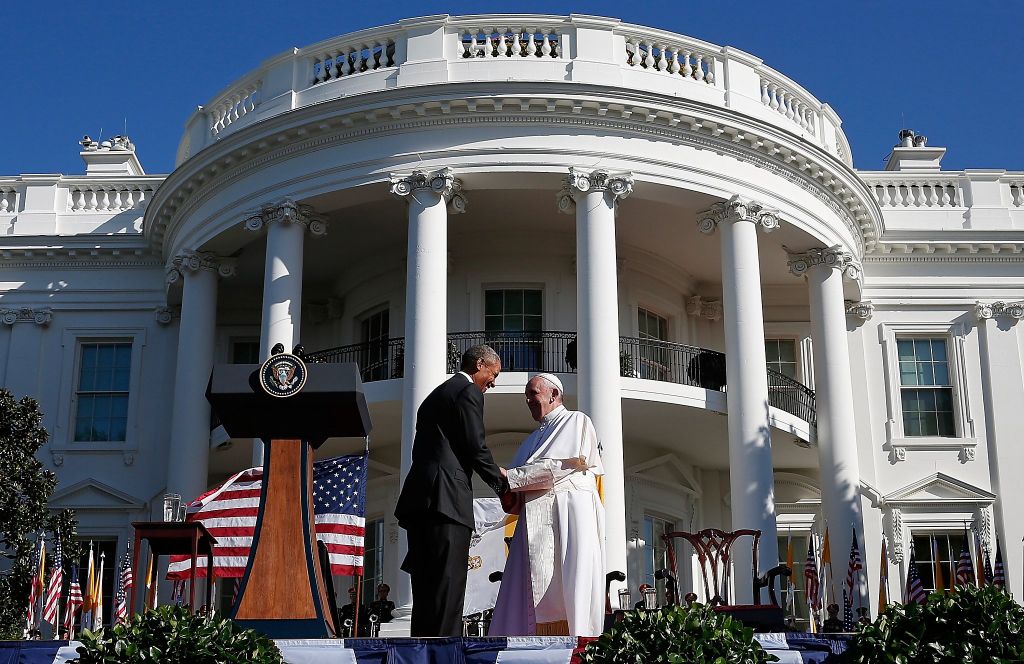
As
the news networks provided wall to wall coverage of the pope’s arrival at the
White House, his parade along the National Mall, and his prayer service at Saint
Matthew’s Cathedral, commentator after commentator spoke facts that seem foreign
to American ears:
This
pope is not a politician, he is a pastor.
His
interest is not power, but people.
He
offers a view that is neither conservative
nor liberal, but a view rooted in
the gospel message.
He
aims to promote no party, no program, no politician--but the common
good of all people.
He
speaks not only to Catholics, but to the
human race.
He
sees the world, not as a collection of allies
fighting enemies, but as “our common home.”
He
is interested less in judging who is right
and who is wrong than in getting all of us to work together.
His
response to power is neither to fear or
fight it, but to offer us the wisdom to use power well.
He
is not a reformer, but a radical in the original sense of going
to the root of things. For rather than changing
the tradition he represents, he is presenting it in a new light as a
comprehensive worldview that the 21st century badly needs.
And
his personal authenticity makes it nearly impossible to simply ignore him, no
matter how uncomfortable listening to him might make us. He is showing us that the leadership we need
must embody a moral authority that few officeholders have.
He
will challenge us, and those who are not too cowardly to listen will listen at
our own peril. As president Obama
said, Francis will “awaken us from our complacence.”
Bernard F.
Swain PhD 201
Sunday, September 13, 2015
The Integral Ecology of Pope Francis-26
NOTE: THIS IS THE FINAL EXCERPT !
As Pope Francis' September visit to the US approaches, I have decided to post excerpts from his recent encyclical letter--which one "traditionalist" wag has dubbed Francis' "Summa Ecologica." It is a long document (40,000 words) more easily absorbed in piecemeal fashion. But these excerpts appear in their original order, to give some sense of the "Flow" of this ground-breaking document. The entire letter is available from many sources, including the Vatican itself at http://w2.vatican.va/content/francesco/en/encyclicals/documents/papa-francesco_20150524_enciclica-laudato-si.html We can expect its themes to be echoed when Francis addresses the US Congress and the General Assembly of the UN.

As Pope Francis' September visit to the US approaches, I have decided to post excerpts from his recent encyclical letter--which one "traditionalist" wag has dubbed Francis' "Summa Ecologica." It is a long document (40,000 words) more easily absorbed in piecemeal fashion. But these excerpts appear in their original order, to give some sense of the "Flow" of this ground-breaking document. The entire letter is available from many sources, including the Vatican itself at http://w2.vatican.va/content/francesco/en/encyclicals/documents/papa-francesco_20150524_enciclica-laudato-si.html We can expect its themes to be echoed when Francis addresses the US Congress and the General Assembly of the UN.

ENCYCLICAL LETTER
“LAUDATO SI”
OF THE HOLY FATHER
FRANCIS
ON CARE FOR OUR COMMON HOME
VIII. QUEEN OF ALL CREATION
241. Mary, the Mother who cared for Jesus, now cares with maternal affection and pain for this wounded world. Just as her pierced heart mourned the death of Jesus, so now she grieves for the sufferings of the crucified poor and for the creatures of this world laid waste by human power. Completely transfigured, she now lives with Jesus, and all creatures sing of her fairness...She treasures the entire life of Jesus in her heart (cf. Lk 2:19,51), and now understands the meaning of all things. Hence, we can ask her to enable us to look at this world with eyes of wisdom.
242...The Gospel presents Joseph as a just man, hard-working and strong. But he also shows great tenderness, which is not a mark of the weak but of those who are genuinely strong, fully aware of reality and ready to love and serve in humility. That is why he was proclaimed custodian of the universal Church. He too can teach us how to show care; he can inspire us to work with generosity and tenderness in protecting this world which God has entrusted to us.
IX. BEYOND THE SUN
243. At the end, we will find ourselves face to face with the infinite beauty of God (cf. 1 Cor 13:12), and be able to read with admiration and happiness the mystery of the universe, which with us will share in unending plenitude...Eternal life will be a shared experience of awe, in which each creature, resplendently transfigured, will take its rightful place and have something to give those poor men and women who will have been liberated once and for all.
244. In the meantime, we come together to take charge of this home which has been entrusted to us...In union with all creatures, we journey through this land seeking God ...Let us sing as we go. May our struggles and our concern for this planet never take away the joy of our hope.
245. God, who calls us to generous commitment and to give him our all, offers us the light and the strength needed to continue on our way. In the heart of this world, the Lord of life, who loves us so much, is always present. He does not abandon us, he does not leave us alone, for he has united himself definitively to our earth, and his love constantly impels us to find new ways forward. Praise be to him!
246. At the conclusion of this lengthy reflection which has been both
joyful and troubling, I propose that we offer two prayers. The first we
can share with all who believe in a God who is the all-powerful
Creator, while in the other we Christians ask for inspiration to take up
the commitment to creation set before us by the Gospel of Jesus.
Given in Rome at Saint Peter’s on 24 May, the Solemnity of Pentecost, in the year 2015, the third of my Pontificate.
241. Mary, the Mother who cared for Jesus, now cares with maternal affection and pain for this wounded world. Just as her pierced heart mourned the death of Jesus, so now she grieves for the sufferings of the crucified poor and for the creatures of this world laid waste by human power. Completely transfigured, she now lives with Jesus, and all creatures sing of her fairness...She treasures the entire life of Jesus in her heart (cf. Lk 2:19,51), and now understands the meaning of all things. Hence, we can ask her to enable us to look at this world with eyes of wisdom.
242...The Gospel presents Joseph as a just man, hard-working and strong. But he also shows great tenderness, which is not a mark of the weak but of those who are genuinely strong, fully aware of reality and ready to love and serve in humility. That is why he was proclaimed custodian of the universal Church. He too can teach us how to show care; he can inspire us to work with generosity and tenderness in protecting this world which God has entrusted to us.
IX. BEYOND THE SUN
243. At the end, we will find ourselves face to face with the infinite beauty of God (cf. 1 Cor 13:12), and be able to read with admiration and happiness the mystery of the universe, which with us will share in unending plenitude...Eternal life will be a shared experience of awe, in which each creature, resplendently transfigured, will take its rightful place and have something to give those poor men and women who will have been liberated once and for all.
244. In the meantime, we come together to take charge of this home which has been entrusted to us...In union with all creatures, we journey through this land seeking God ...Let us sing as we go. May our struggles and our concern for this planet never take away the joy of our hope.
245. God, who calls us to generous commitment and to give him our all, offers us the light and the strength needed to continue on our way. In the heart of this world, the Lord of life, who loves us so much, is always present. He does not abandon us, he does not leave us alone, for he has united himself definitively to our earth, and his love constantly impels us to find new ways forward. Praise be to him!
* * * * *
A prayer for our earth
All-powerful God, you are present in the whole universe
and in the smallest of your creatures.
You embrace with your tenderness all that exists.
Pour out upon us the power of your love,
that we may protect life and beauty.
Fill us with peace, that we may live
as brothers and sisters, harming no one.
O God of the poor,
help us to rescue the abandoned and forgotten of this earth,
so precious in your eyes.
Bring healing to our lives,
that we may protect the world and not prey on it,
that we may sow beauty, not pollution and destruction.
Touch the hearts
of those who look only for gain
at the expense of the poor and the earth.
Teach us to discover the worth of each thing,
to be filled with awe and contemplation,
to recognize that we are profoundly united
with every creature
as we journey towards your infinite light.
We thank you for being with us each day.
Encourage us, we pray, in our struggle
for justice, love and peace.
A Christian prayer in union with creation
Father, we praise you with all your creatures.
They came forth from your all-powerful hand;
they are yours, filled with your presence and your tender love.
Praise be to you!
They came forth from your all-powerful hand;
they are yours, filled with your presence and your tender love.
Praise be to you!
Son of God, Jesus,
through you all things were made.
You were formed in the womb of Mary our Mother,
you became part of this earth,
and you gazed upon this world with human eyes.
Today you are alive in every creature
in your risen glory.
Praise be to you!
through you all things were made.
You were formed in the womb of Mary our Mother,
you became part of this earth,
and you gazed upon this world with human eyes.
Today you are alive in every creature
in your risen glory.
Praise be to you!
Holy Spirit, by your light
you guide this world towards the Father’s love
and accompany creation as it groans in travail.
You also dwell in our hearts
and you inspire us to do what is good.
Praise be to you!
you guide this world towards the Father’s love
and accompany creation as it groans in travail.
You also dwell in our hearts
and you inspire us to do what is good.
Praise be to you!
Triune Lord, wondrous community of infinite love,
teach us to contemplate you
in the beauty of the universe,
for all things speak of you.
Awaken our praise and thankfulness
for every being that you have made.
Give us the grace to feel profoundly joined
to everything that is.
teach us to contemplate you
in the beauty of the universe,
for all things speak of you.
Awaken our praise and thankfulness
for every being that you have made.
Give us the grace to feel profoundly joined
to everything that is.
God of love, show us our place in this world
as channels of your love
for all the creatures of this earth,
for not one of them is forgotten in your sight.
Enlighten those who possess power and money
that they may avoid the sin of indifference,
that they may love the common good, advance the weak,
and care for this world in which we live.
The poor and the earth are crying out.
O Lord, seize us with your power and light,
help us to protect all life,
to prepare for a better future,
for the coming of your Kingdom
of justice, peace, love and beauty.
Praise be to you!
Amen.
Given in Rome at Saint Peter’s on 24 May, the Solemnity of Pentecost, in the year 2015, the third of my Pontificate.
Saturday, September 12, 2015
The Integral Ecology of Pope Francis-25
As
Pope Francis' September visit to the US approaches, I have decided to
post excerpts from his recent encyclical letter--which one
"traditionalist" wag has dubbed Francis' "Summa Ecologica."
It is a long document (40,000 words) more easily absorbed in piecemeal fashion. But these excerpts appear in their original order, to give some sense of the "Flow" of this ground-breaking document. The entire letter is available from many sources, including the Vatican itself at http://w2.vatican.va/content/francesco/en/encyclicals/documents/papa-francesco_20150524_enciclica-laudato-si.html We can expect its themes to be echoed when Francis addresses the US Congress and the General Assembly of the UN.

IV. JOY AND PEACE
222. Christian spirituality proposes an alternative understanding of the quality of life, and encourages a prophetic and contemplative lifestyle, one capable of deep enjoyment free of the obsession with consumption. We need to take up an ancient lesson, found in different religious traditions and also in the Bible. It is the conviction that “less is more.”
A constant flood of new consumer goods can baffle the heart and prevent us from cherishing each thing and each moment. To be serenely present to each reality, however small it may be, opens us to much greater horizons of understanding and personal fulfillment.
Christian spirituality proposes a growth marked by moderation and the capacity to be happy with little. It is a return to that simplicity which allows us to stop and appreciate the small things, to be grateful for the opportunities which life affords us, to be spiritually detached from what we possess, and not to succumb to sadness for what we lack. This implies avoiding the dynamic of dominion and the mere accumulation of pleasures.
223. Such sobriety, when lived freely and consciously, is liberating. It is not a lesser life or one lived with less intensity. On the contrary, it is a way of living life to the full. In reality, those who enjoy more and live better each moment are those who have given up dipping here and there, always on the look-out for what they do not have. They experience what it means to appreciate each person and each thing, learning familiarity with the simplest things and how to enjoy them.
So they are able to shed unsatisfied needs, reducing their obsessiveness and weariness. Even living on little, they can live a lot, above all when they cultivate other pleasures and find satisfaction in fraternal encounters, in service, in developing their gifts, in music and art, in contact with nature, in prayer. Happiness means knowing how to limit some needs which only diminish us, and being open to the many different possibilities which life can offer.
224. Sobriety and humility were not favourably regarded in the last century. And yet, when there is a general breakdown in the exercise of a certain virtue in personal and social life, it ends up causing a number of imbalances, including environmental ones. That is why it is no longer enough to speak only of the integrity of ecosystems. We have to dare to speak of the integrity of human life, of the need to promote and unify all the great values. Once we lose our humility, and become enthralled with the possibility of limitless mastery over everything, we inevitably end up harming society and the environment. It is not easy to promote this kind of healthy humility or happy sobriety when we consider ourselves autonomous, when we exclude God from our lives or replace him with our own ego, and think that our subjective feelings can define what is right and what is wrong.
225. On the other hand, no one can cultivate a sober and satisfying life without being at peace with him or herself. An adequate understanding of spirituality consists in filling out what we mean by peace, which is much more than the absence of war.
Inner peace is closely related to care for ecology and for the common good because, lived out authentically, it is reflected in a balanced lifestyle together with a capacity for wonder which takes us to a deeper understanding of life.
Nature is filled with words of love, but how can we listen to them amid constant noise, interminable and nerve-wracking distractions, or the cult of appearances? Many people today sense a profound imbalance which drives them to frenetic activity and makes them feel busy, in a constant hurry which in turn leads them to ride rough-shod over everything around them. This too affects how they treat the environment. An integral ecology includes taking time to recover a serene harmony with creation, reflecting on our lifestyle and our ideals, and contemplating the Creator who lives among us and surrounds us, whose presence “must not be contrived but found, uncovered”.[155]....
V. CIVIC AND POLITICAL LOVE
228. Care for nature is part of a lifestyle which includes the capacity for living together and communion. Jesus reminded us that we have God as our common Father and that this makes us brothers and sisters. Fraternal love can only be gratuitous; it can never be a means of repaying others for what they have done or will do for us. That is why it is possible to love our enemies. This same gratuitousness inspires us to love and accept the wind, the sun and the clouds, even though we cannot control them. In this sense, we can speak of a “universal fraternity”.
229. We must regain the conviction that we need one another, that we have a shared responsibility for others and the world, and that being good and decent are worth it. We have had enough of immorality and the mockery of ethics, goodness, faith and honesty. It is time to acknowledge that light-hearted superficiality has done us no good. When the foundations of social life are corroded, what ensues are battles over conflicting interests, new forms of violence and brutality, and obstacles to the growth of a genuine culture of care for the environment.
230. Saint Therese of Lisieux invites us to practise the little way of love, not to miss out on a kind word, a smile or any small gesture which sows peace and friendship. An integral ecology is also made up of simple daily gestures which break with the logic of violence, exploitation and selfishness. In the end, a world of exacerbated consumption is at the same time a world which mistreats life in all its forms.
231. Love, overflowing with small gestures of mutual care, is also civic and political, and it makes itself felt in every action that seeks to build a better world. Love for society and commitment to the common good are outstanding expressions of a charity which affects not only relationships between individuals but also “macro-relationships, social, economic and political ones”.[156] That is why the Church set before the world the ideal of a “civilization of love”.[157]
Social love is the key to authentic development: “In order to make society more human, more worthy of the human person, love in social life – political, economic and cultural – must be given renewed value, becoming the constant and highest norm for all activity”.[158] In this framework...social love moves us to devise larger strategies to halt environmental degradation and to encourage a “culture of care” which permeates all of society...
232. Not everyone is called to engage directly in political life. Society is also enriched by a countless array of organizations which work to promote the common good and to defend the environment, whether natural or urban. Some, for example, show concern for a public place (a building, a fountain, an abandoned monument, a landscape, a square), and strive to protect, restore, improve or beautify it as something belonging to everyone. Around these community actions, relationships develop or are recovered and a new social fabric emerges. Thus, a community can break out of the indifference induced by consumerism. These actions cultivate a shared identity, with a story which can be remembered and handed on. In this way, the world, and the quality of life of the poorest, are cared for, with a sense of solidarity which is at the same time aware that we live in a common home which God has entrusted to us. These community actions, when they express self-giving love, can also become intense spiritual experiences.
It is a long document (40,000 words) more easily absorbed in piecemeal fashion. But these excerpts appear in their original order, to give some sense of the "Flow" of this ground-breaking document. The entire letter is available from many sources, including the Vatican itself at http://w2.vatican.va/content/francesco/en/encyclicals/documents/papa-francesco_20150524_enciclica-laudato-si.html We can expect its themes to be echoed when Francis addresses the US Congress and the General Assembly of the UN.

ENCYCLICAL LETTER
“LAUDATO SI”
OF THE HOLY FATHER
FRANCIS
ON CARE FOR OUR COMMON HOME
IV. JOY AND PEACE
222. Christian spirituality proposes an alternative understanding of the quality of life, and encourages a prophetic and contemplative lifestyle, one capable of deep enjoyment free of the obsession with consumption. We need to take up an ancient lesson, found in different religious traditions and also in the Bible. It is the conviction that “less is more.”
A constant flood of new consumer goods can baffle the heart and prevent us from cherishing each thing and each moment. To be serenely present to each reality, however small it may be, opens us to much greater horizons of understanding and personal fulfillment.
Christian spirituality proposes a growth marked by moderation and the capacity to be happy with little. It is a return to that simplicity which allows us to stop and appreciate the small things, to be grateful for the opportunities which life affords us, to be spiritually detached from what we possess, and not to succumb to sadness for what we lack. This implies avoiding the dynamic of dominion and the mere accumulation of pleasures.
223. Such sobriety, when lived freely and consciously, is liberating. It is not a lesser life or one lived with less intensity. On the contrary, it is a way of living life to the full. In reality, those who enjoy more and live better each moment are those who have given up dipping here and there, always on the look-out for what they do not have. They experience what it means to appreciate each person and each thing, learning familiarity with the simplest things and how to enjoy them.
So they are able to shed unsatisfied needs, reducing their obsessiveness and weariness. Even living on little, they can live a lot, above all when they cultivate other pleasures and find satisfaction in fraternal encounters, in service, in developing their gifts, in music and art, in contact with nature, in prayer. Happiness means knowing how to limit some needs which only diminish us, and being open to the many different possibilities which life can offer.
224. Sobriety and humility were not favourably regarded in the last century. And yet, when there is a general breakdown in the exercise of a certain virtue in personal and social life, it ends up causing a number of imbalances, including environmental ones. That is why it is no longer enough to speak only of the integrity of ecosystems. We have to dare to speak of the integrity of human life, of the need to promote and unify all the great values. Once we lose our humility, and become enthralled with the possibility of limitless mastery over everything, we inevitably end up harming society and the environment. It is not easy to promote this kind of healthy humility or happy sobriety when we consider ourselves autonomous, when we exclude God from our lives or replace him with our own ego, and think that our subjective feelings can define what is right and what is wrong.
225. On the other hand, no one can cultivate a sober and satisfying life without being at peace with him or herself. An adequate understanding of spirituality consists in filling out what we mean by peace, which is much more than the absence of war.
Inner peace is closely related to care for ecology and for the common good because, lived out authentically, it is reflected in a balanced lifestyle together with a capacity for wonder which takes us to a deeper understanding of life.
Nature is filled with words of love, but how can we listen to them amid constant noise, interminable and nerve-wracking distractions, or the cult of appearances? Many people today sense a profound imbalance which drives them to frenetic activity and makes them feel busy, in a constant hurry which in turn leads them to ride rough-shod over everything around them. This too affects how they treat the environment. An integral ecology includes taking time to recover a serene harmony with creation, reflecting on our lifestyle and our ideals, and contemplating the Creator who lives among us and surrounds us, whose presence “must not be contrived but found, uncovered”.[155]....
V. CIVIC AND POLITICAL LOVE
228. Care for nature is part of a lifestyle which includes the capacity for living together and communion. Jesus reminded us that we have God as our common Father and that this makes us brothers and sisters. Fraternal love can only be gratuitous; it can never be a means of repaying others for what they have done or will do for us. That is why it is possible to love our enemies. This same gratuitousness inspires us to love and accept the wind, the sun and the clouds, even though we cannot control them. In this sense, we can speak of a “universal fraternity”.
229. We must regain the conviction that we need one another, that we have a shared responsibility for others and the world, and that being good and decent are worth it. We have had enough of immorality and the mockery of ethics, goodness, faith and honesty. It is time to acknowledge that light-hearted superficiality has done us no good. When the foundations of social life are corroded, what ensues are battles over conflicting interests, new forms of violence and brutality, and obstacles to the growth of a genuine culture of care for the environment.
230. Saint Therese of Lisieux invites us to practise the little way of love, not to miss out on a kind word, a smile or any small gesture which sows peace and friendship. An integral ecology is also made up of simple daily gestures which break with the logic of violence, exploitation and selfishness. In the end, a world of exacerbated consumption is at the same time a world which mistreats life in all its forms.
231. Love, overflowing with small gestures of mutual care, is also civic and political, and it makes itself felt in every action that seeks to build a better world. Love for society and commitment to the common good are outstanding expressions of a charity which affects not only relationships between individuals but also “macro-relationships, social, economic and political ones”.[156] That is why the Church set before the world the ideal of a “civilization of love”.[157]
Social love is the key to authentic development: “In order to make society more human, more worthy of the human person, love in social life – political, economic and cultural – must be given renewed value, becoming the constant and highest norm for all activity”.[158] In this framework...social love moves us to devise larger strategies to halt environmental degradation and to encourage a “culture of care” which permeates all of society...
232. Not everyone is called to engage directly in political life. Society is also enriched by a countless array of organizations which work to promote the common good and to defend the environment, whether natural or urban. Some, for example, show concern for a public place (a building, a fountain, an abandoned monument, a landscape, a square), and strive to protect, restore, improve or beautify it as something belonging to everyone. Around these community actions, relationships develop or are recovered and a new social fabric emerges. Thus, a community can break out of the indifference induced by consumerism. These actions cultivate a shared identity, with a story which can be remembered and handed on. In this way, the world, and the quality of life of the poorest, are cared for, with a sense of solidarity which is at the same time aware that we live in a common home which God has entrusted to us. These community actions, when they express self-giving love, can also become intense spiritual experiences.
Subscribe to:
Posts (Atom)