WELCOME !


WELCOME! CrossCurrents aims to provoke thought and enrich faith by interpreting current events in the light of Catholic tradition. I hope you find these columns both entertaining and clarifying. Your feedback and comments are welcome! See more about me and my work at http://home.comcast.net/~bfmswain/onlinestorage/index.html or contact me directly at bfswain@juno.com NOTE: TO READ OR WRITE COMMENTS, CLICK ON THE TITLE OF A POST.

Showing posts with label Catholic. Show all posts

Thursday, June 1, 2017

#466: A Surprisingly “catholic” Encounter


  Catholic spirituality is much like a vast global forest. This is the story of just one tree.
I spent part of the 2016-2017 academic year leading a group of young participants through the RCIA (the Rite of Christian Initiation of Adults).  They were preparing to become Catholics, and my role was to familiarize them with the core elements of Catholic tradition.  One topic was the multiplicity of customs, beliefs, and practices that comprise the rich tapestry of Catholic spirituality. They were amazed to learn how Catholics through history have attached themselves to small practices that shape their faith life in hundreds of varied ways.

My recent trip to France with my wife Anne offered a perfect opportunity to explore one striking example of such practices: the blessing of throats on the feast of Saint Blaise (February 3).

During a day trip south of Paris, we drove to the small town of Milly-la-Forêt to visit a tiny chapel celebrated for its décor, painted by Jean Cocteau. 

We were not even sure the chapel would be open on a weekday afternoon, but as we approached the parking lot I noticed an older man walking away from the chapel carrying a ring of keys to his car.  We stopped and, as I walked toward him, I called out “Monsieur, would it be possible for us to visit the chapel?”

He began walking to us with an apologetic look on his face.  “I am very sorry,” he said.  “I am afraid that will be impossible. The chapel is undergoing renovations, and the technicians are just now at work inside while it is close to the public.”

Even before I could express my own disappointment, our local host Françoise spoke up: “But surely, Monsieur, you cannot refuse these two visitors, who have come all the way from the United States to visit this chapel!”

At this point the man got the first of several surprised looks on his face.  “You are visiting from America?” When we nodded, he went on. “You know, the Americans came through this very village during the Liberations on their way to Paris from the south.  And after the war I became friends with one of the GIs, because he married a local girl and took her back to live in Boston.”

When I quickly observed that we also live in Boston, the man’s face showed surprise a second time.  “No, really? I have always felt attached to the Americans because of Patton’s army coming through here.” I offered the further information that General Patton himself was a resident of the Boston area, and that there is a park named for him on the North Shore where to this day there sits a genuine Patton tank.

The man’s third surprised look was accompanied by a shrug.  “In that case, Madame is correct,” he said, nodding to Francoise. “I cannot refuse you your visit to the chapel.  Follow me.”


As it turned out, the chapel in question is in fact the chapel of Saint Blaise, who was Bishop of Sebastea (in historical Armenia, now modern Sivas, in Turkey) in the 4th century.  When I recalled my childhood experience of the blessing of the throats on the feast to Saint Blaise, the man shifted gears.  From that moment on he would not simply be opening the door to the chapel.  He would be providing a detailed guided tour of the chapel and the surrounding garden.


“Of course, that blessing was done with two candles on the throat,” he said, demonstrating with his fingers set into the shape.  “At the same time the following blessing is given: ‘May Almighty God at the intercession of St. Blaise, Bishop and Martyr, preserve you from infections of the throat and from all other afflictions.’ That’s because of the legend: Saint Blaise was supposed to have saved a choking child by touching his throat.”


We wondered why the name over the chapel was Saint Blaise des Simples. Our guide explained. “That’s because, in French, “simples” refers to medicinal herbs, plants that promote health.  And that explains the link between the saint and the chapel.  You see, due to his legend, he became a patron saint of good health, especially of healthy herbs--and this village of Milly-la-Forêt has, since the 10th century, enjoyed a wide reputation for the medicinal herbs grown here.  So the link between Saint Blaise and this place made a dedicated chapel a natural idea.”
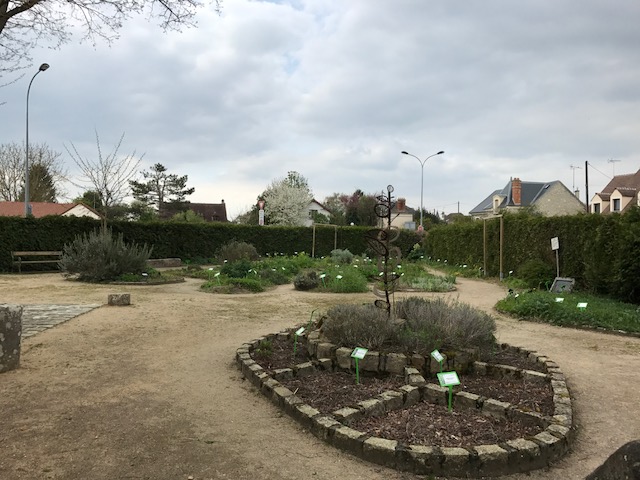

It turns out that the garden around the chapel is still planted with such herbs, each in a separate plot well tended by the village’s committee of volunteers, of which this man is a leading member.  And each plot is marked with a small sign indicating what herb it contains.
Peppermint


The renovation was necessary to save the paintings that Cocteau was commissioned to make in the late 1950s as a way of providing symbolic imagery for the plain interior of this old stone chapel, which had been abandoned for some years.


Cocteau used simple bold strokes, herbal designs, and earth-tone and plant-tone colors to symbolize the veneration of Saint Blaise.


There is a small statue of the saint with a plant-like bishop’s staff in his hands,
and Cocteau’s own tomb is in the middle of the chapel floor with a simple inscription “Je reste avec vous”--I remain with you.  There is also a small framed photograph of the artist.

Outside the building, our guide took us from one plant to another, explaining what each might be used for.  And at the end of a tour that lasted nearly an hour (during which Anne took the photos featured here), he accompanied us back to the parking lot. Francoise suggested that we might get in touch with his friend after we returned to Boston. 

“Unfortunately,” he said, “I don’t have his contact information with me.” Francoise replied, “Why don’t you give me your e-mail address, and then we can pass that information on to our American friends.”

As he dictated his e-mail address to Francoise, and I watched her writing, I realized I was about to provoke yet another surprised look from our new friend.

“So you are Bernard?” I asked.

“Yes, my name is Bernard.”

“Well, I am also Bernard.”

“”Ah non!  It’s not possible!” his face suggested that we had presented one too many coincidences.  But he also looked very pleased.


After that Anne proposed a picture of Francoise standing with the two Bernards, and then we drove off as he waved his farewell.
The Two Bernards and Francoise (Anne Connaughton photos)


It struck me, as I reflect upon this visit, that a sort of instant bond between total strangers had sprung up simply due to two converging factors.  First, was the fact that a war had brought someone from my hometown to his hometown, thus creating a physical link that none of us knew in advance.  Second was the fact that, as Catholics, we strangers already shared--before we even talked about it--a tradition that included one particular spiritual practice, which had in turn given birth to this chapel and created a common interest among us. 

We call that war "World War II" precisely because it engaged people from such far reaches.  And we call the Church “catholic” because it aspires to be a universal community that embraces the entire human race across the globe. 

In the final analysis then, it is actually not so very strange that a 4th century bishop from what is now Turkey would inspire a modern artist’s work in a building in what is now central France, and then trigger a new friendship between a resident of the village and two visitors from across the sea. In that sense, it is not too surprising, after all, that someone who spent his life in a small French village, volunteering his time to attend a small herbal garden around an ancient stone chapel, would one day come across two visitors from 3000 miles away who shared his interest in honoring a saint who himself had lived long ago and far away.  It's a very catholic (and Catholic) thing.


© Bernard F. Swain PhD 2017

Tuesday, July 2, 2013

#395: The Burden of Proof--Part 2

How the new burden of proof challenges the Catholic Church to honor its own teachings.
 
Now that the Supreme Court has entered the same-sex marriage debate, we have reached a tipping point where voter opinion matters less than the constitutional question of how to justify discrimination that denies gays a civil right.
Now, suddenly, the burden of proof is on those defending the traditional definition of civil marriage.  Now, to make their case, they must prove Bishop Vigneron’s assertion that re-defining civil marriage will “hurt us all.”
Having the burden of proof means that mere assertions will no longer work. They will have to demonstrate concrete harmful consequences.
This is exactly the burden of proof that courts have been demanding for 10 years.  And it is the burden of proof that defenders of “one man and one woman” have been failing to meet in case after case.  So in 2003 the Massachusetts Supreme Judicial Court addressed the Department of Public Health’s case against gay marriage and concluded:
The department has had more than ample opportunity to articulate a constitutionally adequate justification for limiting civil marriage to opposite-sex unions. It has failed to do so…It has failed to identify any relevant characteristic that would justify shutting the door to civil marriage to a person who wishes to marry someone of the same sex….The absence of any reasonable relationship between, on the one hand, an absolute disqualification of same-sex couples who wish to enter into civil marriage and, on the other, protection of public health, safety, or general welfare, suggests that the marriage restriction is rooted in persistent prejudices against persons...
In this week’s DOMA case, the Supreme Court first noted that DOMA (Defense of Marriage Act) denied gay people their rights by discriminating against them:
The Act’s demonstrated purpose is to ensure that if any state decides to recognize same sex marriages, those unions will be treated as second-class marriages for purposes of Federal law.  This raises a most serious question under the Constitution’s Fifth Amendment….  DOMA writes inequality into the entire United States code.
It then noted the clear and concrete harm from such discrimination: cutting off gay couples from the benefits contained in more than 1000 Federal laws pertaining to “social security, housing, taxes, up to criminal sanctions, copyright, and veterans’ benefits,” as well as health care, bankruptcy, and even children’s benefits.
Next the court reiterated that denying such rights is a major constitutional violation:
DOMA is unconstitutional as the deprivation of the liberty of the person protected by the Fifth Amendment of the Constitution.
Finally it concludes that no defender of DOMA had proved any justification for such a breach of rights:
DOMA singles out a class of persons…The Federal statute is invalid, for no legitimate purpose overcomes the purpose and effect to disparage and injure.
Similarly, in the ruling about California’s Proposition 8, the Court failed to find justification for that law’s ban on gay marriage.  In fact, the absence of such proof led the Court to conclude that those defending the ban had no business in court at all--that is, no legal “standing”:
It is not enough that the party invoking the power of the court had a keen interest in the issue.  That party must also have “standing,” which requires, among other things, that it had suffered a concrete and particularized to injury….We find the petitioners do not have standing.
Once again, the point is that discrimination requires some extraordinary justification:
The equal protection clause requires the state to have a legitimate reason for withdrawing a right or benefit from one group but not others…This requires the litigant to prove that he has suffered a concrete and particularized injury that is fairly traceable to a challenge to conduct, and is likely to be redressed by a favorable judicial decision.
And, the Court concluded, the petitioner never met this burden of proof:
The only individuals who sought to appeal that order were petitioners, who had intervened in the district court.  But the district court had not ordered them to or refrained them from doing anything…. Here… The petitioners have no “direct stake” in the outcome of their appeal.
All this demand for proof of “concrete and particularized injury” could well be too high a burden of proof for Catholic officials to meet. Perhaps it is time that they remind themselves of two things: (1) The difference between civil marriage and the Sacrament of Matrimony, and (2) Catholic teaching on homosexuality.  Until now, the bishops’ strategy has ignored both.
Catholic teaching says homosexuals must be treated with the same respect and dignity as anyone else.  It condemns any “unjust” discrimination against gay people.  If we apply this teaching to the question of civil marriage after 10 years of debate, two things are clear.
First, it is now well established in American law that access to civil marriage is a civil right, which means laws banning gay couples from civil marriage deny gays their rights and are a form of discrimination.
Second, to continue supporting such bans the Catholic Church would need to prove that such discrimination is not “unjust,” since the Church itself condemns that.  It would have to argue that such discrimination is justified because of the harms caused by allowing same-sex civil marriage.  And to do that, it would need to come up with much stronger proof than the courts have seen so far. Is that possible?
Clearly the burden of proving such a case is heavy indeed.  It seems to me that church officials have now three choices:
(1) They can cling to the arguments they had been using for 10 years: pretending that civil marriage is the same as the Sacrament of Matrimony, (even though the first is administered by the priest acting as an agent of the state, and the second is administered by the couple acting as ministers of the Church), and pretending that any change will “hurt us all.” This option guarantees failure.
(2) Or, they can marshall better evidence showing  that redefining civil marriage to allow gay marriage creates concrete harm, and accept the burden of proving that to the American public and the courts.  Legally, this is the only way to stop gay marriage, now that they courts have determined that this is not a matter of majority will but a matter of civil rights. But proving such harm is a tall order, especially since 10 years of gay marriage have convinced growing millions of Americans that no harm has resulted. 
(3) Or, finally, they can acknowledge that civil marriage has taken a historical fork in the road that diverges from the Sacrament of Matrimony, creating two very different institutions—one a civil right governed by the U.S. Constitution, the other a sacrament governed by Catholic tradition.
They can get priests out of the civil marriage business (one wonders: why are they in it at all?). 
They can admit that banning gay civil marriage equals discrimination, and they can also admit that the burden of proof to justify such discrimination has become an impossible task. 
Thus they can conclude that allowing gays access to civil marriage is an act of justice that treats homosexuals with all the respect and dignity that Catholic teaching promises them.
Then the bishops can focus on strengthening the Sacrament of Matrimony, a task they seem to have forgotten.
  © Bernard F. Swain PhD 2013


Sunday, June 30, 2013

#394: The Burden of Proof--Part 1

The Supreme Court has shifted the burden of proof in the debate over same-sex marriage.

When I began writing CrossCurrents in 2003, America’s debate over same-sex marriage was just heating up.  Almost immediately, the American Catholic hierarchy made protection of the status quo on marriage a top priority.  They have spent 10 years losing ground, and this week’s Supreme Court rulings confirm what has been clear for some time: the burden of proof is now on the US Bishops and anyone else trying to resist this change.
My doubts about the bishops’ strategy are not new.  In my early CrossCurrents pieces on this issue, I advised that the bishops back civil unions for gays, as Pope Francis did in Argentina.  After the Massachusetts Supreme Judicial Court overturned a ban on civil marriage licenses for same-sex couples in 2003, I observed that it was time for the U.S.  Catholic Church to get out of the civil marriage business (in which priests act as agents of the state) while the getting was good, in order to focus on the Sacrament of Matrimony.  I wrote:

The bishops could have drawn a sharp line between “civil marriage” and the “Sacrament of Matrimony”. Then they could have defended the unique meaning of Christian marriage against evolving, secular versions of civil marriage. Instead, the bishops chose to meet the court on its own turf, arguing that the good of society depends on denying same-sex couples, and lobbying against any broadening of civil marriage.

Thus the bishops dug in their heels by talking about “marriage” as though civil marriage and sacramental Matrimony were the same institution, while launching scary warnings about the woes to follow us if gays were to marry one another.

Ten years later, the rising tide has eroded the bishops’ stand, yet they cling to the same losing strategy.  Immediately after the Supreme Court killed the Defense of Marriage Act (DOMA) this week and reinstated a California court’s ruling in favor of gay marriage, Catholic bishops quickly sprung into reaction.  Predictably, they offered only more of the same losing strategy.

Archbishop Alan Vigneron of Detroit said:

Catholics and millions of our fellow citizens will continue to make the case…that marriage cannot be redefined, and that attempts to do so hurt us all.

And Archbishop Salvatore Cordileone of San Francisco hammered away on the theme of the “truth about marriage”:

The federal government ought to respect the truth that marriage is the union of one man and one woman, even where states fail to do so. The preservation of liberty and justice requires that all laws, federal and state, respect the truth, including the truth about marriage...The common good of all, especially our children, depends upon a society that strives to uphold the truth of marriage. Now is the time to redouble our efforts in witness to this truth.

The Bishops’ problem is very simple: by confusing the two institutions of matrimony and civil marriage, they’ve replaced the facts with wishful thinking.  They want to make their case on two grounds: (1) there is one unique, non-negotiable truth about “marriage,” and (2) changing our definition of marriage will “hurt us all.” But both these arguments have become less and less credible over time.

Actually, the “truth about marriage” argument was never very convincing.  It only worked as long as people pretended that “marriage” referred to one thing rather than two different institutions, as I wrote earlier:

Many Catholics can’t tell civil and sacramental marriage apart. They may not realize that in fact civil marriage is a great deal older than sacramental marriage: it existed in archaic cultures, in Egyptian and the Israelite cultures, in Greek and Roman cultures, all before St. Paul ever taught that marriage could be understood as a sign of Christ’s bond with his church. Civil marriage took various forms, with various rules (Israelite men were sometimes required to marry their brother’s widow; Roman men were permitted extra-marital sex with slave-women; Greek men were permitted extra-marital sex with boys). Such rules evolve even within a culture, of course: not long ago most states forbade marriage by mixed-race couples.

But while the Bishops failed to acknowledge this truth, Massachusetts Chief Justice Margaret Marshall stated it plainly in her landmark Goodrich opinion legalizing same-sex marriage:

We begin by considering the nature of civil marriage itself. Simply put, the government creates civil marriage. In Massachusetts, civil marriage is, and since pre-Colonial days has been, precisely what its name implies: a wholly secular institution…No religious ceremony has ever been required to validate a Massachusetts marriage.

The truth is that “civil marriage” is an invention of the government, and different governments have defined it differently for centuries.  Moreover, this re-defining has included the evolving recognition that civil marriage, unlike the Sacrament of Matrimony, is a civil right that people make claim access to as a matter of justice:

The benefits accessible only by way of a marriage license are enormous, touching nearly every aspect of life and death. The department states that "hundreds of statutes" are related to marriage and to marital benefits...It is undoubtedly for these concrete reasons, as well as for its intimately personal significance, that civil marriage has long been termed a "civil right."

Without the right to marry…one is excluded from the full range of human experience and denied full protection of the laws…Because civil marriage is central to the lives of individuals and the welfare of the community, our laws assiduously protect the individual's right to marry against undue government incursion. Laws may not "interfere directly and substantially with the right to marry…"There can be no prohibition of marriage except for an important social objective and reasonable means."

There are two consequences of this fact.  First, civil marriage is now being drawn into the general history of civil rights.  Second, this history now challenges Catholic teaching to practice what it preaches about the just treatment of homosexuals.

First, on general history, Marshall wrote:

The history of constitutional law "is the story of the extension of constitutional rights and protections to people once ignored or excluded."…This statement is as true in the area of civil marriage as in any other area of civil rights.

In this week’s DOMA case, the Supreme Court saw this at work as well in New York State:

The limitation of lawful marriage to heterosexual couples, which for centuries have been deemed both necessary and fundamental, came to be seen in New York and certain other states as an unjust exclusion…New York acted to enlarge the definition of marriage to correct what its citizens and elected representatives perceived to be an injustice they had not earlier known or understood.

This movement linking civil marriage to all other civil rights explains the rising tide of court decisions favoring a new definition of marriage.  For if keeping the “one man and one woman” definition means denying gay people in a civil right, the question arises: how can that be justified? It becomes a matter of justice.

This explains why the movement to accept same-sex marriage has been so rapid: from one state in 2003 to 13 and counting in 2013. Now 40% of gay Americans already have access to this civil right, and the rest are demanding to know why they should be denied their rights.

This has dramatically shifted the burden of proof away from those proposing change; they now have both the rhetoric and the reality of civil rights on their side.

NEXT: How the new burden of proof challenges the Church to honor its own teachings.

  © Bernard F. Swain PhD 2013