WELCOME !


WELCOME! CrossCurrents aims to provoke thought and enrich faith by interpreting current events in the light of Catholic tradition. I hope you find these columns both entertaining and clarifying. Your feedback and comments are welcome! See more about me and my work at http://home.comcast.net/~bfmswain/onlinestorage/index.html or contact me directly at bfswain@juno.com NOTE: TO READ OR WRITE COMMENTS, CLICK ON THE TITLE OF A POST.

Showing posts with label World War II. Show all posts

Monday, June 10, 2019

#477: D-Day Reflections


A tough question for 21st century Catholics.


On this 75th anniversary of the landings at Normandy, I am reflecting on comments made by a reader following my last CrossCurrents posting, about the fire at the Cathedral of Notre-Dame, which also included my comments about Armistice day as it has been observed in Europe,  and my dissatisfaction with the way the date is observed in the United States.  In response I got this comment:

“Would that WWI had truly been the "war to end all wars." Each year, I, too, recognize the historic moment, 11-11-11, and would much prefer that world peace had prevailed since then.

At the same time, I believe that those brave souls who "visited" France on 6-6-44, via the beaches at Normandy, or who parachuted onto French soil behind enemy lines  deserve our respect for their service, not necessarily "praise as warriors." If not for their selfless courage, might not Hitler and his Nazis have had their way....and what then, of Notre Dame Cathedral?”

For me this comment raises an important question: how should we, as Catholics and Christians, regard those who have served in the military?  The question is important because the answer is complex and reveals a contrast between Christian identity and national identity.

My own reflections are personal because they are rooted in both my faith in my family.  My father and five of his brothers served in WWII.  A sixth brother served in Korea, and a seventh - - the youngest--died during active service in the US marines.  Their only sister was also married to a WWII veteran.

Do I recognize that many serving in WWII sacrificed a great deal, and even life itself, for their country?  Yes, of course!  But then the matter is more complex than that.

In my previous blog I mentioned attending Armistice Day services in Paris when I was a student.  On November 11, 2010 I also attended services in Chartres, as part of a reunion group.  We arrived on the train and immediately, next to the station, we came across found a small ceremony at a WWI memorial.  Some texts were read, a wreath was laid, and then one man - - an elderly war veteran--stepped forward and spoke.  He said this day mattered to remind us that the men who died in WWI could only be honored if we commit to ending war.  He said their sacrifice proved, as he too had learned in combat, that “the barbarism of war is an unacceptable way to resolve conflict.” He implored all of us to take that message with us.

I have not often heard an American veteran deliver this kind of speech on Veterans Day.  And it seemed to me that his point was worth repeating: those who die in any war die in vain unless we overcome war itself.  If not, their sacrifice only brings us brief respite before the next war begins.  I say “brief,” since the U.S. has not had a generation without war in more than 120 years. 

I suspect that French veteran would recognize that sometimes war is a necessary evil. This acknowledges, just like the Catholic “just war theory,” that war is always evil, but sometimes unavoidable. Yet since WWII, our nation has engaged in many “wars of choice”—conflicts engaged, not in self-defense (although that has usually been the pretext) but to serve other men’s goals.

And the just war theory also demands that, even when war is unavoidable, its conduct must also meet certain moral standards.  We often think of World War Two as “the good war,” but of course the reality was more complex than that.

Did the men who landed on Omaha Beach display uncommon courage and sacrifice?  Yes--but we must recall that not all who served in WWII were on the beaches of Normandy. 

In any war, those who serve have missions—and we should never confuse their service or their sacrifice with the mission they perform. The men on the Normandy Beaches were sent to fight a well-armed and fortified occupying army that had invaded France. But not all in WWII had such honorable missions. Some who served were sent to firebomb Dresden, killing tens of thousands of terrified civilians. Some were sent to firebomb Tokyo, killing even more civilians. Some were sent to drop the A-Bomb on Hiroshima, and others were sent to drop it on Nagasaki. More than 100,000 civilians were killed in minutes, and countless more died over the following years. All soldiers serve their country, but not all missions are equal.

During one parish meeting after 9/11 an older man approached me during the break. He had served on an unnamed Pacific island in WWII. When it was time for his company to move out, the commander gathered all the prisoners of war they were holding and ordered this man and his mates to shoot them. And this man and his mates shot them. All of them. All dead. In cold blood. By 2001 this man, now in his 80s, had long realized his guilt would haunt him to his grave.

Yet we like to think of World War Two as the “good war.” If that is our idea of good, then the realities about Korea, and Vietnam, and Iraq, and Afghanistan are even more morally fraught.

Those who serve in the military serve policies made by other men, usually older men (and now sometimes women).  They must obey orders that come from others.  Some soldiers may kill, or be killed, in ways we can justify. Others end up committing crimes against humanity.

Whatever the case, the soldiers have this in common: they are cogs in the machine of war. They do what others want—and often those others want evil things.  Even many who survive never really recover. My WWII parishioner never did, and two of my family members suffered permanently from Vietnam. Many veterans now with PTSD suffer pain that is mainly, not physical or psychological, but moral.

So while I recognize we can honor the sacrifice of those who served in the military, for me that honoring is always with a remorseful, even mournful spirit.  For me, this is never a matter for marching bands, cheering, applause, and flyovers. “Taps” for the deceased and a silent salute for the survivors seem better to me.

Recognizing the sacrifices of D-Day is perfectly reasonable, especially on the 75th anniversary of the landings.  But we dishonor the heroes of that day if we pretend that all other soldiers were equally courageous, that all others performed with equal honor, or even that all others were heroes. 

One of the tragedies of our time is that thousands of Americans have died or been maimed or traumatized while serving their country under the pretense that they were protecting our freedom when in fact, in a case like the invasion of Iraq, no threat to our freedom even existed.

Such people served their country, often at great cost, and they deserve our respect. But if we pretend that we benefited from their service, if we pretend they protected us from some phony evil, if we pretend that those who died did not die in vain, then we blind ourselves to the reality that if war is sometimes a necessary evil, more often it is an unnecessary evil.  Victory does not justify such deaths; in the long run, the real enemy is war itself. 

This was the lesson of the original Armistice Day. World War One ended on “The 11th hour of the 11th day of the 11th month” in 1918 because Maréchal Ferdinand Foch, the Supreme Allied Commander, chose the feast of Saint Martin of Tours, a soldier who resigned to become the patron saint of the poor and of peace.  His feast is about repenting wars, not praising its heroics.

It is right and just that we honor the soldiers who fought on D-Day, and especially good if we do it by memorializing their sacrifice with gratitude but also with remorse that their sacrifice was ever necessary. But we also mourn the sacrifice of those many soldiers serving in “wars of choice,” whose sacrifice was never necessary.

We Catholics are taught to hate the sin, but love the sinner. So even as we honor these people, we hate what they were made to do in our name.
© Bernard F. Swain PhD 2019

Thursday, June 1, 2017

#466: A Surprisingly “catholic” Encounter


  Catholic spirituality is much like a vast global forest. This is the story of just one tree.
I spent part of the 2016-2017 academic year leading a group of young participants through the RCIA (the Rite of Christian Initiation of Adults).  They were preparing to become Catholics, and my role was to familiarize them with the core elements of Catholic tradition.  One topic was the multiplicity of customs, beliefs, and practices that comprise the rich tapestry of Catholic spirituality. They were amazed to learn how Catholics through history have attached themselves to small practices that shape their faith life in hundreds of varied ways.

My recent trip to France with my wife Anne offered a perfect opportunity to explore one striking example of such practices: the blessing of throats on the feast of Saint Blaise (February 3).

During a day trip south of Paris, we drove to the small town of Milly-la-Forêt to visit a tiny chapel celebrated for its décor, painted by Jean Cocteau. 

We were not even sure the chapel would be open on a weekday afternoon, but as we approached the parking lot I noticed an older man walking away from the chapel carrying a ring of keys to his car.  We stopped and, as I walked toward him, I called out “Monsieur, would it be possible for us to visit the chapel?”

He began walking to us with an apologetic look on his face.  “I am very sorry,” he said.  “I am afraid that will be impossible. The chapel is undergoing renovations, and the technicians are just now at work inside while it is close to the public.”

Even before I could express my own disappointment, our local host Françoise spoke up: “But surely, Monsieur, you cannot refuse these two visitors, who have come all the way from the United States to visit this chapel!”

At this point the man got the first of several surprised looks on his face.  “You are visiting from America?” When we nodded, he went on. “You know, the Americans came through this very village during the Liberations on their way to Paris from the south.  And after the war I became friends with one of the GIs, because he married a local girl and took her back to live in Boston.”

When I quickly observed that we also live in Boston, the man’s face showed surprise a second time.  “No, really? I have always felt attached to the Americans because of Patton’s army coming through here.” I offered the further information that General Patton himself was a resident of the Boston area, and that there is a park named for him on the North Shore where to this day there sits a genuine Patton tank.

The man’s third surprised look was accompanied by a shrug.  “In that case, Madame is correct,” he said, nodding to Francoise. “I cannot refuse you your visit to the chapel.  Follow me.”


As it turned out, the chapel in question is in fact the chapel of Saint Blaise, who was Bishop of Sebastea (in historical Armenia, now modern Sivas, in Turkey) in the 4th century.  When I recalled my childhood experience of the blessing of the throats on the feast to Saint Blaise, the man shifted gears.  From that moment on he would not simply be opening the door to the chapel.  He would be providing a detailed guided tour of the chapel and the surrounding garden.


“Of course, that blessing was done with two candles on the throat,” he said, demonstrating with his fingers set into the shape.  “At the same time the following blessing is given: ‘May Almighty God at the intercession of St. Blaise, Bishop and Martyr, preserve you from infections of the throat and from all other afflictions.’ That’s because of the legend: Saint Blaise was supposed to have saved a choking child by touching his throat.”


We wondered why the name over the chapel was Saint Blaise des Simples. Our guide explained. “That’s because, in French, “simples” refers to medicinal herbs, plants that promote health.  And that explains the link between the saint and the chapel.  You see, due to his legend, he became a patron saint of good health, especially of healthy herbs--and this village of Milly-la-Forêt has, since the 10th century, enjoyed a wide reputation for the medicinal herbs grown here.  So the link between Saint Blaise and this place made a dedicated chapel a natural idea.”


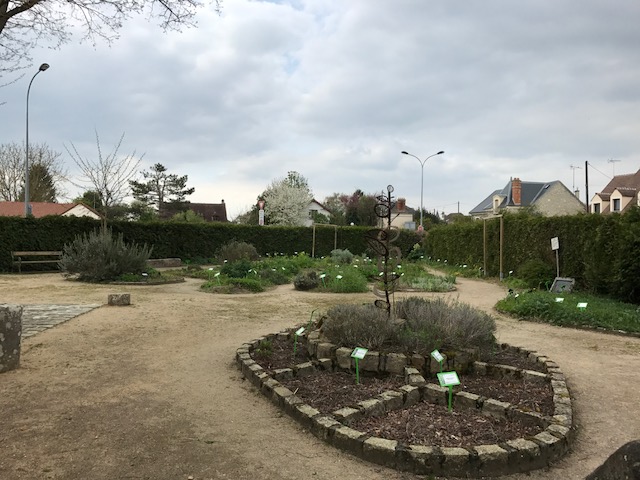
It turns out that the garden around the chapel is still planted with such herbs, each in a separate plot well tended by the village’s committee of volunteers, of which this man is a leading member.  And each plot is marked with a small sign indicating what herb it contains.
Peppermint


The renovation was necessary to save the paintings that Cocteau was commissioned to make in the late 1950s as a way of providing symbolic imagery for the plain interior of this old stone chapel, which had been abandoned for some years.


Cocteau used simple bold strokes, herbal designs, and earth-tone and plant-tone colors to symbolize the veneration of Saint Blaise.


There is a small statue of the saint with a plant-like bishop’s staff in his hands,
and Cocteau’s own tomb is in the middle of the chapel floor with a simple inscription “Je reste avec vous”--I remain with you.  There is also a small framed photograph of the artist.

Outside the building, our guide took us from one plant to another, explaining what each might be used for.  And at the end of a tour that lasted nearly an hour (during which Anne took the photos featured here), he accompanied us back to the parking lot. Francoise suggested that we might get in touch with his friend after we returned to Boston. 

“Unfortunately,” he said, “I don’t have his contact information with me.” Francoise replied, “Why don’t you give me your e-mail address, and then we can pass that information on to our American friends.”

As he dictated his e-mail address to Francoise, and I watched her writing, I realized I was about to provoke yet another surprised look from our new friend.

“So you are Bernard?” I asked.

“Yes, my name is Bernard.”

“Well, I am also Bernard.”

“”Ah non!  It’s not possible!” his face suggested that we had presented one too many coincidences.  But he also looked very pleased.


After that Anne proposed a picture of Francoise standing with the two Bernards, and then we drove off as he waved his farewell.
The Two Bernards and Francoise (Anne Connaughton photos)


It struck me, as I reflect upon this visit, that a sort of instant bond between total strangers had sprung up simply due to two converging factors.  First, was the fact that a war had brought someone from my hometown to his hometown, thus creating a physical link that none of us knew in advance.  Second was the fact that, as Catholics, we strangers already shared--before we even talked about it--a tradition that included one particular spiritual practice, which had in turn given birth to this chapel and created a common interest among us. 

We call that war "World War II" precisely because it engaged people from such far reaches.  And we call the Church “catholic” because it aspires to be a universal community that embraces the entire human race across the globe. 

In the final analysis then, it is actually not so very strange that a 4th century bishop from what is now Turkey would inspire a modern artist’s work in a building in what is now central France, and then trigger a new friendship between a resident of the village and two visitors from across the sea. In that sense, it is not too surprising, after all, that someone who spent his life in a small French village, volunteering his time to attend a small herbal garden around an ancient stone chapel, would one day come across two visitors from 3000 miles away who shared his interest in honoring a saint who himself had lived long ago and far away.  It's a very catholic (and Catholic) thing.


© Bernard F. Swain PhD 2017