WELCOME !


WELCOME! CrossCurrents aims to provoke thought and enrich faith by interpreting current events in the light of Catholic tradition. I hope you find these columns both entertaining and clarifying. Your feedback and comments are welcome! See more about me and my work at http://home.comcast.net/~bfmswain/onlinestorage/index.html or contact me directly at bfswain@juno.com NOTE: TO READ OR WRITE COMMENTS, CLICK ON THE TITLE OF A POST.

Showing posts with label France. Show all posts

Saturday, April 27, 2019

#476: Why Notre-Dame de Paris Matters

A simple building fire provokes world-wide grief.
Mere minutes after the spire of Notre-Dame toppled in flames, a TV journalist asks a by-standing historian about the importance of the cathedral’s treasures.  During her reply he suddenly interrupts: “We’re just getting some sobering news.  The firefighters now say they may not be able to save the cathedral.”
“What?!?” Is the stunned reply.
He repeats himself; what follows is deep long silence.  The eyewitness is literally struck dumb by the prospect of losing Notre-Dame de Paris.
In the end, the building was saved after the roof was lost.  And no one died. 
Objectively, this was not the worst tragedy of recent days.  The Sri Lanka Easter Sunday attacks, the Christchurch mosque shootings--these cost human lives.  France’s Yellow Vests even protested the idea of spending one billion Euros to rebuild Notre-Dame while they struggled to pay their monthly bills in an unequal society.  One commentator even complained about people “whining over an old church.”
This begs a basic question: why such an outpouring of grief over this fire?  Why so many Facebook posts proclaiming a broken heart?
It has taken me more than a week to name why.  The answer is less objective but no less real. Global communications frequently gives us horrific images of tragedies happening halfway round the world, but that suffering and loss--even the deaths--mainly touch those who know the people or places involved.
Notre-Dame is different:  as a simple matter of fact, millions of people took it personally. They took the fire itself as a personal emergency, took the prospect of losing the whole building as a personal tragedy, and took the building’s final rescue as a personal existential relief.  And even so, for millions the sight of the smoking ruins remains heartbreaking. As one American Paris resident put it: “I felt as if I were losing a loved one, member of my family.”

Such global personal reactions are rare.  In my memory, only a sudden shocking loss of life has triggered such widespread heartache:  The assassinations of John F. Kennedy, Bobby Kennedy, and Martin Luther King, Jr.  The death of Princess Diana.  The collapse of the twin towers on 9/11—not because the buildings were destroyed, but because of horror for the people inside.
How could a simple “building fire” have a similarly profound emotional impact on millions?  What is this building’s power?  Why did its threatened loss provoke such personal grief?
For French Catholics, of course, the answer is obvious: Notre-Dame is the center of their nation’s faith life.  For other French, the cathedral represents their national identity across centuries--no other building rivals it.  For others, the reasons are more varied.  No one visits Paris without visiting Notre-Dame.  Few people return to Paris without returning to it. It attracts some by its history, others by its symbolic power, still others by its sheer beauty. For some it is an expression of faith, and for others a marvel of medieval construction and creativity.  As one observer said: “No one encounters Notre-Dame and walks away in different.”
For me too, the fire caused a heartsick reaction echoed by only a few moments in my life.  But in my case a personal attachment to the cathedral is easier to explain.  As a student in France, Notre-Dame de Paris became my home church (it was a ten-minute walk from my school) and it has left me with a parade of personal memories. 
My first Mass in Paris was at Notre Dame, a 6:00 p.m. liturgy following a concert by the world-renowned organist Pierre Cochereau. His playing drew a near-capacity crowd, and I was chagrined when, after the music, most people promptly exited to avoid Mass. I suddenly found myself surrounded by a scattered remnant of worshippers, mostly little old ladies in black. Not only that, the Mass itself was in French (the recent fruit of Vatican II’s liturgical reforms)—I still did not know how to worship in French.
Overall, this first visit reinforced my sense of shifting values: the Church was become more pluralized, and the culture was becoming more secular. I also saw that church beauty was not limited to the white-steeple, plain-glass Protestant churches I grew up with in New England.
My second visit was an entirely different matter, an affair of state. My landlady was a WWII widow, and in October she received an invitation to celebrate the Solemn Mass and Te Deum marking the 50th anniversary of the 1918 Armistice with President Charles De Gaulle on November 11. Since she planned to spend the holiday at her sister's in Caen, she gave me the invite, and I invited a classmate along.
We entered Notre Dame by the south transept door, walked entirely around the backside of the altar, and squeezed into a spot on the other side, against the main column at the intersection of the transept and the sanctuary (one of the four columns bearing the weight of the spire that collapsed!).
There happened to be a spare wooden barrier leaning against the column, and I climbed atop it so see over the masses assembled for the Mass.
When De Gaulle arrived up the nave through the arched swords of the Garde Républicaine, he was enthroned against the column diagonally opposite us.  Several moments during the ceremony, de Gaulle, who faced us squarely, was looking directly at me—a young student perched on a barrier mere weeks after the protesting students’ barriers had been removed from the streets of the Quartier Latin! He did not look amused.
At ceremony’s end dignitaries recessed beneath the arched Garde swords. I noticed the sanctuary gates to the nave remained open, so I led my classmate across the sanctuary to the head of the nave and WE passed under the arched swords to the amazed stares of many lesser dignitaries still in their seats.
Needless to say, the experience left a permanent mark, and 11-11 remains a significant date for me. I regret not making it making it to Notre Dame this past November for the 100th anniversary--but I regret more that the US now observes "Veterans Day" as a generic honoring of soldiers, rather than observing the historic moment, on "the 11th hour of the 11th day of the 11th month” in 1918, when the world began to think that the real enemy is war itself. What was begun as a day to reject war has become, for us, a day to praise warriors. Which makes this memory that much more precious: for me, November 11 will always be about the ending of war. And my lasting image will always be of Notre-Dame on November 11, 50 years ago.
Over the years I have returned many times, often for the pleasure of introducing Notre Dame to those close to me. I brought Anne there during Christmas break 1971-1972. In 2003 we brought our son Tim into the city during his birthday break from studies in Barcelona. Exiting the metro station I deliberately chose the stairway that made the facade of Notre-Dame his first sight of Paris. He never forgot that moment, nor the tour we made around and inside, and he recently returned with his own girlfriend to share his pleasure as I had shared mine.
In 2005 I brought my brother Jay and his wife Janice there. Later Jay said he found Paris more charming than expected (high praise from someone then working in Venice!), in no small part thanks to Notre-Dame.
In 2010 I organized a reunion of Paris classmates, and my visit ended with dinner on the Ile Saint-Louis with the widow of my old school’s director. Walking away afterward, Anne and I found ourselves directly behind Notre-Dame. The photo conveys some of the cathedral's contagious glow.

In 2011 I returned for November 11, but instead of the traditional Armistice ceremonies, I found the cathedral jam-packed for the annual Paris celebration in honor of the French overseas dioceses of Antigua, Martinique, and Guadalupe. The congregation was largely black, mostly women, and many in the bright colors of traditional tribal garb. This was the first time this Mass was celebrated at Notre Dame, and the Archbishop of Paris presided.
The main area was blocked off, so tourists could only pass around the side aisles. I made my way up the aisle with the tourist flow, circled counter-clockwise round behind the altar, and stopped on the far edge facing back across the sanctuary to the nave.

It was exactly the spot I had occupied on November 11, 1968!
The entire Mass was punctuated by the loud, rhythmic, drum-driven music of a large choir singing upbeat multi-part hymns in both French and the creoles of their respective countries.  Most of the hymns were high energy island melodies, with the exception of a gloriously harmonized Creole lyric set to the tune of “Amazing Grace.” The “honor guard” consisted of women bearing breads and fruits typical of their native lands.

The tourists flowing around the side aisles looked puzzled and even a bit stunned to witness the cathedral full, and in active use, and literally vibrating with the pulse and clapping of this “world music” version of folk Mass
As Mass ended, three bishops rose to briefly address the crowd.  The first drew loud applause and warm laughter by noting that, without doubt, this was the first time a black bishop had spoken to his people from the sanctuary of “This beautiful cathedral of Notre Dame of Paris.”
As I listened to these bishops—just minutes after holding black hands on both sides of me during the Our Father, exchanging signs of peace with these French Africans, and filing up with them to receive Communion in this great monument to Catholic faith—I found the moment almost unbearably moving. This cathedral is no museum—it is a living house of faith!
This cathedral is, after all, the crowning product of medieval Christendom, an era when Catholic tradition achieved a remarkable integration of imperial customs (inherited from the Roman Empire) and popular culture.  The resulting Gothic architecture created spaces that soar heavenward with impossibly “light” stoneworks in which walls and pillars are but bit players supporting the real stars: the fragile, flamboyant stained glass windows covering most surfaces. Notre Dame and its sister cathedrals across Europe are thus among the chief glories of Latin Christendom.
On this day I got to witness something new: a vibrant liturgical celebration from three third world cultures--here, in this bosom of Christendom!  Far from violating the wondrous gothic beauty of Notre Dame Cathedral, this heartfelt celebration lifted hearts much as the flying buttresses lift the stone--and the brilliant bright costumes seemed fitting reflections of the brilliant blues and reds, yellows and greens of the cathedral’s great rose windows.

Imagine: this space, built eight centuries ago, embracing anew these resurgent people still crafting a home-grown expression of their faith in the 21st century. In all its years Notre Dame of Paris had never witnessed anything quite like this. 
In 2013 I toured the cathedral with my daughter Melissa and in 2017 with Anne, her sister Patti and her boyfriend Fred. I planned our walking tour so we turned a street corner to suddenly reveal the cathedral in full sunlight.
Patti gasped with sheer pleasure, and Fred marveled (from his longtime work in construction) that such a building could even exist before steel girders and iron frames. After their tour, over dinner, he proposed marriage.
No surprise that for all these people, and for millions of others, the sight of Notre-dame in flames provoked rare pain. For them, Notre-dame matters—and the matter is personal.

© Bernard F. Swain PhD 2019

Thursday, June 1, 2017

#466: A Surprisingly “catholic” Encounter


  Catholic spirituality is much like a vast global forest. This is the story of just one tree.
I spent part of the 2016-2017 academic year leading a group of young participants through the RCIA (the Rite of Christian Initiation of Adults).  They were preparing to become Catholics, and my role was to familiarize them with the core elements of Catholic tradition.  One topic was the multiplicity of customs, beliefs, and practices that comprise the rich tapestry of Catholic spirituality. They were amazed to learn how Catholics through history have attached themselves to small practices that shape their faith life in hundreds of varied ways.

My recent trip to France with my wife Anne offered a perfect opportunity to explore one striking example of such practices: the blessing of throats on the feast of Saint Blaise (February 3).

During a day trip south of Paris, we drove to the small town of Milly-la-Forêt to visit a tiny chapel celebrated for its décor, painted by Jean Cocteau. 

We were not even sure the chapel would be open on a weekday afternoon, but as we approached the parking lot I noticed an older man walking away from the chapel carrying a ring of keys to his car.  We stopped and, as I walked toward him, I called out “Monsieur, would it be possible for us to visit the chapel?”

He began walking to us with an apologetic look on his face.  “I am very sorry,” he said.  “I am afraid that will be impossible. The chapel is undergoing renovations, and the technicians are just now at work inside while it is close to the public.”

Even before I could express my own disappointment, our local host Françoise spoke up: “But surely, Monsieur, you cannot refuse these two visitors, who have come all the way from the United States to visit this chapel!”

At this point the man got the first of several surprised looks on his face.  “You are visiting from America?” When we nodded, he went on. “You know, the Americans came through this very village during the Liberations on their way to Paris from the south.  And after the war I became friends with one of the GIs, because he married a local girl and took her back to live in Boston.”

When I quickly observed that we also live in Boston, the man’s face showed surprise a second time.  “No, really? I have always felt attached to the Americans because of Patton’s army coming through here.” I offered the further information that General Patton himself was a resident of the Boston area, and that there is a park named for him on the North Shore where to this day there sits a genuine Patton tank.

The man’s third surprised look was accompanied by a shrug.  “In that case, Madame is correct,” he said, nodding to Francoise. “I cannot refuse you your visit to the chapel.  Follow me.”


As it turned out, the chapel in question is in fact the chapel of Saint Blaise, who was Bishop of Sebastea (in historical Armenia, now modern Sivas, in Turkey) in the 4th century.  When I recalled my childhood experience of the blessing of the throats on the feast to Saint Blaise, the man shifted gears.  From that moment on he would not simply be opening the door to the chapel.  He would be providing a detailed guided tour of the chapel and the surrounding garden.


“Of course, that blessing was done with two candles on the throat,” he said, demonstrating with his fingers set into the shape.  “At the same time the following blessing is given: ‘May Almighty God at the intercession of St. Blaise, Bishop and Martyr, preserve you from infections of the throat and from all other afflictions.’ That’s because of the legend: Saint Blaise was supposed to have saved a choking child by touching his throat.”


We wondered why the name over the chapel was Saint Blaise des Simples. Our guide explained. “That’s because, in French, “simples” refers to medicinal herbs, plants that promote health.  And that explains the link between the saint and the chapel.  You see, due to his legend, he became a patron saint of good health, especially of healthy herbs--and this village of Milly-la-Forêt has, since the 10th century, enjoyed a wide reputation for the medicinal herbs grown here.  So the link between Saint Blaise and this place made a dedicated chapel a natural idea.”


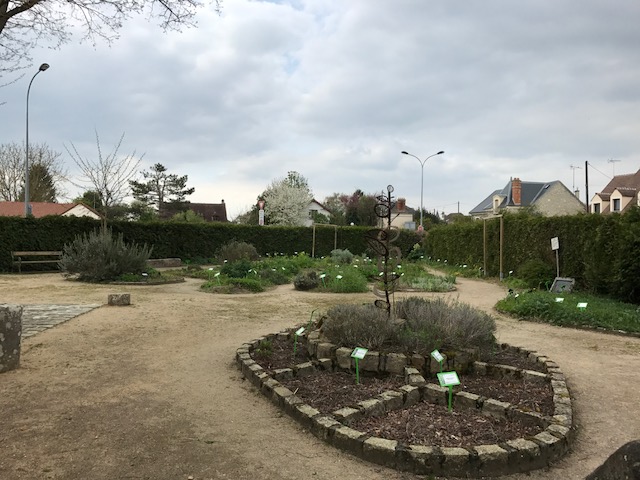
It turns out that the garden around the chapel is still planted with such herbs, each in a separate plot well tended by the village’s committee of volunteers, of which this man is a leading member.  And each plot is marked with a small sign indicating what herb it contains.
Peppermint


The renovation was necessary to save the paintings that Cocteau was commissioned to make in the late 1950s as a way of providing symbolic imagery for the plain interior of this old stone chapel, which had been abandoned for some years.


Cocteau used simple bold strokes, herbal designs, and earth-tone and plant-tone colors to symbolize the veneration of Saint Blaise.


There is a small statue of the saint with a plant-like bishop’s staff in his hands,
and Cocteau’s own tomb is in the middle of the chapel floor with a simple inscription “Je reste avec vous”--I remain with you.  There is also a small framed photograph of the artist.

Outside the building, our guide took us from one plant to another, explaining what each might be used for.  And at the end of a tour that lasted nearly an hour (during which Anne took the photos featured here), he accompanied us back to the parking lot. Francoise suggested that we might get in touch with his friend after we returned to Boston. 

“Unfortunately,” he said, “I don’t have his contact information with me.” Francoise replied, “Why don’t you give me your e-mail address, and then we can pass that information on to our American friends.”

As he dictated his e-mail address to Francoise, and I watched her writing, I realized I was about to provoke yet another surprised look from our new friend.

“So you are Bernard?” I asked.

“Yes, my name is Bernard.”

“Well, I am also Bernard.”

“”Ah non!  It’s not possible!” his face suggested that we had presented one too many coincidences.  But he also looked very pleased.


After that Anne proposed a picture of Francoise standing with the two Bernards, and then we drove off as he waved his farewell.
The Two Bernards and Francoise (Anne Connaughton photos)


It struck me, as I reflect upon this visit, that a sort of instant bond between total strangers had sprung up simply due to two converging factors.  First, was the fact that a war had brought someone from my hometown to his hometown, thus creating a physical link that none of us knew in advance.  Second was the fact that, as Catholics, we strangers already shared--before we even talked about it--a tradition that included one particular spiritual practice, which had in turn given birth to this chapel and created a common interest among us. 

We call that war "World War II" precisely because it engaged people from such far reaches.  And we call the Church “catholic” because it aspires to be a universal community that embraces the entire human race across the globe. 

In the final analysis then, it is actually not so very strange that a 4th century bishop from what is now Turkey would inspire a modern artist’s work in a building in what is now central France, and then trigger a new friendship between a resident of the village and two visitors from across the sea. In that sense, it is not too surprising, after all, that someone who spent his life in a small French village, volunteering his time to attend a small herbal garden around an ancient stone chapel, would one day come across two visitors from 3000 miles away who shared his interest in honoring a saint who himself had lived long ago and far away.  It's a very catholic (and Catholic) thing.


© Bernard F. Swain PhD 2017

Friday, April 22, 2016

#451: Why France—and Europe—Need a New Future


The triple crisis of terror attacks, refugees, and Brexit (Britain’s possible exit from the European Union) show that the EU’s original dream of a unified “Christian Europe” is over.  But a truly Christian vision could be key to building the kind of future these crises call for. 

PARIS--As the French government this week extends France’s state of emergency for two more months, the tension persists in this city following two major attacks in 15 months. 

As my bus approached Charles De Gaulle Airport last week, the driver announced a “bomb alert” that forced him to skip my terminal (A shuttle train and lots of walking got me back).  Airport security was also a good deal more rigorous than usual.  The day I flew authorities announced that last month’s Brussels attacks were originally aimed at two Paris locations--specifically, the commercial center at La Defense and an “unnamed Catholic association.” And one restaurant owner acknowledged that his business had dropped dramatically since the attacks, as tourists traffic is down.

Yet mostly Parisian life remains remarkably normal.  Clusters of Tourists toting smart phones on selfie-sticks still trudge up and down the Champs Elysees.  The famed monuments are still open and still attract long lines.  The streets and subways are still laced with pickpockets, panhandlers, and the homeless.  The Metro itself displays no obvious extra security beyond measures dating from the 1995-1996 subway bombings.  On Friday night in the Latin Quarter, at the same hour as the November attacks, young people still jam outdoor cafes and line up outside clubs. 

Some parks had extra security (the Jardin du Luxembourg was briefly locked down), as did the University of Paris (no entry to the Sorbonne’s courtyard without a student ID), but all that was for the most Parisian of reasons: widespread student street protests (this time, over a new work law threatening to alter their future working conditions). 

On the surface, then, Paris carries on largely as if nothing has happened--but everyone knows that things will never be the same. Parisians persist in their routines lest they hand victory to the terrorists by allowing them to dictate how Paris lives.  But they also know that a future fraught with constant tension and risk is not acceptable. 

So what is next? 

No one here talks of banning or restricting Muslims.  The Muslims I spoke to feel accepted, not stigmatized-- but I spoke to people already assimilated into the core of French life: shopkeepers, restaurant owners, and servers.  And obviously many Muslims in Europe have not been assimilated--not because they are Muslims, but because they are Arabs or Berbers or Turks, who carry a culture that does not match European ways.  And clearly some places--like Molenbeek, the Brussels neighborhood that proved a breeding ground for both the Paris and Brussels attackers—have become deep pockets of isolation, alienation, and resentment.  This has left some young people easily influenced or even “inspired” by those who justify violence by fraudulently invoking Islam

What has gone wrong?  Why is that resentment and anger bubbling over now? 

One opinion I heard came from a woman with decades of experience observing policymakers in both France and Europe.  Her connections include high level academic and business institutions, NATO, the EU, and the UN. 

Her response to my questions: the process of decolonization was badly managed, or even bungled. 

As she spoke I recalled my own school days in the late 1950s when every addition of “My Weekly Reader” (a current events newspaper distributed in my elementary classes) contained another story about a newly independent nation.  These included, of course, many former French Colonies, especially along the Mediterranean coast of Africa and the Middle East which the French call “The Maghreb.”

According to my French commentator, the long-term effects of ending colonialism were never really thought through.  Most Europeans agreed that independence for their former Colonies was necessary, though the mechanisms and timing were controversial and provoked both polarization and violence in France, including assassination plots against Charles De Gaulle. 

But the long-term consequences were not understood or prepared for--probably because they were never considered.  In the former colonies, this led to conflict between those content to maintain the previously imposed colonial (i.e. European) culture, and those insisting on a return to traditional, pre-colonial ways.  This included returning to a reliance on traditional religion--Islam--in lands where French-styled secularization (“laicité”) had been established for decades. 

For the colonizers, the process also brought profound change: a steady influx of formerly colonized peoples into the home country.  In France, this meant a huge influx of both blacks from central and western Africa, and an even larger influx of Arabs and Berbers from all over the Maghreb.  This process began around 1960 and continues today, accelerated by the disruptions of Al Qaeda, the U.S. invasion of Iraq, the Syrian civil war, the Arab Spring, and the rise of ISIS.

The effects on France cannot be overstated.  France has been a unified state longer than any other European country.  For centuries its monarchy worked long to impose the French language and national identity on the country’s regions.  Thus the Celts in Brittany, the German speakers in Alsace, the southerners who spoke Occitan or Italian, and even the Basques, all acquired a single official identity.  This veneer of homogeneity survived the Revolution and remains a cornerstone of French Life.  For most French, the nation’s unifier is the state itself--whether that means Louis XIV or Napoleon or De Gaulle or the current leadership. 

The assumption was that such unity would apply even to migrants from former colonies.  After all, France considered all its colonies part of France itself, and brought the French language, culture, and religion to every colonial outpost.  (To this day, residents in the remaining French possessions vote in French elections.) 

But 60 years into decolonization, France has millions of residents with colonial origins who are too young to remember colonial days.  They cannot say if colonial life was good or bad--they only know that they continue to be considered and treated as outsiders.  They learn French in school but speak Arabic or a tribal language at home and among their peers.  They have their own food, music, and customs—and their own religion.

 All this has broken through France’s veneer of homogeneity. For all the public rhetoric about recent arrivals “becoming French,” the fact is that decolonization has introduced social, cultural, and religious pluralism into a country that is neither experienced with nor committed to the kind of pluralism we already know in the U.S. 

The failure to develop an adequate process for integrating the post-colonial peoples means that many of them remain unassimilated into “the nation.” Decolonization gave them juridical freedom, but it did not give them a place in French life (much like Emancipation failed to give U.S. blacks their rightful place in American Life).

One further problem: since 1905 France has been officially a secular nation, where religious practices are subordinate to public policy.  There is no premium on religious liberty, as in the U.S.  Over the last century, the Roman Catholic Church has learned to accept this restriction, but Muslims might naturally contrast this with the open or even established practice of Islam in their lands of origin.

What can be done?

As I explained in CrossCurrents #350, the European Union has its roots in a Catholic, personalist vision for a peaceful, unified, Christian Europe.  My recent trip confirms that it is time to recast that vision before Europe breaks down.  This will take several steps.

First, the problem must be acknowledged. The legacy of colonialism is that Europe is no longer simply a “Christian continent,” even in its cultural underpinnings (let alone its actual religious practice, which has long been in decline).  Personalism can still ground a vision of European unity and peace--but not by presuming a “Christian” system.  While Europe’s heritage is undoubtedly Christian, its culture is now largely secular, and its population is now both religiously and ethnically diverse.  A new vision must include them all.  Failure to do this will perpetuate violence.

Second, public expectations of migrant populations must change.  Unlike the U.S., Europe has not been a land of immigrants--but it is now.  Not only must Europe find out how to welcome them into their midst, it must also find ways to help them belong and give them a stake in the dominant culture around them.  If they see no benefit in that culture, they will have nothing to lose by attacking it.  Thus Europe must not only accept newcomers, but also make them feel at home.

Third, integrating new peoples will be neither easy nor simple.  The New York Times, profiling the Molenbeek neighborhood, distinguished two groups of Muslims.  The Turks feel little connection to Belgian culture but also expect little, and lived in stable, mostly peaceful isolation.  But the Berbers from Morocco inherit the effects of French colonialism, speak French, understand the prevailing customs and culture, but do not feel welcomed or accepted. So their isolation is resentful and dangerous—and the attackers come from this group.

In their recent book Why Muslim Integration Fails in Christian-Heritage Societies, scholars Claire Adida, David Lattin, and  Marie-Anne Valfort argue that “anti-Muslim discrimination is a significant social phenomenon,” in France, Belgium, and the rest of Western Europe. It will take new, different policies to correct the situation.

Fourth and finally, this all means that recasting the new vision for Europe will require careful and creative planning about how to promote better integration of these new people.  This will have to include altering attitudes on sides, creating opportunities for disaffected people to invest in the surrounding culture, and inviting these people to identify as Europeans.  This in turn challenges traditional Europeans to simultaneously acknowledge their Christian heritage but then demonstrate radical Christian hospitality by welcoming their “Muslim neighbors” with open arms into a new, pluralized vision of a shared and peaceful future.
   © Bernard F. Swain PhD 2016

Thursday, November 19, 2015

#443: Can We Get From Paris to Peace?


The Paris attacks leave my head and heart full of jumbled thoughts and feelings.
Philippe and Marie-Paule were parked at the curb when I exited the Oberkampf Metro station into the cool November evening.  They had agreed to meet me for dinner at a small place I’d been wanting to try on the edge of Paris’ 10th and 11th arrondissements. 

We spent half an hour window shopping in the Place de la République (Marie-Paule was after shoes, and Philippe could always use another of his trademark garish ties).  Then we strolled up the Rue des 3 Bornes to the tiny triangle-shaped Place de la Fontaine Timbaud, with its modest green fountain--one of nearly 80 “Wallace Fountains” sprinkled across the city, named after the English philanthropist Richard Wallace, who financed their construction. They feature 4 sculpted female figures symbolizing “Kindness, Simplicity, Charity and Sobriety.”
La Place de la Fontaine Timbaud (fountain at left)
We took a window table facing the fountain and spent the next two hours relaxing into the rituals of French dining: three leisurely courses, with intervals long enough to enjoy the company, the venue, the conversation--and the wine.  It was a Friday evening, so we were in no rush.

The service was good, the food was decent, we loved the dessert (a very intense molten chocolate cake), and we were particularly pleased by the wine policy: after we left our second bottle of wine half-finished, our waiter took it back to the kitchen, measured the remainder--and billed us only for what we had drunk! 

It was a perfect way to start the weekend, and we gave no thought to our own safety. It was November 2008. 

But when news of last week’s Paris attacks broke, I checked the map and found what I suspected: that cool November Friday evening we were sitting 1000 feet north of the Bataclan Theater.  And the next street up from our table was the Rue de La Fontaine au Roi, where 5 diners  were killed at the Cosa Nostra pizzeria.

 Just 2 ½ blocks further west, two more restaurants (le Petit Cambodge and Le Carillon) were attacked, killing 15 more diners.  In other words, we sat that quiet night almost exactly half way along a line that this week connected four of the six attack sites.  All are within ½ mile of each other, and none is more than ¼ mile from our seats. 


I guess I feel like the homeowner who returns home to discover the house has been ransacked by burglars:  I  was not there at the time of the attacks (even though I had expected to make a November visit), so I am glad to be safe--but I nonetheless feel invaded and even violated.  And I would feel this way even if no one had been killed, which of course is the principle tragedy of this event. 

In this I am like many people (including non-Parisians), who are sad for the city itself as well as for the victims. Many of us share this emotional attachment, as if Paris were a second home, and as if we, so far away and safe, nonetheless feel invaded, even violated. We feel the urge to rush "home" and embrace the wounded city and those we love there.


Canal Saint-Martin
I am especially fond of this neighborhood, just outside the Place de la République, a traditionally working class neighborhood, where my best Paris friend Philippe grew up. But it is only one block from the Canal Saint-Martin, which in recent years it has become gentrified, especially for younger Parisians attracted to its many nightspots. It also borders Belleville, which has a large Arab population.

On the hill just above those four attack sites is the Parc de Belleville. On a warm weekend day the park is full of young people smoking hookahs.
Parc de Belleville
 Strolling down the stairs through the park’s lower end, one sees clusters of Arab women in long robes and head-veils, gathered together on park benches. Five minutes further down the slope are the men, standing near the Couronnes subway stop, wearing head caps and speaking Arabic.


Signs of Arab culture are everywhere. Couscous bistros and Middle-East groceries. Travel agents offering packages to Tunisia, Algeria, Morocco. Kids sporting soccer jerseys for North African and Mediterranean teams. A woman crossing the street in full-length black veil, even her face covered, holding hands with a man in white head-cap, full white robe, and basketball shoes. An Algerian pastry shop with 60 varieties of tiny pastries displayed under a glass counter. A teen-age girl wearing a full-length lavender robe over jeans, a white baseball cap, and cellular earphone. Muslim bookstores featuring religious education materials for all age groups. Tea parlors with chairs lined up with men sipping tea and smoking tall water-filled hookahs. A shop selling “Ready-to-Wear” robes and veils.

One day I noticed saw a butcher standing in his shop doorway, next to a poster advertising the “21st annual meeting of French Muslims,” sponsored by the National Union of Islamic Organizations. I noticed the conference title was written in both French and Arabic: “What is the Place for Freedom of Religion in Today’s Society?” I also noticed the conference dates had already passed.

So I introduced myself and, pleading a journalist’s interest, asked the butcher if I might have the poster. He immediately pulled it down for me, chatted amiably about the issue for a few minutes, then apologized when a voice called from within the shop.”Excuse me he said, “I must get back to my meat.”

Many "mainstream" Parisians do not even know this area, and tourists seldom see it.  Once I used a Belleville anecdote during a Parisian parish workshop. Listeners reacted with surprise: Belleville was a place they would never go.

Thus this part of Paris is a kind of symbolic venue for Euro-Arab relations.  The attacks straddled the fault line between two Paris populations, and offered a tempting, simple-minded model for the myth about terrorism that is embraced by both the terrorists themselves and many westerners on the far right.  Both agree: this is a “clash of civilizations” which requires “boots on the ground.”

This view of terror—“Islam vs. the West”—depends, of course, on ignoring the facts. 

It ignores all the Muslim victims killed last Friday. It ignores last week’s attacks in Kenya and Beirut. It ignores how much of terror does not target the west.

It depends on focusing on Paris, while ignoring Muslim on Muslim terror in Iraq, Syria, and Africa.  

One example of such ignoring: The same week when 17 Parisians were killed at Charlie Hebdo, Boko Haram murdered up to 2,000 civilians in Baga, Nigeria, and a few a days later  used a 10-year old girl as a suicide bomber to kill at least 16 people.  Those tragedies commanded much less attention—as if western lives matter more. Are we surprised if the southern hemisphere concludes that we care less about their lives?  Do we really believe that sending that message helps us fight such violence?

Such a simplistic view (“Islam vs. the West”) also ignores the fact that modern terrorism is not recent at all.  It dates at least from my student days in Paris, when “the troubles” erupted in Northern Ireland from 1969 to the Good Friday accords. It ignores the Red Brigades, the Baader-Meinhof and Munich Olympic attackers in the 1970s, the death squads in El Salvador and the Contras in Nicaragua in the 1980s, the bombers of New York (1993), and Paris (1995 and 1996), the sarin gas attacks in Japan, the Madrid bombings of 2004, U.S. drone attacks in Yemen and Pakistan, bombings in Bali and Mumbai, Boko Haram abductions and massacres, etc. In fact, terrorism as we know it probably dates from WWII, and has been a global problem without a solution for nearly 80 years.

Such ignorance brings bliss—specifically, in the appealing and powerful idea that we can wage and win a “war on terror.”  But if we wage war, can it lead to peace?

My long-time view is that the very idea of a “war on terror” leading to peace is a fraud. In 2003, Pope John-Paul II and virtually all the world's bishops (among others) predicted that the US invasion of Iraq would destabilize the entire region and worse. Indeed, the invasion killed 200,000, mostly civilians, created 2+ million refugees, and spawned a fanatical counter-attack—ISIS, led by Saddam's former subordinates—that is worse than Al Qaeda . Why are we shocked?

The brutal fact is that human history reveals an unending supply of people willing to employ evil tactics--even to kill the innocent--to gain their goals.  One cannot end terrorism by killing all the terrorists, because one cannot uproot from human nature its potential for evil. The “last terrorist” does not exist.

For me, the key notion is that terrorism IS a “counter-attack"--so we should start with the question: "WHY is there a counter-attack against us?" After all, solutions will eludes us as long as we insist on missing the point of that question (which is why all solutions attempted since 9/11 have only made things worse).

Nearly all terror attacks of the last century reflect the attackers’ resentment for perceived injustice.  That resentment has nearly always been fueled by poverty.  Arguably, terrorism and poverty go hand in hand: the more poverty, the more terrorism--and the less poverty, the less terror.

This premise cries out for urgent consideration.  For it implies that the trillions we spend on military invasions are futile--and worse, they preclude our chance to spend such resources on reducing poverty.  If the links between terror attacks and poverty are compelling--and I believe they are (just look at profiles of suicide bombers)--then attacking poverty becomes our number one weapon, our number one hope, against terrorism.

Pope Francis has gone even further, connecting the dots that link terrorism to all aspects of our current global crisis. He links climate change to excessive carbon emissions to a consumption-obsessed society that generates massive global inequality, which in turn breeds massive resentment that is fertile soil for recruiting terrorists.  In this view, the current global system is neither physically nor politically sustainable.  Physically, the earth has insufficient resources for the whole world to duplicate the wealthy nations’ lifestyle.  Politically, global inequality is a recipe for permanent conflict—the ongoing piecemeal violence that Francis has called “World War III.”

I think he is right.  I think terrorism reflects a global dysfunction we must face, or peace will never be possible.

And as I pray for the victims of the Paris attacks, I pray too for our leaders to stop ignoring the facts, to face reality as it is, and to lead us on a path where “Kindness, Simplicity, Charity and Sobriety” can prevail.
© Bernard F. Swain PhD 2015