WELCOME !


WELCOME! CrossCurrents aims to provoke thought and enrich faith by interpreting current events in the light of Catholic tradition. I hope you find these columns both entertaining and clarifying. Your feedback and comments are welcome! See more about me and my work at http://home.comcast.net/~bfmswain/onlinestorage/index.html or contact me directly at bfswain@juno.com NOTE: TO READ OR WRITE COMMENTS, CLICK ON THE TITLE OF A POST.

Showing posts with label Trump. Show all posts

Monday, January 25, 2021

#480: What Stands Before Us

     “We are striving to forge our union with purpose.

To compose a country committed to all cultures, colors, characters and conditions of man.

And so we lift our gaze, not to what stands between us, but what stands before us.

We close the divide because we know to put our future first, we must first put our differences aside.”

--Amanda Gorman, The Hill We Climb, 1-20-21

Amid the optimistic pomp of Joe Biden’s inauguration lurked an undercurrent of realism--as when Biden himself referred to the “cascading crises” that we face. 

This new year brings us (1) the worst public health crisis since the 1918 “Spanish flu,” (2) the worst economic crisis since the 1930s great depression, and (3) the worst civil unrest since 1968.  This triple catastrophe is without precedent in our history.

Trying to process this reality, my mind reaches back to my own childhood to retrieve two keys to understanding what this moment means and why it matters.

Key #1: Peaceful transfer?

It is a 1959, and my sixth grade teacher Mr. Peirce conducts a current events quiz each morning.  It’s the height of the Cold War and Mr. Peirce indoctrinates us daily on the superiority of America over Russia.  Nikita Khrushchev has only recently emerged as the Russian leader, and we’re told that when Joseph Stalin died a few years earlier a vicious power struggle ensued to determine his successor.

But the U.S. is different, Mr. Peirce tells us.  In America we have elections, and no matter who wins, his rival concedes and power passes to the winner.  The process is routine, predictable, and free of struggle or conflict.  So Truman gave way to Ike (who would, in turn, give way to JFK). 

This, at age 10, is my first civics lesson: America is great because it has maintained the peaceful transfer of power since its founding.  In our way of life, no one is indispensable, we’re a government of laws not men, and no one may rise above that law.

The election of 2020 has changed all that.

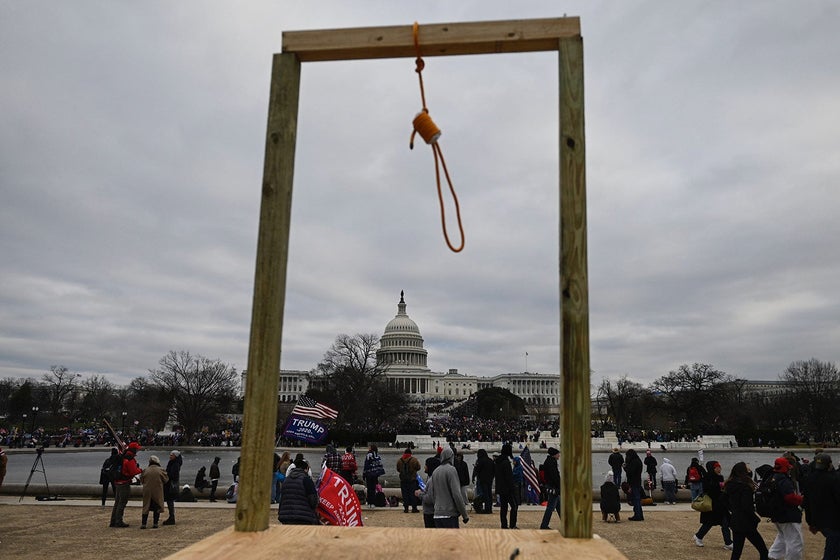
On September 11 2001, the terrorists attempting to attack the U.S. Capitol failed, as heroic passengers crashed the plane into a Pennsylvania field.  But on January 6 2021, homegrown terrorists succeeded where foreign terrorists had failed, halting the certification of an election by invading the Capitol during a joint session of Congress.  It took police and National Guard action to restore order. 

So the transfer of power to Joe Biden has not been peaceful--it required the suppression of an armed insurrection. Yes, “democracy prevailed”–but the unbroken string of peaceful transfers has been permanently broken.  Our system is more fragile than we believed. My boyhood civics lesson is now obsolete

Key #2: Fantasyland

It is 1953.  I sit watching our 10-inch black and white TV screen as Walt Disney introduces the very first broadcast of “Wonderful World of Disney.” Each week’s episode, he tells us, will visit a different world: “Frontierland,” “Adventureland,” “Tomorrowland,” and “Fantasyland.”

I love Fantasyland.  It’s a land where elephants fly, where broomsticks fetch water in buckets, where the gods still reign on Olympus, and where skeletons ride horses up from their graves.  It’s a land of dreams (and nightmares!) where anything can happen.  It’s a place where magic rules, untethered by facts.

I love it, but even at age five I know it is not real.  I don’t expect our cat to talk, or a magic wand to appear, or a genie or fairy to grant me my fondest wish.  However much I love the TV fantasies, I remain grounded in reality.  I love playing make-believe with my friends, I die hundreds of pretend deaths on make-believe battlefields.  But I know that real soldiers, shot dead, do not walk away.

But now, I fear, Fantasyland has taken hold of millions of Americans.  They seem possessed by magical thinking. They seem to be watching a movie in their own minds, a movie where a make-believe  world obeys their desires. 

In that magical land, Donald Trump did not lose the 2020 election. He won a landslide victory.

In that fantasyland, the Covid virus is not a terrible pandemic causing 400,000 American lives. It is no worse than the flu. It is not to be feared.

In that make-believe land, climate change is not real.

In that pretend realm, there is no systemic racism, no white privilege, no white supremacy movement.

In that alternate reality, Russians never interfered with the U.S. elections.

In that imaginary existence, vaccines do not protect us--they make us sick—or worse, they wire us for surveillance.

Such widespread magical thinking constitutes nothing short of a wholesale denial of facts.

It strikes me that these two phenomena - - the breakdown of peaceful transfer and the prevalence of Fantasyland thinking--are the two barriers we face in overcoming our cascading crises.  One threatens our constitutional order, while the other threatens our public discourse.  Both threaten our national unity.

Our Constitutional Order

The long stability of our constitutional system is no longer assured.  It took multiple recounts, 50 court cases, the Supreme Court, the suppression of a coup, and an impeachment to get us from President Trump to President Biden.  This was the very definition of a power struggle, not a peaceful transfer.

We might hope that this struggle was a one-off recurrence, and never to be repeated.  But the signs are ominous.  Since 2000, Americans have been increasingly ready to question the legitimacy of presidential elections.  In 2000, people questioned the Florida recount, which determined the overall outcome.  In 2008, Trump and others questioned Obama’s very birthright to the presidency.  In 2016, 33% of Democrats and 50% of young Democrats considered Trump’s victory “illegitimate.” In 2020, similar numbers of Republicans disputed the election results.

I submit that, unless we find a way to conduct elections acceptable to all, we’re in for trouble.  There already has been too much unrest--Biden called it our “uncivil war.”  Too many norms had been broken, making me wonder if norms are enough to maintain our fragile fractured system.  Disrespect for our institutions is now dangerously widespread.  And it appears that America’s celebrated “individualism” has metastasized to the point where any sense of “common good” maybe too weak to motivate Americans to set aside private interest for a unified future.

The last year has finally exposed how fragile our civil stability has become, and the trends of the last 20 years point to further breakdown. The growing, infectious willingness of millions of Americans to reject outcomes they do not like is the mark of a failed state.  That infection must be stopped.  But that depends on repairing public discourse.

 Public Discourse

An open society requires dialogue among people of differing views. But differing opinions are only constructive if they respond to the same facts.  Facts are the currency of public discourse: we must agree on facts before further discussion can proceed.  Thus the cliché: the “you have a right to your own opinion, but not to your own facts.”

If facts are devalued or even dismissed, dialogue breaks down. People begin to fabricate their own “alternative facts,” and they enter that fantasyland where the real and the imaginary merge and blend

“Conspiricism” poses a special threat. While conspiracy theorists merely concoct a scheme that explains to them the true meaning of a PARTICULAR event (say, the assassination of JFK or 9/11), people infected with conspricism believe that such schemes lurk behind ALL events. For them, ANY reportage of news is merely the smokescreen behind which reality lurks. The smokescreen is part of the conspiracy and the reality behind it is evil. Thus all of life’s events, all the facts presented, are mere distractions luring us into a hidden evil. Our lives come to depend on dismissing facts and replacing them with our own imagined schemes.

In such a fact-free country, public discourse withers. Different people form different opinions based on different sets of facts, some of which exist only in their minds.  They end up with nothing to say to each other beyond epithets, name-calling, insults, and threats.  Instead of helping to reduce our civil unrest, this reign of fantasy fuels discord, conflict.  In the end, people decide discourse is futile, and then, as we saw on January 6, “initiative becomes the privilege of violence.”

Our Task

The year 1968 also brought a parade of horrors: the Tet offensive, the student riots, the assassination of Martin Luther King, the riots burning up whole sections of our cities, the assassination of Robert Kennedy, the police riot in  Chicago, the Soviet tanks invading Prague, the election of Richard Nixon, the bombing of North Vietnam.  In the wake of that awful year, I quit my political science studies and my political career ambitions because I had lost faith in our political system’s ability to solve the nation’s real problems.  

It is possible that 2020 was as bad as, or worse than, 1968.  If so, my conviction is confirmed: more than 50 years later, we have still not resolved the issues that plagued us then. 

Martin Luther King named three great evils that threaten America’s greatness and threaten us still: racism, materialism, and militarism.  He knew civil rights alone could not solve these problems, so he called for a “revolution of values,” that would transform America’s culture.  He was calling, not for political reform, but for spiritual transformation.

We get the government we deserve, and since 1968 we have not deserved the best.  Our civic stability is fractured, our people too often choose fantasy over reality, and so we have brought the “cascading crises” of Disease, Depression, and Disorder upon ourselves.  “What Stands Before Us” now is the same vast task King named then: a revolution of values.

© Bernard F. Swain PhD 2021


Sunday, March 6, 2016

#449: Can Americans Elect a Moral President?


Chagrined observers of the nastiness we call “Campaign 2016” have begun to inject the character question into their coverage of the candidates. 


Even before the KKK uproar, the below-the-belt debating, and Mitt Romney’s aspersions and allegations, commentators (especially on the conservative side) were denouncing mean-spirited tactics and schoolyard taunts as evidence off the candidates’ unethical roots. 

So evangelical talk show host Michael Brown derided the willingness of voters to support candidates who lack a “solid moral base.” He wondered how they can justify voting for “someone who has a long track record of being ruthless, cruel, unchristian, immoral, profane, full of pride, greedy, and double-minded.” He bemoans that people are not looking for “men [sic] of integrity.” This is because he believes that an American president must be “a moral and ethical leader, a leader who will make godly choices.”

On the Catholic side, columnist George Weigel has lamented the anger pervading the campaign, grouping supporters of Ted Cruz, Donald Trump, and Bernie Sanders under the same “glandular” label.  Such anger, he claims, cannot be righteous:

Anger is a glandular thing. An angry politics is a politics of the gut. A passionate politics, informed and disciplined by reason, can be a politics of the intelligence, a politics of great ideas: a politics, if you will, of sound moral judgment. And sound moral judgment is rarely, if ever, the child of anger.

(Note that George Weigel neglects the reverse possibility: that anger can often be the righteous child of sound moral judgment--witness Jesus with the money changers!). 

Catholic politics, he says, must always be moral politics:

Catholic political theory is an extension of Catholic moral theology; or to put it another way, Catholic political theory treats politics as an arena of moral reasoning and moral judgment. The Catholic citizen, as the Church understands these things, is obliged to think, not just to feel; to judge, not just to react; to exercise prudence in weighing options among usually-imperfect alternatives, not to indulge in fantasies about simplistic quick-fixes to all that ails us and the world.

I think both men are onto something—but they  fail to go far enough.  The truth is that asking for a “moral president” is really asking for two things.

A Moral Person.  First, it is asking if the president is a moral person, a person of integrity.  Given contemporary politics (perhaps politics in general), this is asking a lot: a public official who is consistently honest, humble, dignified, unselfish, kind-hearted, willing to sacrifice, acts with sound judgment rather than blind anger.  How many past presidents could pass that test?  How many public officials today? 

In my view it is fair to pose the “personal integrity” test, although we risk having no one to vote for.  And anyhow, it may be important to look for more.

A Moral Presidency. A presidential inauguration includes a solemn oath.  In it, the new president promises, not to be a good person, but to protect and defend the Constitution.  In other words, the oath of office pertains to the president’s official duties rather than his or her private life.  And as Weigel notes, political policies are (for Catholics, at least) rooted in moral principles—or should be.

Thus we voters must hope not just for a moral president, but also for a moral presidency.

The standards for this are not rocket science.  Catholic Social Teaching, rooted in the Gospels and shaped by papal teaching since 1891, provides clear criteria for moral policymaking.  And since 2013, Pope Francis has shrewdly employed his popularity to make these criteria the stuff of headlines.  During his U.S. visit, for example, both his White House speech and his address to Congress offered us clear guidelines for a moral presidency.

Thus we can list major current issues and compare the positions of any candidate with Catholic Social Teaching.  Here are some examples. 

Climate Change.  The official Catholic position, forcefully articulated in Pope Francis’ June 2015 encyclical letter, is clear: climate change is real, is fueled by runaway consumption which breeds economic inequality, widespread resentment, and terror.  Reversing this threat to “our common home” is a moral imperative of the highest order.

We should look for candidates, then, who make this position a key plank of their platform.

Economic Inequality.  Pope Francis has called inequality “the root of all social ills,” and concluded that peace remains impossible until the problem of inequality is solved.

Since 1970 the U.S. has emerged, under both parties, as the most unequal of all major nations.  And the gap between rich nations and poor nations has also grown wider.

Which candidates call us to break with this history? 

Open Immigration.  Catholic Social Teaching acknowledges the right of governments to regulate immigration in the interest of public safety--but it also proclaims migration to be a human right, which governments cannot violate.  Which candidates stand by this human right? 

Nuclear Weapons.  Since Vatican II, Catholicism considers the production, installation, distribution, sale, threat, or use of nuclear weapons to be an unconditional evil.  A moral presidency would include aggressive efforts to remove nuclear weapons from the planet.

Weapons Sales.  The U.S. is the world’s largest arms dealer, and Catholicism teaches that arms sales not only promote war, but they also prevent the poor from escaping poverty.  Which candidates name the arms industry as a scourge on the common good?

Defense of Life.  Before the U.S. Congress, Francis called for defending life at every stage--which means opposing both abortion and the death penalty.  A moral presidency would defend this “seamless garment” of life.

Human Rights.  The Catholic definition of human rights includes the right to Health Care, to Housing, to Migration, to a Living Wage, to Education, etc.  None of these are privileges to be reserved, inherited, or rewarded. They are everyone’s birthright. A moral presidency would be committed to the government’s responsibility for securing such rights for all citizens

This list ignores both parties and personalities.  It focuses only on moral principles.

As Americans prepare to choose a president, it makes perfect sense to seek a moral person.  It makes even more sense to seek a moral presidency.

This sets extraordinarily high standards for voters to consider.  I doubt we have a single candidate who meets them all.  Our responsibility is to get beyond the personalities and parties to determine this: which candidate measures up to these standards better than any other?

Given what I have seen of this campaign, I can only think: God help us all! 
   © Bernard F. Swain PhD 2015

Saturday, February 20, 2016

#448: 10 Reasons Why Pope Francis Was Right about Trump


The controversy following the Pope’s remarks about Donald Trump included overblown reactions that missed the point.. 
 1. Context.  If you read the entire interview text, you see that the pope’s statement comes only in answer to a question about Trump calling the pope a pawn and an instrument of the Mexican government.  When Trump took offense at being called “not Christian,” he was the pot calling the kettle black.  
2. A Hypothetical Comment.  Francis qualified his answer by saying “If a person…” and then offered the benefit of the doubt.  It was as if he could not believe a Christian would say the things attributed to Trump, and thus presumed that Trump must be something else than Christian. 
3. Not a Personal Attack.  This was how the Vatican clarified later.  But note that Francis spoke of “A person who thinks only about building walls…and not building bridges.” He did not specifically apply this to Trump.  And the key word is “only.”
4. Off the Cuff. The pope was speaking spontaneously, and his point would have been clearer had he said such a person “Is not acting Christian.” In other words, that would have made it clear that his comment was not about Trump’s religious membership (clearly the pope has no idea of Trump’s personal life) but about the public behavior attributed to him. 
5. No Magic Potion.  The focus on behavior is relevant because even a baptized person does not automatically follow the gospel.  Baptism is not a magic potion, and neither is church attendance. One may be officially a member of the Christian church, but the clear test of following Jesus is following Jesus’ command to “Love your neighbor.”
6. A Wall Along The Road.  The parable of the Good Samaritan is Francis’ favorite image for loving our neighbor--no wonder, since Jesus offered it to answer the question “Who is my neighbor?” The answer, of course, is: “the person who needs me.”  Imagine if we revise the parable to include someone who builds a wall around the man on the road so no one will help him!  Would anyone call that a Christian act?
7. Immigration.  Thus immigration becomes a key test for authentic Christianity.  The Church teaches that migration is a human right, so walls designed to prevent immigration (not just regulate it) are denying migrants their rights.  Francis is quite right that “this is not in the gospel.”
8. The Pope’s Job.  Trump professed offense that the pope “question another’s faith.” But the pope’s job description, as “moral leader,” includes challenging us all to live up to our faith by reminding us of its true meaning and obligations.  If Trump wants to be a “proud Christian,” he will need to show that his positions fit the Christian message.  He cannot claim “proud membership” but avoid the ethical test that goes with it.
9. The Vatican’s Walls.  It is true the Vatican has high walls, although one may enter St. Peter’s Square openly at almost any time (you need only walk over a white line). It is also true that since Vatican II (1962-1965) popes had been breaching that wall to connect with the world--especially with the world’s poor.  Donald Trump has dated himself by pretending that popes still hide in the Vatican, protected behind walls, as he wants Americans to be.
10. The Real Drama.  The media constantly marvel at the “theatrical” power of Trumps candidacy. 
But the pope’s comment came hours after 200,000 Mexicans gathered with him at the U.S. border while Americans watched from 300 feet away, across the Rio Grande.
All prayed for those who had died at the border, and also prayed for more open borders. 

  
 Is there any real doubt  whose performance is more powerful—or better reflects the Christian faith?

   © Bernard F. Swain PhD 2015

Tuesday, December 8, 2015

#444: To Defeat Terror, We Must Fight Islamophobia

 Fearing or blaming Islam for terrorism only cultivates more terror.
As the mass murders pile up, more people are tempted to blame and fear Islam. We hear Ted Cruz proposing we accept Christian refugees but not Muslims and Donald Trump calling to ban even Muslim tourists. And a poll shows New Hampshire voters' paranoia: 53% of Trump supporters favor a "Muslim database," and 49% want to shut down mosques.
Others, like Catholic columnist George Weigel, are more subtly paranoid. Weigel claims that attacks in Paris and elsewhere target “crusader nations” regarded as enemies of the true religion, Islam.  Terrorists killed those who embody “the West,” he thinks--even though many attacks have been in Africa and Asia and Russia. Weigel says terrorists attack due to “religiously-warranted convictions”--as if Islam justifies such attacks.  He says they kill innocents whom they considered “infidels”--even though many victims (even in Paris) have themselves been Muslims.  He asked for prayers for “the ultimate defeat of the evil that he is Jihadist terrorism” by every legitimate means.
Meanwhile, Brown University’s Stephen Kinzer argues that “terrorism and mass migration are bitter results of outside meddling” by colonial and neo-colonial powers--and he predicts they will intensify.  “Interventions multiply our enemies,” he writes, since every act “produces anti-western passion” that can be radicalized into the “thirst for bloody revenge.” Killing such militants backfires: “killing creates more, not fewer” of them.  So retaliation by European and American forces hands the terrorists what they want: to trap us in the quicksands of the Middle East.
So who’s right?  Is Islam to blame, and we must use “every legitimate means” to kill all the “jihadist murderers”? Or is colonial history behind this, and we must find another solution?
Faced with this urgent question, I find myself doing what, by now, has become a regular habit: I consult the global moral wisdom of Pope Francis.  In his view, the real blame for much of the world’s mass violence is fundamentalism, which has become “a disease of all religions.” "Fundamentalism,” he says, “is always a tragedy. It is not religious, it lacks God, it is idolatrous."
Let’s assume Francis is right--he usually is!  Then we must ask: what does this mean?  What is the connection between fundamentalism and terror?
Karen Armstrong’s landmark book The Battle For God: Fundamentalism in Judaism, Christianity and Islam supplies a clear and practical answer.  Based on her studies of fundamentalist movements in Judaism, Christianity, Islam, Armstrong concludes that all fundamentalism follows a regular pattern that can lead to violence. Let me summarize:
Fear.  The pattern begins with discontent or fear.  Almost always it arises among people who live traditional lives and are confronted by “modernity.” This takes many forms: Christians who fears secular humanism, or the sexual revolution, or the theory of evolution; Jews alarmed by the growing Palestinian population in Israel--or even the growth of secular Jews; Muslims who fear the invasion of modern customs of dress, drinking, sexual openness, even feminism.  This fear creates a desire to escape or resist modernity.
Powerlessness.  Next comes a feeling of helplessness.  Such people want to avoid or resist modernity, but they feel its momentum is too powerful to stop.  Naturally, this feeling of powerlessness is strongest among the most desperate: people who are already poor, underprivileged, disadvantaged, or disenfranchised.  In other words, the initial fear of modernity is fueled by inequality.
“Tradition.”  Third, fundamentalism turns to “tradition” as a shield that can protect them from the overwhelming power of modernity.  Often, “tradition” means a specific religious tradition, although secular ideologies (white supremacy, neo-Nazism, etc.) are sometimes used. 
But using tradition as a shield faces an obstacle.  All "western"
religious traditions (including Islam) have a history of adapting to changing times--but fundamentalism needs a shield that is fixed, frozen in time.  This requires distorting the tradition, reshaping it into an immovable barrier against modernity.  Thus fundamentalist Christians insist on a literal interpretation of Genesis (a creation lasting seven 24-hour days) to reject the theory of evolution.  Fundamentalist Catholics pretend that priestly celibacy (and the lifelong virginity of Jesus) are absolute doctrines.  And fundamentalist Muslims twist “sharia” into an oppressive legal system and invoke “jihad” as a pretext for killing innocent people.
Violence. Left alone, fundamentalists may be content to survive sheltered behind the shield of their distorted tradition.  But   they may feel that modernity’s threat requires counterattack.  This can happen in two ways.  First, they may feel attacked from within their religion by those who reject the way they distort tradition.  Clearly, Jews, Christians, and Muslims all experience such internal conflicts.  Second, fundamentalists may feel attacked by outside forces representing modernity itself.  Thus the Russian invasion of Afghanistan brought “godless communism” to the fundamentalists’ doorstep.  And repeated intrusions by Western powers--especially the Western military presence in the sacred spaces of Saudi Arabia--threatened to pierce the shield across the Middle East.
Once they are thus cornered, fearful fundamentalists may then turn to violence.  It may be directed at Planned Parenthood (by Christians), at innocent concert-goers (by Muslims), or at Palestinian teens (by Jews).  And it finds a pretext for such violence by invoking “tradition”--even when those traditions do not, in reality, warrant such attacks.
Weaponizing religion.  The final stage comes when this newly violent version of the religious tradition is then wielded as propaganda to “inspire” other discontented people, who then become recruits to terrorism, even to suicidal violence.  Thus fundamentalism reveals itself as the “disease of all religions” whose cancerous expansion can finally metastasize into random outbreaks of terrorism whenever (1) people fear the culture around them and (2) can be converted to embracing the lie of “tradition as weapon.”
Since 9/11, we have learned that anything—a plane, shoes, underwear, a kitchen pot—can be weaponized. But perhaps the most powerful weapon comes when one mutilates faith into a form of hate.
Karen Armstrong’s convincing portrait of fundamentalism leads me to conclude that people like George Weigel have it backwards.  Terrorists are not actually motivated by their religious faith.  What moves them is their fear of the world around them, which breeds a desire for “revenge” so fierce that they hijack their own religion.  Islam does not justify terrorism, nor does it inspire terrorism.  Rather, some hate-and-fear-filled people exploit Islam as a handy “tool” they can use to rationalize the evil they do.  And this rationalization is not a “religious warrant” for terror—it is (like ANY rationalization) just an excuse. In short, Islam does not provoke terror; rather, those already committed to terror invoke Islam since it suits their purpose.
Thus the terrorists are not dangerous because they are Muslim.  They are dangerous because, since they’re so filled with hate, they reject Islam’s peaceful message and will use anything, even their own religion, as a weapon against those they hate. 
The truth is that almost all of us find that “modernity” is difficult at times.  The modern world is full of rapid change, diversity, even conflicts.  Few of us embrace these easily and naturally.  But most of us cope with the challenges of modern life and carry on.  For others, the challenges prove too much.  And whether the result is emotional disorder that leads to violent behavior, or even blind hatred that twists faith into lethal form, we must remember that they’re reacting against something that makes them afraid, helpless, and irrational.  Until we develop the means to eliminate that fear, that helplessness, and that irrationality, modernity will continue to inspire dangerous reactions. 
If we attack or blame their religion, we merely make modernity (which now “rejects” their faith) even more threatening to others who may be vulnerable to the terrorists’ propaganda. THEY may claim the battle is about “Islam vs. the West"—but we must not accept their version of events. We must not help them do their job. To defeat them, we must fight against their demonization of Islam.
The cancer of terror has reached the point where it seems out of control.  It is too late to undo the history that unleashed terror, but it is not too late to help terrorism’s potential recruits—the disenfranchised, disillusioned youth of the Middle East, Europe, and America--learn constructive ways to cope with the challenges of modern life. 
Of course, this would require, not military force, but a solution to the vast inequalities that leave millions afraid, powerless, and desperate.  And so far, we have been much better at producing guns than good will. Can we change?
© Bernard F. Swain PhD 2015