WELCOME !


WELCOME! CrossCurrents aims to provoke thought and enrich faith by interpreting current events in the light of Catholic tradition. I hope you find these columns both entertaining and clarifying. Your feedback and comments are welcome! See more about me and my work at http://home.comcast.net/~bfmswain/onlinestorage/index.html or contact me directly at bfswain@juno.com NOTE: TO READ OR WRITE COMMENTS, CLICK ON THE TITLE OF A POST.

Showing posts with label constitution. Show all posts

Monday, January 25, 2021

#480: What Stands Before Us

     “We are striving to forge our union with purpose.

To compose a country committed to all cultures, colors, characters and conditions of man.

And so we lift our gaze, not to what stands between us, but what stands before us.

We close the divide because we know to put our future first, we must first put our differences aside.”

--Amanda Gorman, The Hill We Climb, 1-20-21

Amid the optimistic pomp of Joe Biden’s inauguration lurked an undercurrent of realism--as when Biden himself referred to the “cascading crises” that we face. 

This new year brings us (1) the worst public health crisis since the 1918 “Spanish flu,” (2) the worst economic crisis since the 1930s great depression, and (3) the worst civil unrest since 1968.  This triple catastrophe is without precedent in our history.

Trying to process this reality, my mind reaches back to my own childhood to retrieve two keys to understanding what this moment means and why it matters.

Key #1: Peaceful transfer?

It is a 1959, and my sixth grade teacher Mr. Peirce conducts a current events quiz each morning.  It’s the height of the Cold War and Mr. Peirce indoctrinates us daily on the superiority of America over Russia.  Nikita Khrushchev has only recently emerged as the Russian leader, and we’re told that when Joseph Stalin died a few years earlier a vicious power struggle ensued to determine his successor.

But the U.S. is different, Mr. Peirce tells us.  In America we have elections, and no matter who wins, his rival concedes and power passes to the winner.  The process is routine, predictable, and free of struggle or conflict.  So Truman gave way to Ike (who would, in turn, give way to JFK). 

This, at age 10, is my first civics lesson: America is great because it has maintained the peaceful transfer of power since its founding.  In our way of life, no one is indispensable, we’re a government of laws not men, and no one may rise above that law.

The election of 2020 has changed all that.

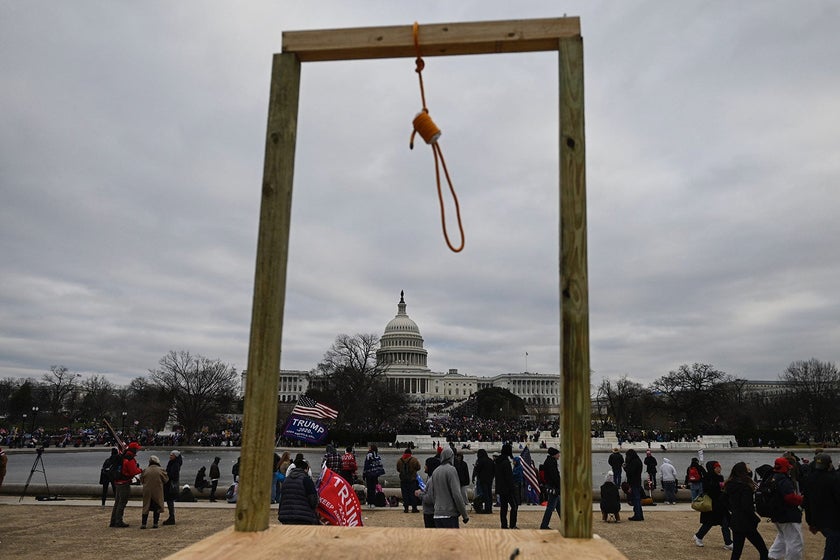
On September 11 2001, the terrorists attempting to attack the U.S. Capitol failed, as heroic passengers crashed the plane into a Pennsylvania field.  But on January 6 2021, homegrown terrorists succeeded where foreign terrorists had failed, halting the certification of an election by invading the Capitol during a joint session of Congress.  It took police and National Guard action to restore order. 

So the transfer of power to Joe Biden has not been peaceful--it required the suppression of an armed insurrection. Yes, “democracy prevailed”–but the unbroken string of peaceful transfers has been permanently broken.  Our system is more fragile than we believed. My boyhood civics lesson is now obsolete

Key #2: Fantasyland

It is 1953.  I sit watching our 10-inch black and white TV screen as Walt Disney introduces the very first broadcast of “Wonderful World of Disney.” Each week’s episode, he tells us, will visit a different world: “Frontierland,” “Adventureland,” “Tomorrowland,” and “Fantasyland.”

I love Fantasyland.  It’s a land where elephants fly, where broomsticks fetch water in buckets, where the gods still reign on Olympus, and where skeletons ride horses up from their graves.  It’s a land of dreams (and nightmares!) where anything can happen.  It’s a place where magic rules, untethered by facts.

I love it, but even at age five I know it is not real.  I don’t expect our cat to talk, or a magic wand to appear, or a genie or fairy to grant me my fondest wish.  However much I love the TV fantasies, I remain grounded in reality.  I love playing make-believe with my friends, I die hundreds of pretend deaths on make-believe battlefields.  But I know that real soldiers, shot dead, do not walk away.

But now, I fear, Fantasyland has taken hold of millions of Americans.  They seem possessed by magical thinking. They seem to be watching a movie in their own minds, a movie where a make-believe  world obeys their desires. 

In that magical land, Donald Trump did not lose the 2020 election. He won a landslide victory.

In that fantasyland, the Covid virus is not a terrible pandemic causing 400,000 American lives. It is no worse than the flu. It is not to be feared.

In that make-believe land, climate change is not real.

In that pretend realm, there is no systemic racism, no white privilege, no white supremacy movement.

In that alternate reality, Russians never interfered with the U.S. elections.

In that imaginary existence, vaccines do not protect us--they make us sick—or worse, they wire us for surveillance.

Such widespread magical thinking constitutes nothing short of a wholesale denial of facts.

It strikes me that these two phenomena - - the breakdown of peaceful transfer and the prevalence of Fantasyland thinking--are the two barriers we face in overcoming our cascading crises.  One threatens our constitutional order, while the other threatens our public discourse.  Both threaten our national unity.

Our Constitutional Order

The long stability of our constitutional system is no longer assured.  It took multiple recounts, 50 court cases, the Supreme Court, the suppression of a coup, and an impeachment to get us from President Trump to President Biden.  This was the very definition of a power struggle, not a peaceful transfer.

We might hope that this struggle was a one-off recurrence, and never to be repeated.  But the signs are ominous.  Since 2000, Americans have been increasingly ready to question the legitimacy of presidential elections.  In 2000, people questioned the Florida recount, which determined the overall outcome.  In 2008, Trump and others questioned Obama’s very birthright to the presidency.  In 2016, 33% of Democrats and 50% of young Democrats considered Trump’s victory “illegitimate.” In 2020, similar numbers of Republicans disputed the election results.

I submit that, unless we find a way to conduct elections acceptable to all, we’re in for trouble.  There already has been too much unrest--Biden called it our “uncivil war.”  Too many norms had been broken, making me wonder if norms are enough to maintain our fragile fractured system.  Disrespect for our institutions is now dangerously widespread.  And it appears that America’s celebrated “individualism” has metastasized to the point where any sense of “common good” maybe too weak to motivate Americans to set aside private interest for a unified future.

The last year has finally exposed how fragile our civil stability has become, and the trends of the last 20 years point to further breakdown. The growing, infectious willingness of millions of Americans to reject outcomes they do not like is the mark of a failed state.  That infection must be stopped.  But that depends on repairing public discourse.

 Public Discourse

An open society requires dialogue among people of differing views. But differing opinions are only constructive if they respond to the same facts.  Facts are the currency of public discourse: we must agree on facts before further discussion can proceed.  Thus the cliché: the “you have a right to your own opinion, but not to your own facts.”

If facts are devalued or even dismissed, dialogue breaks down. People begin to fabricate their own “alternative facts,” and they enter that fantasyland where the real and the imaginary merge and blend

“Conspiricism” poses a special threat. While conspiracy theorists merely concoct a scheme that explains to them the true meaning of a PARTICULAR event (say, the assassination of JFK or 9/11), people infected with conspricism believe that such schemes lurk behind ALL events. For them, ANY reportage of news is merely the smokescreen behind which reality lurks. The smokescreen is part of the conspiracy and the reality behind it is evil. Thus all of life’s events, all the facts presented, are mere distractions luring us into a hidden evil. Our lives come to depend on dismissing facts and replacing them with our own imagined schemes.

In such a fact-free country, public discourse withers. Different people form different opinions based on different sets of facts, some of which exist only in their minds.  They end up with nothing to say to each other beyond epithets, name-calling, insults, and threats.  Instead of helping to reduce our civil unrest, this reign of fantasy fuels discord, conflict.  In the end, people decide discourse is futile, and then, as we saw on January 6, “initiative becomes the privilege of violence.”

Our Task

The year 1968 also brought a parade of horrors: the Tet offensive, the student riots, the assassination of Martin Luther King, the riots burning up whole sections of our cities, the assassination of Robert Kennedy, the police riot in  Chicago, the Soviet tanks invading Prague, the election of Richard Nixon, the bombing of North Vietnam.  In the wake of that awful year, I quit my political science studies and my political career ambitions because I had lost faith in our political system’s ability to solve the nation’s real problems.  

It is possible that 2020 was as bad as, or worse than, 1968.  If so, my conviction is confirmed: more than 50 years later, we have still not resolved the issues that plagued us then. 

Martin Luther King named three great evils that threaten America’s greatness and threaten us still: racism, materialism, and militarism.  He knew civil rights alone could not solve these problems, so he called for a “revolution of values,” that would transform America’s culture.  He was calling, not for political reform, but for spiritual transformation.

We get the government we deserve, and since 1968 we have not deserved the best.  Our civic stability is fractured, our people too often choose fantasy over reality, and so we have brought the “cascading crises” of Disease, Depression, and Disorder upon ourselves.  “What Stands Before Us” now is the same vast task King named then: a revolution of values.

© Bernard F. Swain PhD 2021


Saturday, September 30, 2017

#468: The NFL’s Loyalty Test


  The controversy swirling around the bended knees by NFL players raises issues about our national identity and our commitment to it. 


On Thursday, the Supreme Court Justice picked by Donald Trump spoke to a select audience about defending the First Amendment. Here is what Neil Gorsuch said:

To be worthy of the First Amendment freedoms, we have to all adopt certain civil habits that enable others to enjoy them as well. When it comes to the First Amendment, that means tolerating those who don’t agree with us or those whose ideas upset us, giving others the benefit of the doubt about their motives.

Also Thursday, Tennessee Titans tight end Delanie walker revealed that he and his family had been receiving death threats.  These were apparently how fans responded after he suggested that fans should not come to NFL games if they felt disrespected by player protests.  

These two events reveal the opposite extremes the controversy has surfaced.

It’s tempting to think that the upset over the NFL protests is a mere distraction from the more serious problems facing America.  Certainly, for Trump himself, it is convenient if the public and media fight among themselves over the NFL players rather than focusing their attention on his handling of affairs with North Korea, or his slow response to the crisis in Puerto Rico, or his tax plans.

But in 21st century America, matters of race are never a “mere distraction.” And this case is above all about race.  But the real and unfortunate distraction has been to pretend that is about something else. So perhaps it is helpful to reflect and clarify on how the controversy about the NFL is a test of loyalty both for Americans and for Christians.

The clarification requires stating some basic facts to clear the air:

First: the NFL players did not introduce politics onto the playing field.  This was done in 2009 when the U.S. government began paying the NFL millions to stage “patriotic” events before each game: color guards, gun salutes, fly-overs—all designed to boost recruiting efforts by whipping up patriotic fervor.  In short, this is government-paid advertizing for the military, and it had the effect of bringing politics onto the NFL’s playing fields.

It’s just silly to complain if the players, understanding that politics is already at work here, decide to take advantage of the situation someone else has created.

Second: the players are not protesting the flag or the anthem.  Colin Kaepernick explicitly said that he meant no disrespect to either, but was in fact protesting the bad treatment of African Americans by police.  One may agree or disagree about the issue of police brutality, but it has nothing to do with either our flag or national anthem.

Third, this is not a protest about soldiers or veterans.  The original protest about police brutality has been transformed, in response to Trump’s “Sons of bitches” attack, into a protest about the First Amendment itself.  In neither instance are the players attacking, objecting to, or showing any disrespect for members of the military.  In fact many protesters are themselves veterans, and many other veterans support them. 

The players did not make the decision to have soldiers on the field, and they should not have to take any responsibility for it.  The players need to be on the field to play the game, but football could continue even if no soldier ever set foot on the gridiron.

Fourth: player salaries have nothing to do with the protests.  Yes, these players are millionaires - -but they are responding in protest to the attacks of someone who is even richer than they are. To allow a billionaire president to make such attacks, and then to claim that his target audience cannot protest because they are rich, is completely inconsistent. 

Some fans are even arguing that the players are “ungrateful” because they want to protest despite being well paid.  But First Amendment rights cannot be bought off; players do not lose those rights when they accept a paycheck, no matter how large.  And since most of them are African-Americans, calling them ungrateful sounds like a new way of calling Black Americans “uppity.”
Bill Russell takes a knee with his Medal of Freedom

Fifth:  Kneeling is not disrespectful.  The simple fact is, kneeling has been a gesture of respect, loyalty, even fealty, for centuries.  Many of us kneel when we pray, as a sign of respect.  And many players kept their hands over their hearts to reinforce that sign of respect.  This protest does not use kneeling as a sign of disrespect, but simply as a sign of protest--first, a protest against racialized police brutality, and second as a protest in favor of First Amendment rights.

Sixth:  Thus the real issues are (1) racialized police violence and (2) the right to protest itself--that is, free speech.

Once we accept the facts of the case, we can look at the underlying question of loyalty.

Loyalty here can mean many things.  It can mean loyalty to a flag, or to a song, or to a team, or to the Constitution, or even to a higher law.

Many Americans of course have strong emotional feelings about the flag, and we’re even in the habit of pledging our allegiance to it.  But while the actions that surround the flag often suggest that people regard it as something sacred, this cannot really be true. 

First, the U.S. Supreme Court has long determined that in the name of protest people may even burn the flag.  It also ruled that people have the right not to salute the flag. What this demonstrates, no matter how you feel about it, is that the right to protest is more important than this piece of cloth.  We cannot defend the flag by preventing protest.  Instead, we must protect protest even if it harms the flag.

Many Americans also have strong emotional attachment to the national anthem.  And the singing of the anthem at sports events became popular and routine during the 20th century, and especially during and after World War II.  But most people only know the first verse, and except for the final line “The land of the free and the home of the brave,” the rest of the song is simply a celebration, not of American values or institutions, but of a battle victory over the British in 1812. 

The song has been linked to sports, but we do not sing it in a theater before a movie, or a play, or in church before each ceremony.  We are perfectly capable of being Americans and celebrating American values and institutions whether we sing this song or not.

These things symbolize our nation and our people, but they are only that: symbols. If we treat them as though we must love them to love the country, we make them fetishes, as if they are the whole of us. It’s like loving someone’s big toe, instead of the whole person. This is not patriotism, it’s pathology.

And worse, to turn this song or this flag into something sacred—something, for example, higher than protest itself--is to fail the loyalty test that Americans, and especially American Christians, should be passing.

For Americans, the values enshrined in our Constitution are the highest standards we possess as a people.  The right to protest is the First Right among these, and nothing else in our social life is higher or more important.  Any attempt to prevent rightful protest as “disrespectful” to the flag or the anthem--or even to the military--is actually an act of profound disrespect for the Constitution itself, the very foundation of our nation, which those other things represent..

And for Christians, the lesson should be even more obvious.  Treating any object--a song, a flag, even a veteran or soldier--as something sacred fails the test of loyalty to the First Commandment: “Thou shall not have false gods.” Christians believe that only God is sacred, and that God’s will creates a higher law than any other law.

That law includes, especially for Catholics, the idea that we are one human family, all children of God, all brothers and sisters in Jesus Christ, and that therefore any division among us is a scandal to our faith.


 The very notion that Blacks in our country have been mistreated for centuries must be a source of shame to all of us.  That shame reflects the fact that America has failed to do God’s will for centuries, that slavery really is our original sin, and that we have not finished our penance and amendment for that sin. Using the flag and the anthem as camouflage to hide that makes the sin worse. Using our soldiers as human shields to hide our sin is worst of all.

So while loyalty to team, to flag, to a song, to the military may all be good things, the real test of our loyalties this: is our first loyalty as Americans to the Constitution?  Is our first loyalty as people of faith to the will of God and God’s higher law?

Viewed this way, the controversy is hardly a “mere distraction.” As serious as the other problems facing us are, this challenge of loyalty to God and Constitution cannot be ignored, cannot be forgotten, cannot be avoided.  It is a test of loyalty that, sooner or later, this nation must pass—or the nation will fail.
© Bernard F. Swain PhD 2017

Friday, May 12, 2017

#465: Time Is Running Out for Roe v. Wade

  Roe v. Wade was always a ticking time bomb, and although it’s had a very long fuse, it’s about to go off.


No, I’m not talking about the prospect of a conservative SCOTUS majority overturning the case. I’m talking about the natural outcome of the case itself.

Two major features characterized the legal argument of the majority in Roe v. Wade.  First was the idea that privacy was an implied right under the US Constitution which protected women from the intrusion of government.  Second, it determined that the “viability” of the fetus was the dividing line between the woman’s private interest before viability, and the state’s interest after.

Of course, there were two risky implications in using the idea of “viability.” First, determining when was “before” and when was “after” might prove to be difficult.  And in fact the court chose an arbitrary method: it divided pregnancy into trimesters, and determined that the first was “before,” the third trimester was “after,” and the second trimester was someplace in between.

The second risk is that the very idea of “viability” was, in reality, a sliding scale, a moving target.  The court decided Roe v Wade in 1973, when fetuses rarely survived outside a mother until the third trimester--that is, after 24 weeks.  A fetus born prematurely at six months almost surely died.

As time passed, however, and medical technology and prenatal care evolved, early births received better and better treatment, and premature babies survived at younger and younger ages.  By the 21st century, it was common for babies born at 24 weeks and even younger--that is, in the second trimester--to survive.  Babies born at 24 weeks now have a 40% chance of survival, and babies born at 23 weeks still have a 17% chance of survival.  This represents a remarkable shift in “viability” in the 44 years since Roe v. Wade.
 But now comes a much more dramatic development, with the recent report of the invention of an artificial womb. (https://www.theatlantic.com/health/archive/2017/04/preemies-floating-in-fluid-filled-bags/524181/) Until now, the device has been used only with baby lambs, but the inventors reported it would soon be available to assist “premature babies.”

To be this seems to be a case of under-reporting.  For if we’re really going to have an artificial womb, the implications go far beyond what we now think of as premature babies.  Such a device potentially offers the prospect of bringing fetuses to term in pregnancies much shorter than the current “viability” limit:

Within a decade or so, babies born between 23 and 25 weeks might not be thrust into the harsh outside world at all. Instead, they may be immediately plunged into a special bag filled with lab-made amniotic fluid, designed to help them gestate for another month inside an artificial womb.

--the Atlantic April 25, 2017


The current device is quite primitive, but will surely evolve. Dear reader, imagine the practical impact of a device that could, for example, offer survivability to a fetus in mid-or even early second trimester.

This impact was explored long ago in a hypothetical discussion that was part of a popular Boston TV show called “Miller’s Court.”

Arthur Miller, a Harvard law professor (now at NYU law school), used the program from 1979-1988 to discuss legal issues in a quasi-courtroom forum, usually cross examining several panelists at once.

On the occasion I have in mind, the issue under discussion was abortion.  The panel included then- Congressman Barney Frank and feminist writer Gloria Steinem.

Miller posed this hypothetical question: suppose that an artificial womb could be used to bring a fetus to term AFTER the pregnancy was terminated by abortion. Would that mean that the mother would lose her legal standing, and the state would gain a legal interest in preserving the child’s life? Both Barney Frank and Gloria Steinem agreed that to be the case. They said yes: at that point the state could act to save the child, and the mother’s right to decide would be gone (presumably because her privacy right had ended).

Two noteworthy points here: first, Frank and Steinem were answering a really hypothetical question, which at the time (the mid-1980s) had no practical importance.  Second, it was nonetheless stunning to hear two such prominent pro-choice advocates take the position they took. In effect, they were limiting the women’s control over the effects of her choice, once the fetus was outside her body.

You see, this discussion revealed a generally overlooked element about abortion itself.  It demonstrated that an abortion is really two events at once: it is the termination of a pregnancy, and it is the death of a fetus.  Generally, these two events are inevitably connected; one cannot choose one without the other.  And so most discussions about abortion jumble the two together, with pro-lifers opposing the killing, and pro-choicers defending the woman’s right to end her pregnancy.  In such discussions, the two sides inevitably talk past each other--which is exactly what has been happening for more than 40 years.

But Miller’s hypothesis opens the possibility of speaking of these two elements separately.  In other words, what if women could terminate a pregnancy without killing the child?  Then what?

What Frank and Steinem were essentially agreeing to was the idea that, if it were possible to terminate pregnancy without causing a death, then the resulting life would become a matter, not of the mother’s privacy, but a matter of public interest.  At that point, the state could take over the attempt to save the child.

But if Miller’s hypothesis highlighted the basic fact that abortion does 2 things (terminates a pregnancy, but also kills the fetus)--now it seems the hypothesis itself may soon become real. For now we DO have an artificial womb, and now it may soon be possible to terminate pregnancy yet save the fetus!

What this means that the artificial womb completely explodes the notion of “viability” built into Roe v. Wade.

It opens the prospect that women can retain the right to choose an abortion, but lose the right to kill their fetus.  Since that latter right depends on the location of the fetus within the woman’s body, the artificial womb opens up the entirely new horizon of allowing the fetus to survive outside woman’s body, where a mother no longer has legal jurisdiction.

Depending on how effective the artificial womb is, and how quickly it evolves, this could mean that many abortion cases which are currently treated as private under Roe v. Wade could become legally controversial under the same case.  For example, what if a woman’s partner (or mother or father or sister or brother) sues to save the child using an artificial womb?  What if a state attorney general sues to enjoin any pregnancy longer than, say 12 weeks, to be subject to state review and intervention? 

None of this would require a reversal of Roe v. Wade.  Theoretically, it could lead to cases where the woman has her abortion but the child survives. 

Not only would this prevent many deaths, but it would also pose a new challenge for both the pro life and pro choice communities.  For pro-lifers, it would mean reconsidering their attitude to abortion itself, recognizing a woman’s right to terminate the pregnancy as long as someone else takes responsibility for saving the child.  For pro-choices, it would pose a difficult challenge: acknowledging that a woman’s right to choose extends only to the termination of pregnancy, not to the fate of the child produced by the pregnancy.  In individual cases, this could mean that a woman might choose to abort with the knowledge that her child survive, and grow, and live in the same world she does, without her consent, and without any legal recourse.  In other words, this could mean that choosing abortion means relinquishing any voice over the future life of one’s own child.

None of this represents a change in abortion itself.  None of this represents a change in Roe v. Wade.  This would simply be a long-term final outcome of a time-bomb decision that has been ticking away for more than 40 years.  And it would finally bring to surface the long overlooked reality that abortion is two things at once, and that each side of this long and anguished debate has been arguing about only one of them, and ignoring the other.

Would this mean the end of the debate?  I suspect not.  Would it make people happier?  I suspect neither side would be fully satisfied, since one side would continue to object to the first trimester abortions, and the other side would feel that somehow a woman’s freedom was being curtailed.

But even if the debate continued and both sides remain unhappy, one thing is sure: Sunday, somewhere, each of us might well meet someone who owes their life to an artificial womb, and who can say to us “I am an abortion survivor.”
 © Bernard F. Swain PhD 2017

Thursday, May 4, 2017

#464: Is the Common Good the Enemy of Sovereignty—or Vice-Versa?


  A recent Harvard discovery suggests why this Sunday's French Presidential Elections French should interest Americans, and especially American Catholics.
"France for the French" vs. France, member of Europe
The French Election
Some observers have said the 2017 election for president of France is all about sovereignty, since Marine Le Pen wants to pull France out of the European Union and Emmanuel Macron wants to stay in the EU but reform it.
Le Pen’s supporters believe the EU Impinges on France's sovereignty as a nation; they want their country back, their money back, their borders closed, their industries protected, their immigrants expelled. They want “France for the French.”
Macron's supporters often do not actually support his politics or agenda, but they support France's continued membership in the EU. They know this means sacrificing some of the nation’s sovereignty: the Euro replaced the Franc, trade is subject to EU "free trade" regulations, the borders are open to anyone from the EU, even the traditional French license plates have been replaced by euro-style plates. But those prepared to vote for Macron believe that giving up some national sovereignty serves the common good of both the French people and Europe as a whole, especially in bringing peace to a chronically war-torn continent (see CrossCurrents # 463).
Catholic Social Teaching (CST) acknowledges the dilemma here. On the one hand, CST makes promoting the common good a top priority, which leaves little room for a self-serving agenda that ignores the effects on others. Pope Francis in particular has decried the “Exclusion” of others that occurs when policy is set to benefit some narrow part of any population.
On the other hand, CST also values “subsidiarity”—the principle of keeping decisions at the most local level possible, and solving problems by the participation of those closest to the problem.
The EU clearly aims to serve the common good of Europeans, but that means decisions get made, not at the local or regional or even national level, but at the international level which sometimes is far removed from the people affected. So common good and subsidiarity sometimes clash. How can this clash be addressed?
Some, like Julius Krein, editor of American Affairs, take a hard line view of sovereignty. He argues that internationalism of any kind cannot really achieve the common good: for him, the real common good comes only with national sovereignty:
“The only democratic institutions that we have are national institutions.  So if you get rid of the nation-state, what you’re really doing is getting rid of democracy.”
In other words, Krein considers that, to serve common good, all sovereignty must be national.  This is exactly what Le Pen is proposing in her campaign, and it is exactly what Macron is opposing.
Wednesday Night's Debate
But it strikes me that such a hard line is completely arbitrary and also completely contrary to our experience as Americans.  That’s why last week’s Harvard discovery is so interesting.
The Harvard Find
Two Harvard researchers, Danielle Allen and Emily Sneff, have recently reported the discovery of an early handwritten parchment copy of the Declaration of Independence--only the second such copy in existence.  They call it the “Sussex declaration” after the location of its discovery in England. 
The significance of the discovery is that this version is slightly different from the one in the national archives.  That original in 1775 reflected the practice of the Continental Congress of having state delegations sign official documents as a group, with state labels for each group.
But the Sussex declaration dates from the 1780s.  By then the War is over, and war debts have led to conflicts among the states, especially farming states vs. the coastal mercantile states.  Eventually these conflicts would lead to a constitutional convention, but already the clash was between federalists (who saw the new nation as a single united people) and anti-federalists (who saw it as a collection of states).  The issue here was whether sovereignty would belong to the nation as a whole, or whether each state would retain its own sovereignty. 
The Sussex Declaration
This newer version shows the balance shifting to the federalists. Allen points out the key difference:
“The Sussex Declaration scrambles the names so they are no longer grouped by state. It is the only version of the Declaration that does that…This is really a symbolic way of saying we are all one people.”
Of course, during the time between these two versions, the US was governed by the Articles of Confederation, adopted in 1777 and ratified in 1781.  The guiding principle here was to preserve the independence and sovereignty of each state.  It legalized the Continental Congress, but gave that Congress very little power. There was no president, no judiciary, no executive agencies, no tax base--which meant no way to pay off the war debts.  Even the Congress had only one body, comprised of state delegations.
Shifting Sovereignty
The Articles of Confederation failed, because the national government lacked enough power to perform its essential duties.  This provoked a Constitutional Convention and eventually led to the U.S. Constitution which governs us today.  The essential difference is that the U.S. Constitution shifted much of our sovereignty from individual states to the nation as a whole.  But the shift involve major compromises, including a Congress split into two houses; Senate representing the states, and the House of Representatives representing the people by proportional vote.
In other words, US history is rooted in a compromise which recognized that sovereignty needed to be shared between the nation and its member states.  When Krein says that our only democratic institutions are national institutions, he is simply ignoring our own history.
What is happening in Europe follows a direct analogy to U.S. history.  If we think of France as a member state of the European Union, we can see that the issue of sovereignty, and the conflict over how much sovereignty France should sacrifice to the common good of Europe, is precisely the same issue as the argument over States’ rights vs. Federal power in the US.
From the point of Catholic Social Teaching, this means that American history can help show us how the tension between the common good and the principle of subsidiarity can be resolved.
We don’t need to look into the distant past to observe this history.  Recent events provided ample examples.  These show that debates over shifts in sovereignty reflect a tension that still exists in American Life.
Current Examples
1. Death Penalty. When Dhzokar Tsarnaev was tried for his role in the Boston marathon bombings, his trial took place in Massachusetts, which rejects the death penalty—and yet he received a death sentence, because his crime was determined to be a violation of Federal law.  Thus Massachusetts could not control the judicial process because the authority of the Federal government prevailed. The state does not enjoy absolute sovereignty
2. Sanctuary Cities. When Donald Trump attacks the notion of sanctuary cities, he is pitting the rule of local law enforcement in preserving public safety against the interests of the immigration authorities to locate and detain illegal immigrants.  Most states that have sanctuary cities are claiming that their law enforcement officials cannot be forced by the Federal government.
3. Healthcare. The current struggle to repeal Obamacare involves the question of whether the U.S. government will continue to mandate coverage, or the states will have the option to seek alternative plans.  Obamacare relied on the sovereignty of the Federal government; the repeals are pushing for state sovereignty.
4. Border Wall. Donald Trump’s border wall involves the Federal government imposing construction in many border states that oppose a wall.  Here again, the common good becomes the rationale for overruling local decision-making.
5. Tribal Sovereignty. When the Wampanoag Tribe tries to establish a casino on Martha’s Vineyard, this pits the tribe as a sovereign nation vs. the power of the local community, and invokes both state and Federal power to resolve the issue.  In this case, the dispute is about sovereignty on four different levels.
6. Gay Marriage. In 2003, the Massachusetts Supreme Judicial Court legalized gay marriage, exercising its own authority to regulate marriage on the state level.  But when the US Supreme Court imposed its Federal authority over state laws and regulations, gay marriage became legal across the US. 
7. “Romneycare.” Obamacare’s rules for health care were remarkably similar to the rules that already existed in Massachusetts under the program supported by a Republican Governor Mitt Romney. Romneycare reflected the state’s sovereignty, Obamacare reflected the federal government’s sovereignty
The Moral of the Story
In all of these cases, the question of sovereignty has been resolved on a case-by-case basis.  It is true that some people would prefer the Federal government to always impose its will over states, while others would prefer that states always get to decide all matters for themselves without any Federal interference.  But the vast majority of Americans accept a constant balancing act between two (or more) levels of legitimate authority.
Thus life in “these United States” involves a chronic but healthy tension between the sovereignty of the nation and the sovereignty of the states.  Neither sovereignty is absolute, so a Federal System like ours requires repeated negotiation to redefine the shifting limits of each sovereignty.
And that is exactly what Europe is going through today, especially if we think of each country as something like our states. 70 years after the Treaty of Rome established the idea of a united Europe, its federal system is still being formed.
The European Union has reached a moment much like the crisis caused by the Articles of Confederation.  In other words, its governing treaties are failing to provide the right mix of sovereignty between the European Union itself and the member states. 
It seems that, if Europe is to serve both the common good and honor the principle of subsidiarity, it will need to find ways to democratize its operations and reflect comment local and national interests and preferences rather than make all decisions by some remote process that does not reflect public will.
But the failure of the Articles of Confederation did not lead to the failure of the United States; it required instead a reformed federal system. Europe faces the same challenge, and France’s commitment to meeting that challenge (rather than quitting to protect its own sovereignty) will say much about Europe’s future prospects.
 © Bernard F. Swain PhD 2017

Friday, February 19, 2016

#447: Why Justice Scalia’s “Original” Genius Is a Bad Guide for Catholics

The death of Supreme Court Justice Antonin Scalia reminds us that how we interpret the past also guides us into the future—but his method is less helpful for the Church’s future. 

Any official document that guides a people must be interpreted, so that people know what it means.  And once the authors die, the task of interpreting falls to others. That is why we have the U.S. Supreme Court: to interpret the charter we call the U.S. Constitution. And the tributes following the sudden death of Justice Antonin Scalia make it clear that, for his contribution to how the Supreme Court functions, Scalia can arguably be ranked the most important Italian-Catholic in American history (with all due respect to Columbus and Frank Sinatra).

Scalia’s famous method for interpreting the Constitution was labeled either “originalism” or “textualism.” Either way, the strategy was to detect the true meaning of the Constitution in the words of the text itself, the legislation, without the “legislative history” (ideas, influences, sources, historical conditions or developments).

This strategy grew from Scalia‘s broader convictions.  Son of an academic, graduate of a Jesuit high school and college, trained in philosophy and theology and classical western culture, he developed deep respect for the rule of law, and a healthy suspicion that human nature often seeks to avoid or rationalize the demands of law into something more to our liking.

For Scalia, law reflects the agreements people reach to achieve a consensus about the basic question “How shall we live together?” Laws answer the question with standards of conduct, rules for proper procedure, and boundaries of what was acceptable behavior.  The law is thus a kind of fundamental social compact: it embodies agreement in the text--the very words--of any law.  Respect for such law, for such texts, is thus the foundation for the social solidarity of a people, guiding our unity against the whims and prejudices and disputes of the moment.  And thus the “rule of law” is superior to the “rule of man.”

Scalia knew that, in American Life, such rule is even more fundamental.  Our social solidarity does not come naturally to Americans.  We trace our roots to too many places; we emerge from too different cultures; we belong to too diverse races; we speak too many languages.  Even our shared national memories go back only a few generations.  Our nation of immigrants must find unity elsewhere then culture, or language, or race, or history.  And so we find it in the law, in the Constitution, which unites us by establishing the principals, the institutions, and the rights that we all share.  It is the Constitution which provides the unifying force that trumps (you should pardon the expression) all our differences.

This unifying function, Scalia knew, makes the Constitution our most sacred text--our “American scriptures.”  And that makes interpreting it a solemn responsibility.  In his view, that responsibility required a method of interpretation focused above all--or even only--on the text itself.  The aim was to determine “what did this text’s authors mean?” Any other meanings were either secondary or irrelevant.

But of course the practical result of this approach was to make Scalia one of the Supreme Court’s most conservative justices.  And it strikes me that many conservative Catholics find his approach equally attractive for interpreting things in Catholic life as well as American Life.  They prefer to stick to the texts of things, often taking them quite literally without reference to outside sources.

This is especially true when it comes to the documents of Vatican Council II (1962-1965).  Once the Council’s 16 documents were published in 1966, Catholics at all levels devoted untold hours to examining their texts.  And the impact of the Council has generally been determined by how the documents have been interpreted and explained.

Naturally those interpretations vary, and for 50 years three generations of Catholics have read the documents and come away with different meanings.  No wonder!  Compared to the U.S. Constitution, the documents of Vatican II are a dramatically more difficult interpretive challenge.  They cover hundreds of pages, they are translated from Latin originals into hundreds of languages, they draw on 20 centuries of thinking and practical experience, and they address not only constitutional workings of the world’s largest organization, but also its historical development, political system, practical procedures, and its priorities for the future.

This textual complexity was unavoidable, even necessary--but the results have been troubling.  Even 50 years later, no interpretation enjoys consensus.  Some Catholics view Vatican II calling for revolutionary change, while others see it affirming tradition.  Some find warrant for wide experimenting in liturgy, but others find a call to preserve Latin.  Some see justification for every for new moral teachings, but others find only permission to employ new wording for the old teachings.  Some see a historical watershed, others detect a call for continuity.

In most of these debates, all sides have invoked the Council’s texts to prove their case.  But this has not led to consensus, for the Council’s documents are so vast they provide--like the Bible itself--fuel for almost any position.

Personally, I have long believed that we cannot fully understand the work of Vatican II by focusing solely on the documents themselves. And Scalia’s death has forced me to clarify why.

Let’s began with an analogy: Vatican II is to its 16 documents as the Constitutional Convention is to the Constitution. 

In both cases, the texts we need to interpret are the products of a deliberative body--they were both “composed by committee” and then voted on.  Scalia argued that, once the members of the Constitutional Convention had committed their intentions to paper, our interpretation must be limited to what the text says.  Whether we agree or not, it is a reasonable position--and it has proven influential.  Even liberal justices have said of Scalia’s impact, “We are all textualists now.”

But this analogy limps, because the two cases are not exactly alike.  Here is the difference: for 50 years, Catholics have not quit talking (and debating) about “Vatican II”--meaning Vatican Council II.  But what is the last time you heard any one debate about the Constitutional Convention?  You see, Americans have always focused on the document, not the event that produced it.  But Catholics have always focused on the event, even if they never read the documents.

There are two reasons for this.  One is common sense: the Council was the biggest meeting in history: 2000 men gathering for four years in the glare of constant global publicity.  The second reason is more complicated, and has to do with how authority works in the Catholic Church.

The Roman Catholic Church is a hierarchical structure, with fairly centralized authority under the pope and Bishops.  But for Catholics, this authority is not supposed to be blind or arbitrary, for we believe that it enjoys the inspiring guidance of the Holy Spirit.  Thus, the Church’s authority always depends on the greater authority behind it: the will of God.

Now the highest ranking office is the pope, but even the pope’s authority is not as great as a general council, where the pope presides over the world’s bishops and they act together.  There have only been 21 such councils in Catholicism’s 20 centuries. By definition they are extraordinary events—events where, Catholics believe, the Spirit’s guidance is especially powerful.

For Catholics, what is sacred about Vatican II is not the documents themselves, but rather the Spirit’s presence, guiding the Church at that precise moment in history. In other words, it is in Vatican II as an event that we expect to find the Spirit working.  And this event was much greater than the documents it produced.  It began the moment Pope John XXIII conceived the idea of the Council within weeks of his election in 1958.  It continued through several years of preparations before the Council convened in October 1962.  It includes what John said about his intentions for the Council in speeches, interviews, and letters.  It includes the work of many commissions, the hundreds of speeches by the Council Fathers, the decision after John’s death to elect Paul VI, the working relationship between John and Paul, and Paul’s own statements during and after the council.

In short, we cannot interpret Vatican II’s meaning by looking only at its official texts.  To discern the divine guidance of the Spirit--to discover the sacred truth of the Council expressing the will of God--we must consider the entire event. Such consideration, far from complicating our interpretations, can actually clarify and simplify. 

For example, John XXIII more than once (including his speech opening the Council) called Vatican II “A New Pentecost” or even “A Second Pentecost.” Moreover, when John died and Paul VI was elected, he opened the Council’s next session (in October 1963) by quoting John about “The New Pentecost”! Since Pentecost marked the birth of the Church, John (and Paul) clearly intended Vatican II to bring about the rebirth of the Church.

 This was a lofty, historic, even heroic expectation--and no interpretation of Vatican II can leave it out. John’s vision, clearly grasped and embraced by his successor, must frame every interpretation of every text the Council produced.

 If the Catholic Church has not been “Reborn” in the last 50 years, then either we have failed to achieve the Council’s purpose, or we have never really understood (or accepted) it.

In sum, Antonin Scalia’s “textualism” is a plausible theory for interpreting the U.S. Constitution, for that document grounds our national unity even though we may not believe the Founding Fathers were divinely inspired.  But when Catholics interpret Vatican II, we affirm that the Council Fathers were divinely inspired, and so all their work--and not just the Texts they produced--demand our attention.

Thus we may say “Long Live the Constitution!” (meaning the text) but we also say “Long Live Vatican II” (meaning the event). In secular terms, we must honor not just the Council’s “legislation” but also its “legislative history.” After all, America is a nation of laws, but Catholics worship the God of history.

   © Bernard F. Swain PhD 2015