WELCOME !


WELCOME! CrossCurrents aims to provoke thought and enrich faith by interpreting current events in the light of Catholic tradition. I hope you find these columns both entertaining and clarifying. Your feedback and comments are welcome! See more about me and my work at http://home.comcast.net/~bfmswain/onlinestorage/index.html or contact me directly at bfswain@juno.com NOTE: TO READ OR WRITE COMMENTS, CLICK ON THE TITLE OF A POST.

Showing posts with label terrorism. Show all posts

Monday, June 15, 2020

#480: Is this, finally, our nation’s Great Awakening?

In this moment of national crisis, the popular uprising triggered by George Floyd’s killing raises the question: Is America finally ready to acknowledge and repair the systemic racism embedded in our culture? 
William Bratton is the former police commissioner in Boston, New York city, and Los Angeles.  When interviewed recently about George Floyd’s killing, he referred to slavery and racism as “America’s original sin--the scar that never heals.” My own awakening to that scar’s depth took many years, but I was fortunate to have many opportunities.
In December 1969, during my senior year at Holy Cross, all the Black students packed their bags and left campus, vowing never to return unless a group of expelled Black students received amnesty.  During a recent student sit-down protesting a campus visit by GE recruiters considered “scabs” (since GE was on strike), a disproportionate number of the protestors punished were Black.  A college administrator offered the excuse that, in a big mostly white crowd, those students were easier to spot!
In response, we white students went on strike in solidarity with the Black students.  Eventually amnesty was granted, and all the Black students returned to a campus newly awakened to their plight.
I spent the summer of 1971 as a research assistant for a doctoral thesis on “Racial Stratification in the US in the 20th century.” My job was collecting data for the chapter on lynching.  I constructed tallies of the lynchings in each state for each year since 1900.  Such tallies were rarely published in mainstream (white) periodicals, so I spent two months digging through obscure, often defunct Black journals that printed monthly totals of lynchings.
One day a Black reference librarian confronted me.  Why, she asked, was a white boy like me searching through these Black journals?  Why wasn’t this job given to a Black student?  What was I trying to prove?
Our encounter, perhaps 20 minutes long, ended with me (1) getting access to the archives I sought and (2) realizing that the burden of proof was on me to both acknowledge my privileged state and to persuade her of my bona fides.
My research left me appalled. I learned that thousands of Blacks were lynched not only without trials but also often without being charged, and even without any crime at all being committed.  Blacks were often lynched to cover the crimes—or simply the embarrassing behavior—of whites (as when a white girl flirted with a Black who was then lynched for rape after she was, in fact, beaten by her white boyfriend).  Blacks were lynched singly and in groups.  Blacks were not just lynched by hanging: Blacks were shot, drawn and quartered, tarred and feathered, buried alive, burnt at the stake, blowtorched, skinned alive. Pregnant Black girls were lynched after their babies were ripped from their wombs.
And blacks were lynched in frighteningly large numbers throughout the 20th century, well into the 1950s— right into my own lifetime.
It became clear to me that lynching was a cultural institution aimed not at justice, nor at crime, not even at individual conflicts. Lynching was often disguised as vigilanteeism, but in reality it aimed at terror--terror to frighten the Black population into continued submission.  In short, lynching replaced slavery to keep Blacks in their place during the Jim Crow era. And I saw that, as lynching finally faded away, the states with the most lynching became the states that executed the most Blacks.
My work that summer made me aware that terror against Black people had “evolved” from one institution to another: from slavery to lynching to the death penalty to mass incarceration to police brutality.  These different forms of terror all aimed to keep Blacks in “their place.”  Whites thus aimed to maintain supreme control.
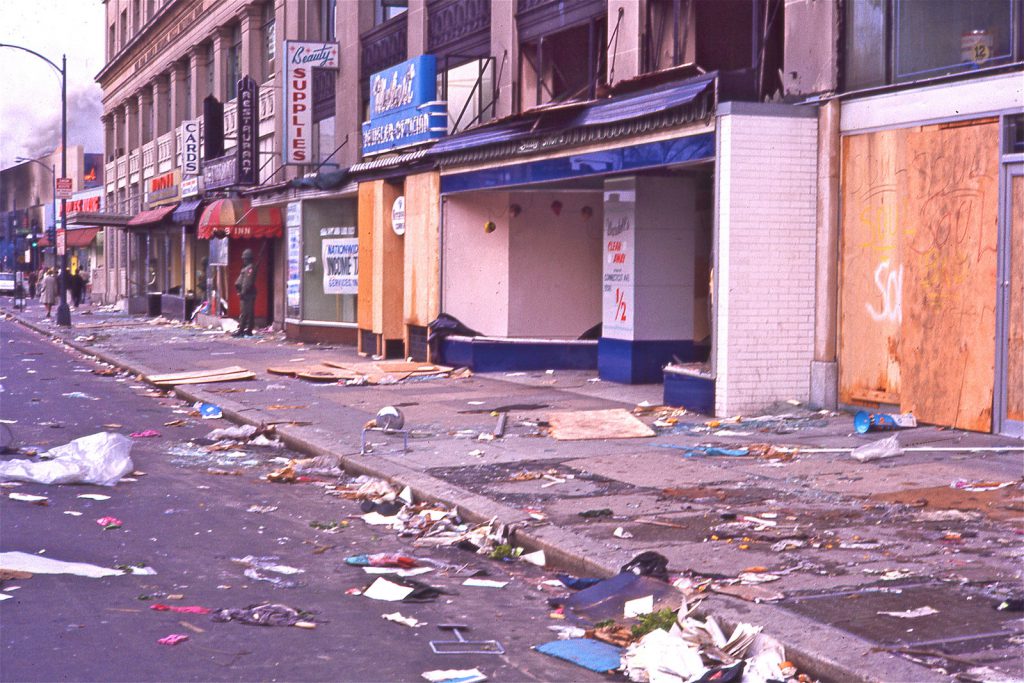
In 1972 I moved to Washington, DC for work, and barely three miles away whole city blocks still lay in ruins from the riots that followed Martin Luther King’s assassination four years before.  My job was in a comfortably white suburb, but there was nothing comfortable about those burnt-out Black neighborhoods.
In April 1973 I flew to Chicago to scout the University of Chicago for my doctoral studies.  Riding the elevated train south from the Loop would bring me west of the campus, so I planned to catch a bus east to the school.  I soon realized I was the only white person on the train, and every station stop simply added more Black passengers.  Finally an older Black woman got up and approach.
“Do you know where you’re going, young man?” she asked.
I told her my plan to reach the campus.
“Well, it’s best if you get off this train as soon as possible.  This is not a safe train for you.”
I thanked her, thinking that I was still not fully aware just how deeply divided our culture was--and had been for generations.
That fall my wife and I move to Hyde Park, the university enclave on Chicago’s South Side. We soon learned that none of our neighbors dared to venture into the “ghetto” neighborhoods to our north, west, and south.
 The following summer my parents visited and I offered to drive them to see the house they had lived in when my father was in the navy in the 1940s.  Thirty years later, it was an all-Black neighborhood, and when we parked across the street the Black gentleman rocking on the porch was clearly frightened by this car full of white people staring at his house--and we were too frightened even to explain our presence.  We simply drove off. To this day I regret I did not talk to the man.
In 1977 we moved to Dorchester, a rapidly changing inner-city Boston neighborhood with its historic Irish and Italian population fleeing as Black families moved in.  We found our apartment by word of mouth: it  had been off the market for two years for fear of Black tenants. Our suburban relatives were often reluctant to visit our “tenement” home, but we stayed.
Our children eventually enrolled in the Raphael Hernandez Bilingual School, where they acquired a unique education as members of a white minority in a multiethnic student body.  This was, of course, fresh in the wake of Boston’s busing crisis over segregated schools, and as we persisted we witnessed most of our white neighbors moving away rather than subject their kids to Boston’s public schools.  Citywide, schools became increasingly Black as white families abandoned a school system they could no longer dominate.
We still live in Dorchester, and our once lily-white neighborhood now includes a stable mix of Black families, Vietnamese, Cambodians, Haitians, gay couples, and a remnant of the Irish and Italians.  But as late as the late 1990s, my daughter’s Holy Cross classmates were often not allowed by their parents to spend weekends at our “inner city” home.
By now our own family includes people of color on both sides: my brother’s wife is Chinese-American, and our nephew’s wife is African-American. Their wonderful bi-racial kids are now our beloved kin.
Through all this time I’ve met my share of overtly racist people, but for every person who spouted racist sentiments there have been many more who were simply blind to, or even in denial of, racism’s pervasive grip on American Life.  Perhaps they have not benefited from experiences like my own, which awakened me to the reality depicted by the evocative imagery of Kareem Abdul-Jabbar:
African Americans have been living in a burning building for many years, choking on the smoke as the flames burn closer and closer. Racism in America is like dust in the air. It seems invisible — even if you’re choking on it — until you let the sun in. Then you see it’s everywhere. As long as we keep shining that light, we have a chance of cleaning it wherever it lands. But we have to stay vigilant, because it’s always still in the air.
For me, the basic truth is that slavery’s impact has never been eradicated.  And this brings me back to the notion of slavery as our Original Sin.
Most people’s worldview is shaped by their view of human nature. People who think human nature is simply good expect a world of happy human relations, and seek to blame any distress or injustice on external forces. People who see human nature as basically evil expect the worst of others, and seek to shield themselves from all threats.  But Christians have a more complex view.  For us, human nature is essentially good but factually flawed and wounded. We therefore hope for the best but expect that humans, unaided by divine grace, will typically fall into evil ways, not because of external forces alone, but because there is a moral misery within us.
This idea is usually applied to the whole human race.  But what if we apply it to a nation?  Is it possible that our national character is so rooted in our original enslavement of others that we as a people are fatally wounded and permanently incapable of goodness?
My own experience since 1969 until now has made me think so.  Yes, we have witnessed great gains since the civil rights movement of the 1960s.  Since the 1968 assassination of Martin Luther king, we have seen Blacks take leading roles in movies, television, sports, business, and politics at all levels--including the presidency itself.  Mixed-race couples and families and now more widely accepted, and there are broad legal protections for Blacks in housing, folding, employment, voting, and education. 
But the Covid-19 crisis has exposed how superficial some of these gains have been.  Black Americans are harder hit by the pandemic because Black Americans still lacked the privileges white Americans enjoy in housing, health care, wealth, and education. It was Dr. King himself who believed that America’s wounded nature would require more change than mere civil rights:
The Black revolution is much more than a struggle for civil rights of the Negroes. It is forcing America to face all its interrelated flaws--racism, poverty, militarism, and materialism. It is exposing evils that are rooted deeply in the whole structure of our society.  It reveals systemic rather than superficial flaws and suggests that radical reconstruction of society itself is the real issue to be faced.
The moral ills King decried in 1968 remain deep flaws in American Life.  One might even think that their persistence, despite all the activism and progress of the past 50 years, proves that no treatment will ever heal our national scar, so deep is the wound.  We might fear that slavery and racism comprise not only our Original Sin but even our permanent moral defect.

But now the perfect storm of pandemic and police killing has unleashed fresh healing forces.  People pent up from confinement take to the streets, unmindful of the health risks, to decry the death toll that both police and pandemic have taken on Black America.  We now see both the spread of virus and the blight of brutality as symptoms of our deeper moral malady.
And now come polls suggesting that, for the first time ever, a majority of Americans are finally awakening to the historic reality of systemic racism.

So against all odds, amid all the sickness and chaos, all the failed national leadership and the heroism of frontline workers, all the patience of those staying home and the persistence of protesters marching and kneeling and even lying in our streets--amid all this rises the hope that now, at long last, we might be ready to shed our past, to rip off that ancient scar and find true healing of our deep national wound and, with God’s grace, get to our nation’s promised land where we can, finally all together, breathe freedom’s fresh air
© Bernard F. Swain PhD 2020

Saturday, February 1, 2020

#479: Auschwitz 75--A Pilgrim's Memory


This week’s 75th anniversary of the liberation of Auschwitz has revived an indelible image from my long–past (but not lost) youth. I wrote this piece 5 years ago, and it continues to shock me that my first encounter with the Nazi genocide came barely 20 years after it was ended. Some of those survivors, now old, were then in their 20s and 30s. But this memory must outlive all our lives.

One November day in 1968, during my college year in Paris, I killed time between classes by wandering the area around Notre Dame Cathedral. After a few minutes exploring the Pope John XXIII garden behind the church, I noticed a low stone wall at the far end of a small green across the street, and crossed over to get a closer look at the words carved into the stones.
My French was still pretty basic, but I managed to figure out that the wall commemorated 200,000 French deported by the Nazis who occupied France during WWII. Actually, it was not a wall at all, but the roof of a (mostly) underground building, with stairways cut into it leading down into a courtyard.
This was the Mémorial de la Déportation. I had never heard of it, but I was about to experience it for the first time. I would emerge convinced it was the most powerful monument in all Paris---and I would emerge a changed person, someone whose personal pilgrimage had taken a sudden unseen turn.
The roofline rose around the narrow stairs as I descended, squeezing me between the stone walls. The same high wall enclosed the deep-set courtyard itself, blocking any sight of the city beyond. The Seine’s waters just below showed through one small grated opening, topped by the jagged points of a plate-iron sculpture that looked like barbed-wire enlarged 100 times. It felt like I was standing in a prison yard.
Turning back toward the stairs, I saw two massive stone slabs splitting a narrow space leading inside.
I squeezed through and found myself in an underground crypt softly lit by faint light coming from its four corners. In each corner I found a barred doorway to a stone jail-cell; the light came from windows one could not see from outside the locked empty cells. Carved into one stone wall is a poem reflecting the spiritual anguish of the camps:
I've dreamt so much of you
I’ve walked so much
Talked so much
So much loved your shadow
That there is nothing of you left for
     me—
What’s left for me is to be
The shadow between the shadows
The shadow that will come
And come again 
Into your sunlit life.
Returning to the center, I stood before a fifth set of bars blocking entrance to a low, long, tunnel-shape corridor. 
It led, like a horizontal black hole, to an invisible destination, but along both sides I saw thousands of tiny, faint-white lights, and instantly knew each one represented an individual lost to the Nazi genocide machine.
 
 Just beyond the bars, at my feet, was a raised coffin-shaped black stone, to mark the resting-place of an unknown deportee. Just behind me, in the middle of the floor, burnt an eternal flame.
And as I turned to go I saw, carved over the huge slabs leading out, the plea:  “Pardonne, n'oublie pas”—“Forgive, but Don’t Forget.”
When I climbed up the cramped exit stairs to ground level, cold drizzle greeted me like a refreshing breath of life after the stunning, symbolic specter of so many deaths. The few minutes I had spent inside had marked me, and shadowed the rest of that day and the weeks that followed.
I remained in France another eight months, and returned to the Mémorial every three or four weeks. In a city unrivaled for its cathedrals, monuments, places of historical significance and breath-taking beauty, this obscure, almost invisible memorial became my own personal place of pilgrimage.
Three years later I returned to Paris, and made time one morning to visit the Mémorial. After a few minutes of reflection I noticed the guard on duty approaching me.
“Excuse me, Monsieur, I do not mean to intrude. But I was wondering—you have been here before, non?”
I admitted I had.
“But it was some time ago, was it not? Two, maybe three years? And more than once?”
Yes, I agreed.
“You see, Monsieur, most people who come, they are just on tour—they walk in and walk out, maybe they take a photo or two. After five minutes they are gone, and have already checked this place off their list of sights to see. But you would come and stay, spend time, and you would return again.”
“Yes, it’s true,” I said. “But I was studying here, not on tour. I was here a whole school year.”
“That is what is even more striking, Monsieur. You see, the people who live here, the Parisians? They do not come at all. Most of them don’t even know it exists. And frankly, Monsieur, many would not care to know.”
He then added that I was not the only pilgrim who returned, telling me of the US officer who led the first US liberation of a Nazi death camp in January 1945.
“He saw what there was to see, Monsieur, and immediately said, ‘Ike (Supreme Allied Commander Dwight D. Eisenhower) has gotta see this.’ He got Eisenhower to come, and (Generals) Bradley and Patton with him. The man was marked for life, and every year, when he returns there to observe the anniversary, he also comes here to pay his respects.”
“You see, Monsieur, I can tell the pilgrims from the tourists! That is why I remember you.”
My first visit came only 23 years after the camps were liberated. It shocks me to think how near that awful history was to me then, and how fast the time since has passed.
Now, this week, we observe the 70th anniversary. That old guard is gone (as are, of course, most of the holocaust survivors), but the Mémorial remains.  It is still mainly seen by tourists who traipse in and out and check it off their lists. It is still largely invisible to, and ignored by, the average Parisian.
In 1995, on the 50th anniversary of the Holocaust, Boston erected its own Holocaust Memorial, an evocative rendering of 6 glass chimneys symbolizing the 6 major death camps, each one etched with 1 million numbers—one for each of the victims. It is a haunting venue, and I am grateful to have it near my home.
The New England Holocaust Memorial, Boston
But whenever I return to Paris, I still make sure to go back to the Mémorial. Often I bring someone along: in 1971 it was with the woman who became my wife; another year, it was a Parisian friend seeing it for the first time; in October 2013, it was my daughter.
And more than once I have returned to my old American school in Paris to arrange an official tour of the Mémorial for the students. This tour includes an upper level inside the building containing a great deal of historical documentation.
On one occasion, several English–speaking tourists tagged along with our group. Realizing this, the tour leader, who spoke only French, asked me to act as interpreter. For half an hour I translated her remarks for the tourists. So once again this place touched me in a personal way.
In the last 10 years, however, the Mémorial de la Déportation has been largely displaced by the new Holocaust Memorial, only a few hundred meters across the Seine, which is the largest center for Holocaust research in Europe.
So when I go back to this place—and I do, as often as I can—I know it will probably be quiet, or even empty, and unchanged. It will still urge me “Pardonne, n’oublie pas”—Forgive, but Do Not Forget.
For our generation, this has become a sacred duty. We face a time when, more than ever, faith and violence seem linked by emerging Holy Wars waged by global crusaders. The horrifying prospect: genocide may not yet be buried in our past, as long as fanatics seek a “final solution” for their fears by liquidating the hated evil enemy.
 As former President Jacques Chirac said in 2005 at the Holocaust Memorial’s opening: “The refusal to forget is all the defense we have against the renewal of barbarism.” And part of what we remember is that Nazi genocide emerged, not from a historical vacuum, but from the history of Christian anti-Semitism.
The holocaust was, indeed, mass murder—but it was more than that. It was a deliberate, intentional program aimed at making the Jewish people extinct. And it was carried out by people who claimed the Christian faith as their heritage, and a “Christian” view of Jews (as, for example, “Christ-killers” guilty of “deicide”) as their justification.
So, as we journey out of the shadow of the 20th century (history’s bloodiest century) into this new century of terror and revenge, our refusal to forget—our determination never to forget, to remember always—may be all that determines, for each of us, whether we are mere tourists or genuine pilgrims.
“Am I Tourist or Pilgrim? Just sightseeing, or sharing a journey?” If we ignore this question, we cannot give the right answer.
© Bernard F. Swain PhD 2020


Tuesday, August 2, 2016

#456: What Would a “Hillary America” Be Like?


Base on Hillary Clinton’s acceptance speech at the Democratic National Convention, it is possible to project the impact of her proposed policies on American Life.

I am repeating last week’s thought experiment, this time for Hillary Clinton.  Like last time, I’ll assume Clinton is a serious political leader. I will assume she wins November’s election.  I will assume she follows through on her acceptance speech agenda. I will even assume she is successful in implementing her proposed policies. These are all big “ifs,” but they allow us to imagine America under the leadership of Hillary Clinton, and to compare that image with Catholic Social Teaching (CST).

Based on Clinton’s own words, we can expect the following;

In Foreign Policy: We can expect continued war (especially air war and drone war) and occupation aimed at nation building and regime change.  We can also expect more war against ISIS and other terrorist organizations. We can expect support for allies, and special support for Israel, with no stated concern for the Palestinians or their supporters. We can expect continued tense relations with Russia. We can expect trade tensions with China.  But we can also expect strong efforts at diplomatic solutions, as with Iran. 

The first of these expectations is clearly out of step with Catholic Social Teaching, as almost all Catholic leaders opposed the invasion of Iraq and other similar attempts at regime change or nation building.  Most of the other elements are also more or less in conflict with CST too, except Clinton’s preference for diplomatic agreements over confrontation. 

Catholic Social Teaching has also long shown a major concern for the relation between the advanced industrial nations and the developing world. On this significant issue, Clinton (like Trump) was totally silent during her speech. Her concern about globalization’s impact focuses, not on developing nations, but on the US. We can expect her to fight for our middle class, but not against global poverty. In this respect, both Clinton and Trump talk about solving terror without solving poverty, as if terror has a military solution—a position Pope Francis has soundly rejected.

On Public Safety and Social Harmony: Here Clinton promised many things: no wall with Mexico, a path to citizenship for undocumented immigrants, reform of the criminal justice system to build trust in communities and defend rights, common sense gun reforms, no ban on any religion or religious group, comprehensive immigration reform, and protection for the right to choose abortion. Except for this last, most of Clinton’s promises match Catholic Social Teaching. On other “culture war” issues where we could expect more conflicts with CST, she was mostly silent.

Clinton’s promises on immigration are especially supportive of CST. The Church regards migration “for a better life” as a human right, a concept unknown to Trump based on his words.

On Economics.  Based on her words, we can expect many initiatives to reduce income inequality. Clinton called on Wall Street, corporations, and the very rich to begin “paying their fair share”—which sounds like higher taxes for the 1%. She also promised to end tax breaks and loopholes and collect taxes from corporations that outsource jobs. We can expect a “living wage” minimum wage. We can expect large government investments to create jobs (she promised the largest investment since World War II, which seemed to imply New Deal-style public works jobs). We can expect easier credit for small businesses.

All this fits (somewhat roughly) with Catholic Social Teaching’s long-standing critique of “unbridled capitalism,” its calls for income equality and even the redistribution of wealth (Pope Francis labels income inequality “the worst of all social ills”). This contrasts with Trump, who relied entirely on unchecked market forces to improve the economy, and promised to reduce taxes for the wealthy.

On Climate Change. Saying “I believe in science,” Clinton promised to fight climate change and in the process create many new jobs in clean energy. This contrasts with Trump’s total silence about climate change.  Clinton thus supports the same perspective as Catholic Social Teaching in general. But she failed to address the specific concerns of Pope Francis in his major encyclical “Laudato Si,” in which he linked climate change to nearly all global and social unrest, including global poverty and terror. In short, Clinton is against climate change while Trump ignores it—but neither of them connects the dots to our global situation they way Francis has.

On Social Welfare and the Safety Net: Based on Clinton’s words, we can expect more good paying jobs, good schools for all, tuition free college for middle class Americans and debt-free college for all, more training for people to learn trades, and an expansion of Social Security. This contrasts with Trump, who said almost nothing about policies regarding jobs, student debt, poverty, social security, etc. Rather, his speech implied that he expects the unbridled forces of the market to resolve all social problems. Catholic Social Teaching, meanwhile, has long rejected this idea, which Pope Francis himself has referred to as a fraud. So in this contrast Clinton’s positions on social welfare are a closer match with CST.

On the Supreme Court: Trump offered a generic promise to name more conservative justices to the Supreme Court, but Clinton was much more specific. With Clinton, we can expect justices prepared to defend Roe v Wade, expand voting rights, and reverse Citizens United—in short, the most “progressive” SCOTUS in a generation. From the point of view of Catholic Social Teaching, this would be a mixed blessing, raising the prospect of the reinforcing Roe v Wade, but at the same time holding the prospect of many decisions promoting the advancement of a freer, more just society.

In short, the America we can imagine under Clinton mixes many ideas congenial to Catholic Social Teaching (especially on issues like inequality, immigration, and social welfare), some other issues where she simply remains silent (like climate change’s global impact, and third world development), and some issues (like war and abortion) where her position conflicts implicitly or explicitly with Catholic Social Teaching. 

Compared to my Trump posting, I believe my assumptions this time are a bit less problematic.  While I do not find Trump a serious leader, I do find Clinton a potentially strong leader and I do expect her to win. But, given Washington’s gridlock, I doubt that she will succeed in achieving many of her goals, though she will undoubtedly pursue them vigorously. Yet it is still instructive to understand exactly what Clinton (and Trump) are proposing for our country, and how it fits--or does not fit--with the propositions of our faith. 
© Bernard F. Swain PhD 2016