WELCOME !


WELCOME! CrossCurrents aims to provoke thought and enrich faith by interpreting current events in the light of Catholic tradition. I hope you find these columns both entertaining and clarifying. Your feedback and comments are welcome! See more about me and my work at http://home.comcast.net/~bfmswain/onlinestorage/index.html or contact me directly at bfswain@juno.com NOTE: TO READ OR WRITE COMMENTS, CLICK ON THE TITLE OF A POST.

Showing posts with label race. Show all posts

Monday, June 15, 2020

#480: Is this, finally, our nation’s Great Awakening?

In this moment of national crisis, the popular uprising triggered by George Floyd’s killing raises the question: Is America finally ready to acknowledge and repair the systemic racism embedded in our culture? 
William Bratton is the former police commissioner in Boston, New York city, and Los Angeles.  When interviewed recently about George Floyd’s killing, he referred to slavery and racism as “America’s original sin--the scar that never heals.” My own awakening to that scar’s depth took many years, but I was fortunate to have many opportunities.
In December 1969, during my senior year at Holy Cross, all the Black students packed their bags and left campus, vowing never to return unless a group of expelled Black students received amnesty.  During a recent student sit-down protesting a campus visit by GE recruiters considered “scabs” (since GE was on strike), a disproportionate number of the protestors punished were Black.  A college administrator offered the excuse that, in a big mostly white crowd, those students were easier to spot!
In response, we white students went on strike in solidarity with the Black students.  Eventually amnesty was granted, and all the Black students returned to a campus newly awakened to their plight.
I spent the summer of 1971 as a research assistant for a doctoral thesis on “Racial Stratification in the US in the 20th century.” My job was collecting data for the chapter on lynching.  I constructed tallies of the lynchings in each state for each year since 1900.  Such tallies were rarely published in mainstream (white) periodicals, so I spent two months digging through obscure, often defunct Black journals that printed monthly totals of lynchings.
One day a Black reference librarian confronted me.  Why, she asked, was a white boy like me searching through these Black journals?  Why wasn’t this job given to a Black student?  What was I trying to prove?
Our encounter, perhaps 20 minutes long, ended with me (1) getting access to the archives I sought and (2) realizing that the burden of proof was on me to both acknowledge my privileged state and to persuade her of my bona fides.
My research left me appalled. I learned that thousands of Blacks were lynched not only without trials but also often without being charged, and even without any crime at all being committed.  Blacks were often lynched to cover the crimes—or simply the embarrassing behavior—of whites (as when a white girl flirted with a Black who was then lynched for rape after she was, in fact, beaten by her white boyfriend).  Blacks were lynched singly and in groups.  Blacks were not just lynched by hanging: Blacks were shot, drawn and quartered, tarred and feathered, buried alive, burnt at the stake, blowtorched, skinned alive. Pregnant Black girls were lynched after their babies were ripped from their wombs.
And blacks were lynched in frighteningly large numbers throughout the 20th century, well into the 1950s— right into my own lifetime.
It became clear to me that lynching was a cultural institution aimed not at justice, nor at crime, not even at individual conflicts. Lynching was often disguised as vigilanteeism, but in reality it aimed at terror--terror to frighten the Black population into continued submission.  In short, lynching replaced slavery to keep Blacks in their place during the Jim Crow era. And I saw that, as lynching finally faded away, the states with the most lynching became the states that executed the most Blacks.
My work that summer made me aware that terror against Black people had “evolved” from one institution to another: from slavery to lynching to the death penalty to mass incarceration to police brutality.  These different forms of terror all aimed to keep Blacks in “their place.”  Whites thus aimed to maintain supreme control.
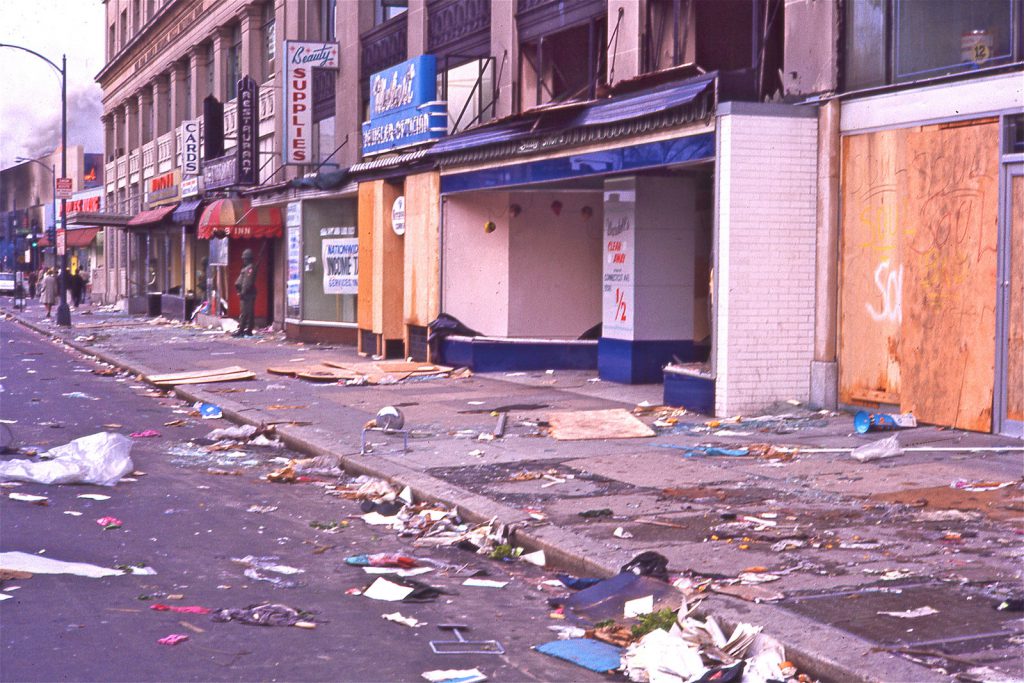
In 1972 I moved to Washington, DC for work, and barely three miles away whole city blocks still lay in ruins from the riots that followed Martin Luther King’s assassination four years before.  My job was in a comfortably white suburb, but there was nothing comfortable about those burnt-out Black neighborhoods.
In April 1973 I flew to Chicago to scout the University of Chicago for my doctoral studies.  Riding the elevated train south from the Loop would bring me west of the campus, so I planned to catch a bus east to the school.  I soon realized I was the only white person on the train, and every station stop simply added more Black passengers.  Finally an older Black woman got up and approach.
“Do you know where you’re going, young man?” she asked.
I told her my plan to reach the campus.
“Well, it’s best if you get off this train as soon as possible.  This is not a safe train for you.”
I thanked her, thinking that I was still not fully aware just how deeply divided our culture was--and had been for generations.
That fall my wife and I move to Hyde Park, the university enclave on Chicago’s South Side. We soon learned that none of our neighbors dared to venture into the “ghetto” neighborhoods to our north, west, and south.
 The following summer my parents visited and I offered to drive them to see the house they had lived in when my father was in the navy in the 1940s.  Thirty years later, it was an all-Black neighborhood, and when we parked across the street the Black gentleman rocking on the porch was clearly frightened by this car full of white people staring at his house--and we were too frightened even to explain our presence.  We simply drove off. To this day I regret I did not talk to the man.
In 1977 we moved to Dorchester, a rapidly changing inner-city Boston neighborhood with its historic Irish and Italian population fleeing as Black families moved in.  We found our apartment by word of mouth: it  had been off the market for two years for fear of Black tenants. Our suburban relatives were often reluctant to visit our “tenement” home, but we stayed.
Our children eventually enrolled in the Raphael Hernandez Bilingual School, where they acquired a unique education as members of a white minority in a multiethnic student body.  This was, of course, fresh in the wake of Boston’s busing crisis over segregated schools, and as we persisted we witnessed most of our white neighbors moving away rather than subject their kids to Boston’s public schools.  Citywide, schools became increasingly Black as white families abandoned a school system they could no longer dominate.
We still live in Dorchester, and our once lily-white neighborhood now includes a stable mix of Black families, Vietnamese, Cambodians, Haitians, gay couples, and a remnant of the Irish and Italians.  But as late as the late 1990s, my daughter’s Holy Cross classmates were often not allowed by their parents to spend weekends at our “inner city” home.
By now our own family includes people of color on both sides: my brother’s wife is Chinese-American, and our nephew’s wife is African-American. Their wonderful bi-racial kids are now our beloved kin.
Through all this time I’ve met my share of overtly racist people, but for every person who spouted racist sentiments there have been many more who were simply blind to, or even in denial of, racism’s pervasive grip on American Life.  Perhaps they have not benefited from experiences like my own, which awakened me to the reality depicted by the evocative imagery of Kareem Abdul-Jabbar:
African Americans have been living in a burning building for many years, choking on the smoke as the flames burn closer and closer. Racism in America is like dust in the air. It seems invisible — even if you’re choking on it — until you let the sun in. Then you see it’s everywhere. As long as we keep shining that light, we have a chance of cleaning it wherever it lands. But we have to stay vigilant, because it’s always still in the air.
For me, the basic truth is that slavery’s impact has never been eradicated.  And this brings me back to the notion of slavery as our Original Sin.
Most people’s worldview is shaped by their view of human nature. People who think human nature is simply good expect a world of happy human relations, and seek to blame any distress or injustice on external forces. People who see human nature as basically evil expect the worst of others, and seek to shield themselves from all threats.  But Christians have a more complex view.  For us, human nature is essentially good but factually flawed and wounded. We therefore hope for the best but expect that humans, unaided by divine grace, will typically fall into evil ways, not because of external forces alone, but because there is a moral misery within us.
This idea is usually applied to the whole human race.  But what if we apply it to a nation?  Is it possible that our national character is so rooted in our original enslavement of others that we as a people are fatally wounded and permanently incapable of goodness?
My own experience since 1969 until now has made me think so.  Yes, we have witnessed great gains since the civil rights movement of the 1960s.  Since the 1968 assassination of Martin Luther king, we have seen Blacks take leading roles in movies, television, sports, business, and politics at all levels--including the presidency itself.  Mixed-race couples and families and now more widely accepted, and there are broad legal protections for Blacks in housing, folding, employment, voting, and education. 
But the Covid-19 crisis has exposed how superficial some of these gains have been.  Black Americans are harder hit by the pandemic because Black Americans still lacked the privileges white Americans enjoy in housing, health care, wealth, and education. It was Dr. King himself who believed that America’s wounded nature would require more change than mere civil rights:
The Black revolution is much more than a struggle for civil rights of the Negroes. It is forcing America to face all its interrelated flaws--racism, poverty, militarism, and materialism. It is exposing evils that are rooted deeply in the whole structure of our society.  It reveals systemic rather than superficial flaws and suggests that radical reconstruction of society itself is the real issue to be faced.
The moral ills King decried in 1968 remain deep flaws in American Life.  One might even think that their persistence, despite all the activism and progress of the past 50 years, proves that no treatment will ever heal our national scar, so deep is the wound.  We might fear that slavery and racism comprise not only our Original Sin but even our permanent moral defect.

But now the perfect storm of pandemic and police killing has unleashed fresh healing forces.  People pent up from confinement take to the streets, unmindful of the health risks, to decry the death toll that both police and pandemic have taken on Black America.  We now see both the spread of virus and the blight of brutality as symptoms of our deeper moral malady.
And now come polls suggesting that, for the first time ever, a majority of Americans are finally awakening to the historic reality of systemic racism.

So against all odds, amid all the sickness and chaos, all the failed national leadership and the heroism of frontline workers, all the patience of those staying home and the persistence of protesters marching and kneeling and even lying in our streets--amid all this rises the hope that now, at long last, we might be ready to shed our past, to rip off that ancient scar and find true healing of our deep national wound and, with God’s grace, get to our nation’s promised land where we can, finally all together, breathe freedom’s fresh air. 
© Bernard F. Swain PhD 2020

Wednesday, January 23, 2019

#474: What Would King Say?


      Had he lived, Martin Luther King, Jr. would have turned 90 this past week.  As the nation celebrates his birthday, it is easy to honor King as a champion of civil rights, perhaps even easy to note that in 2019 America risks losing some of the gains he championed. 
But it is much harder for us to actually honor him as our national prophet--as America’s conscience--because that means honoring all the causes he stood for.  And those causes taken together, have not merely lost ground; they have nearly disappeared from our public discourse. 
Let me survey what King called the “three great evils,” and ask two questions: What would King say now?  And: Who in our public life still speaks for King? 
Racial Injustice.  Most celebrations honoring King focus on him as leader of the civil rights movement.  And surely a key message in his mission was that people be judged not “by the color of their skin, but by the content of their character.” By 1968 King had witnessed many gains, including the 1964 Civil Rights Act and the 1965 Voting Rights Act.  And since then, African-Americans have continued many gains. 
Still, were King alive today he might well say that too often people continue to be judged by the color of their skin, whether in efforts to suppress black votes, or in cases of police shooting unarmed Blacks, or in the rollback of the Voting Rights Act itself. 
And more recently the challenge of accepting people of color has increasingly focused, not only on the descendants of slaves, but also on immigrants and their children (indeed, our first Black president was the son of an immigrant, not the descendant of slaves).  And while King did not face the same issues over immigration that we face now, it’s easy to know what he might say--in fact he already actually said it:
“We may all have come from different ships, but we're in the same boat now."
Indeed, by the end of his career King would be increasingly clear that the evil of racism was not just a problem for U.S. blacks, but for all those oppressed by others:
“In one sense the civil rights movement in the United States is a special American phenomenon which must be understood in the light of American history and dealt with in terms of the American situation. But on another and more important level, what is happening in the United States today is a relatively small part of a world development.”
Looking around today, King might well say we remain far from fulfilling the goal of racial justice for all.
Inequality.  In later years King spoke more and more about economic inequality.  He often called it “poverty,” since up to 1968 the middle class was still gaining in wages and benefits, so it made sense to focus on those below the poverty line.  But since King’s death, the U.S. has seen nearly 50 years of steadily declining real wages even for the middle class, and we now see a wealth gap worse than any time since the great depression of the 1930s.  So when King spoke of poverty, he said:
“Why are there forty million poor people in America? And when you begin to ask that question, you are raising questions about the economic system, about a broader distribution of wealth.’ When you ask that question, you begin to question the capitalistic economy.”
This question of a “broader distribution of wealth” has changed since his death, with fewer below the poverty line but more struggling to make ends meet as wealth has been even more concentrated.  This makes King’s view not less, but even more timely.  Today he would surely repeat these words:
“Call it democracy, or call it democratic socialism, but there must be a better distribution of wealth within this country for all God’s children... God never intended for one group of people to live in superfluous inordinate wealth, while others live in abject deadening poverty.”
War. King lost many supporters and became an even more controversial figure when he campaigned against the Vietnam War.  Even other civil rights leaders felt this was not his role.  But they did not realize that, for King, this was the inevitable result of his own growing vision. 
Once he decided that nonviolence was the key to fighting racism, and once he incorporated the theories of Gandhian nonviolence into his own Christian theology, that naturally altered his views on war, as he moved from a “just war” perspective to pacifism.  He called this his “pilgrimage to nonviolence”:
“I felt that while war could never be a positive good, it could serve as a negative good by preventing the spread and growth of an evil force. War, horrible as it is, might be preferable to surrender to a totalitarian system. But now I believe that the potential destructiveness of modern weapons totally rules out the possibility of war ever again achieving a negative good.”
Indeed, King seemed to know that without a concerted anti-war strategy, the threat of mass destruction would spread.  Today’s worries about North Korea, Iran, and the U.S. abandoning the INF treaty all echo King’s warning:
“Nations are not reducing but rather increasing their arsenals of weapons of mass destruction. The best brains in the highly developed nations of the world are devoted to military technology. The proliferation of nuclear weapons has not been halted…On the contrary, the detonation of an atomic device by the first nonwhite, non-Western, and so-called underdeveloped power, namely the Chinese People’s Republic, opens new vistas of exposure of vast multitudes, the whole of humanity, to insidious terrorization by the ever-present threat of annihilation.”
When accepting the Nobel Peace Prize in 1964, King made his rejection of militarism clear:
“I refuse to accept the cynical notion that nation after nation must spiral down a militaristic stairway into the hell of nuclear annihilation... I believe that even amid today's mortar bursts and whining bullets, there is still hope for a brighter tomorrow... I still believe that one day mankind will bow before the altars of God and be crowned triumphant over war and bloodshed.”
I have no doubt that he would say matters now have only become worse.  Since 9/11 the U.S. has engaged in multiple, seemingly endless wars in Iraq, Afghanistan, Syria, and elsewhere. And unlike the Vietnam era, these wars are not even especially controversial.  In the 1960s a band of public leaders loudly opposed U.S. war policy: King, Robert F. Kennedy, Eugene McCarthy, George McGovern, and many others.  In 2019, who are the public leaders opposing our warlike foreign policy? 
Yet our troop deployments and arms sales (not to mention defense pending) far outstrip all other nations.  It is as if Americana have accepted that war is inevitable and peace is impossible. King would disagree:
“World peace through non-violent means is neither absurd nor unattainable. All other methods have failed. Thus we must begin anew. Non-violence is a good starting point.”
For Catholics today, King’s views are important for three reasons. 
First, his views on race, economic inequality, and peace fit almost exactly with Catholic Social Teaching of the last 50 years--especially with the teachings of the last four popes.  You can look it up! 
Second, King agrees with the Church that these three issues are linked:
“We must see now that the evils of racism, economic exploitation and militarism are all tied together…you can’t really get rid of one without getting rid of the others…the whole structure of American life must be changed.”
Third, King’s vision of the contemporary world exactly matches the Catholic vision emerging from Vatican Council II (1962-1965).  The Council saw technological progress as the hallmark of modern life, and praised such progress but offered this caution: technological progress confers new power, but the good use of that power requires a matching progress in wisdom and goodness. 
Here is how King saw the same “moral lag”:
“Through our scientific and technological genius, we have made of this world a neighborhood and yet we have not had the ethical commitment to make of it a brotherhood. But somehow, and in some way, we have got to do this.”
For King, as for Vatican II, this “moral lag” is at the root of what he calls the world’s three great evils:
“This problem of spiritual and moral lag, which constitutes modern man’s chief dilemma, expresses itself in three larger problems which grow out of man’s ethical infantilism. Each of these problems, while appearing to be separate and isolated, is inextricably bound to the other. I refer to racial injustice, poverty, and war.”
And for King, as for Vatican II, the challenge lies in our moral progress catching up to our technological progress:
“Mankind’s survival is dependent upon man’s ability to solve the problems of racial injustice, poverty, and war; the solution of these problems is in turn dependent upon man squaring his moral progress with his scientific progress, and learning the practical art of living in harmony”
Based on his own words, then, King’s voice still speaks to our time, much the way Catholic Social Teaching does.  Taken together, they represent our brightest wisdom and our clearest hope--but who will champion of such vision? 
On a day when many seek to fence in King’s legacy to narrow questions of race, we should rededicate ourselves to his broader cause of waging nonviolent combat against racism, inequality, and militarism. 
© Bernard F. Swain PhD 2019

Saturday, September 30, 2017

#468: The NFL’s Loyalty Test


  The controversy swirling around the bended knees by NFL players raises issues about our national identity and our commitment to it. 


On Thursday, the Supreme Court Justice picked by Donald Trump spoke to a select audience about defending the First Amendment. Here is what Neil Gorsuch said:

To be worthy of the First Amendment freedoms, we have to all adopt certain civil habits that enable others to enjoy them as well. When it comes to the First Amendment, that means tolerating those who don’t agree with us or those whose ideas upset us, giving others the benefit of the doubt about their motives.

Also Thursday, Tennessee Titans tight end Delanie walker revealed that he and his family had been receiving death threats.  These were apparently how fans responded after he suggested that fans should not come to NFL games if they felt disrespected by player protests.  

These two events reveal the opposite extremes the controversy has surfaced.

It’s tempting to think that the upset over the NFL protests is a mere distraction from the more serious problems facing America.  Certainly, for Trump himself, it is convenient if the public and media fight among themselves over the NFL players rather than focusing their attention on his handling of affairs with North Korea, or his slow response to the crisis in Puerto Rico, or his tax plans.

But in 21st century America, matters of race are never a “mere distraction.” And this case is above all about race.  But the real and unfortunate distraction has been to pretend that is about something else. So perhaps it is helpful to reflect and clarify on how the controversy about the NFL is a test of loyalty both for Americans and for Christians.

The clarification requires stating some basic facts to clear the air:

First: the NFL players did not introduce politics onto the playing field.  This was done in 2009 when the U.S. government began paying the NFL millions to stage “patriotic” events before each game: color guards, gun salutes, fly-overs—all designed to boost recruiting efforts by whipping up patriotic fervor.  In short, this is government-paid advertizing for the military, and it had the effect of bringing politics onto the NFL’s playing fields.

It’s just silly to complain if the players, understanding that politics is already at work here, decide to take advantage of the situation someone else has created.

Second: the players are not protesting the flag or the anthem.  Colin Kaepernick explicitly said that he meant no disrespect to either, but was in fact protesting the bad treatment of African Americans by police.  One may agree or disagree about the issue of police brutality, but it has nothing to do with either our flag or national anthem.

Third, this is not a protest about soldiers or veterans.  The original protest about police brutality has been transformed, in response to Trump’s “Sons of bitches” attack, into a protest about the First Amendment itself.  In neither instance are the players attacking, objecting to, or showing any disrespect for members of the military.  In fact many protesters are themselves veterans, and many other veterans support them. 

The players did not make the decision to have soldiers on the field, and they should not have to take any responsibility for it.  The players need to be on the field to play the game, but football could continue even if no soldier ever set foot on the gridiron.

Fourth: player salaries have nothing to do with the protests.  Yes, these players are millionaires - -but they are responding in protest to the attacks of someone who is even richer than they are. To allow a billionaire president to make such attacks, and then to claim that his target audience cannot protest because they are rich, is completely inconsistent. 

Some fans are even arguing that the players are “ungrateful” because they want to protest despite being well paid.  But First Amendment rights cannot be bought off; players do not lose those rights when they accept a paycheck, no matter how large.  And since most of them are African-Americans, calling them ungrateful sounds like a new way of calling Black Americans “uppity.”
Bill Russell takes a knee with his Medal of Freedom

Fifth:  Kneeling is not disrespectful.  The simple fact is, kneeling has been a gesture of respect, loyalty, even fealty, for centuries.  Many of us kneel when we pray, as a sign of respect.  And many players kept their hands over their hearts to reinforce that sign of respect.  This protest does not use kneeling as a sign of disrespect, but simply as a sign of protest--first, a protest against racialized police brutality, and second as a protest in favor of First Amendment rights.

Sixth:  Thus the real issues are (1) racialized police violence and (2) the right to protest itself--that is, free speech.

Once we accept the facts of the case, we can look at the underlying question of loyalty.

Loyalty here can mean many things.  It can mean loyalty to a flag, or to a song, or to a team, or to the Constitution, or even to a higher law.

Many Americans of course have strong emotional feelings about the flag, and we’re even in the habit of pledging our allegiance to it.  But while the actions that surround the flag often suggest that people regard it as something sacred, this cannot really be true. 

First, the U.S. Supreme Court has long determined that in the name of protest people may even burn the flag.  It also ruled that people have the right not to salute the flag. What this demonstrates, no matter how you feel about it, is that the right to protest is more important than this piece of cloth.  We cannot defend the flag by preventing protest.  Instead, we must protect protest even if it harms the flag.

Many Americans also have strong emotional attachment to the national anthem.  And the singing of the anthem at sports events became popular and routine during the 20th century, and especially during and after World War II.  But most people only know the first verse, and except for the final line “The land of the free and the home of the brave,” the rest of the song is simply a celebration, not of American values or institutions, but of a battle victory over the British in 1812. 

The song has been linked to sports, but we do not sing it in a theater before a movie, or a play, or in church before each ceremony.  We are perfectly capable of being Americans and celebrating American values and institutions whether we sing this song or not.

These things symbolize our nation and our people, but they are only that: symbols. If we treat them as though we must love them to love the country, we make them fetishes, as if they are the whole of us. It’s like loving someone’s big toe, instead of the whole person. This is not patriotism, it’s pathology.

And worse, to turn this song or this flag into something sacred—something, for example, higher than protest itself--is to fail the loyalty test that Americans, and especially American Christians, should be passing.

For Americans, the values enshrined in our Constitution are the highest standards we possess as a people.  The right to protest is the First Right among these, and nothing else in our social life is higher or more important.  Any attempt to prevent rightful protest as “disrespectful” to the flag or the anthem--or even to the military--is actually an act of profound disrespect for the Constitution itself, the very foundation of our nation, which those other things represent..

And for Christians, the lesson should be even more obvious.  Treating any object--a song, a flag, even a veteran or soldier--as something sacred fails the test of loyalty to the First Commandment: “Thou shall not have false gods.” Christians believe that only God is sacred, and that God’s will creates a higher law than any other law.

That law includes, especially for Catholics, the idea that we are one human family, all children of God, all brothers and sisters in Jesus Christ, and that therefore any division among us is a scandal to our faith.


 The very notion that Blacks in our country have been mistreated for centuries must be a source of shame to all of us.  That shame reflects the fact that America has failed to do God’s will for centuries, that slavery really is our original sin, and that we have not finished our penance and amendment for that sin. Using the flag and the anthem as camouflage to hide that makes the sin worse. Using our soldiers as human shields to hide our sin is worst of all.

So while loyalty to team, to flag, to a song, to the military may all be good things, the real test of our loyalties this: is our first loyalty as Americans to the Constitution?  Is our first loyalty as people of faith to the will of God and God’s higher law?

Viewed this way, the controversy is hardly a “mere distraction.” As serious as the other problems facing us are, this challenge of loyalty to God and Constitution cannot be ignored, cannot be forgotten, cannot be avoided.  It is a test of loyalty that, sooner or later, this nation must pass—or the nation will fail.
© Bernard F. Swain PhD 2017

Monday, January 21, 2013

America’s Moral Crossroads

On this Martin Luther King Day, during which the Inauguration festivities repeatedly linked freedom and war, I offer this reminder (written on King Day 2005):

In the years since King’s death, people who insist on reducing him to a “champion for racial justice,” period, have tamed his legacy. This dulls the true prophetic edge of a man who saw his own nation at odds with God’s will both at home and abroad.

       
For many Americans, Martin Luther King Day gets lost as one of those minor, even token observances like Labor Day and Veterans Day. Yet there are three important reasons to pay serious attention to this holiday.
(1) Since slavery was America’s "original sin,” and since we still struggle with its consequences, it makes sense to take this occasion to stop and reflect on our Christian responsibilities in promoting a racially just society.

(2) The second reason is somewhat broader: Dr. King was not a public official, nor even a professional politician. He was an ordained Christian minister, a preacher, a trained theologian. By the time of his assassination in April 1968, he had become widely regarded as the moral leader of America. Today he is the only American singled out for his own holiday. He has become the closest thing were have to a national patron saint. Today, when many are concerned about “moral values” (some even expect their President to be their moral leader), King offers a timely example of what moral leadership really looks like.

(3) The third reason may be even timelier: Peace. We’ve just come through the Holy Day of “Peace on Earth” we call Christmas, as well as the World Day of Peace we now celebrate on January 1. Now, two weeks later, we honor the man who finished his career by moving beyond the civil rights movement to become a champion for peace.

Of course, King won the Nobel Peace Prize in 1964 because of his commitment to a non-violent campaign for racial justice. But in his acceptance speech, he spoke of a commitment to non-violence that went beyond race-relations:

“This awards represents a profound recognition that non-violence is the answer to the crucial political and moral questions of our time—the need for men to overcome oppression and violence without resorting to violence and oppression.”

King knew, of course, that such recognition had not yet worked its way into US public policy. Indeed, 40 years later we still try to overcome oppression and violence by resorting to violence and oppression.

The Nobel Prize did not alter King’s character, but it did transform his agenda. While he still fought for black people’s rights, he began to sense the movement had an even higher   calling: to work for all people of good will. “Maybe our mission,” he said, “is to save the soul of America.”

For years King had promoted non-violence as the chief “weapon” in the civil rights struggle. Even as innocent children died in that struggle, he had long preached that the solution was not “getting our ammunition and going out shooting physical weapons.” Instead, he said, “We must know that we have something much more powerful. Just take up the ammunition of love.”

This was nothing but straight Gospel talk, of course, but King was coming to see non-violence as more than just a tool—in fact, as a value in itself—and he began to address himself to “Americans of good will who are committed to the struggle for brotherhood and the crusade for world peace.”

By then the US was not just struggling with civil rights; it was also a nation at war. Many within the movement urged King not to overstep his role, not to risk bogging down in the growing national turmoil over war in Vietnam. But finally King’s conscience dictated that he break his silence on the war, even if it meant breaking ranks with his allies in the movement.

The decisive moment came in April 1967, with his sermon at Riverside Church in New York City, the speech now known as the “Silence of the Night” speech, the speech many historians regard as King’s greatest—and the speech that redefined his place in American life.

He admitted that many supporters lamented his move, asking, “Why are you joining the voices of dissent?” and arguing “Peace and civil rights don’t mix.” His response: “My conscience leaves me no other choice. ” For he had come to see a darkness closing around America, and he believed someone had to break “the silence of the night.”

What was that darkness? It was the victory of violence in the world—not only violence by those oppressing racial minorities, but especially by “the greatest purveyor of violence in the world today: my own government.” He even worried that the war could make America a nation whose soul was “totally poisoned.”

He knew this would shock many, but he challenged them to see the logic of his outlook, appealing to his vocation as a minister of Jesus Christ:

 To me, the relationship of this ministry to the making of peace is so obvious that I sometimes marvel at those who ask me why I am speaking against the war... Have they forgotten that my ministry is in obedience to the one who loved his enemies so fully that he died for them?

For King, as for Pope John Paul II, being a Christian means being above all a citizen of the world, and he shared the world’s view that US war-making was “disgraceful” and “perverse.” He urged all draft-aged people to seek conscientious objector status, and called on clergy to mobilize war resistance.

But King was not done.

“The war in Vietnam,” he said, “is but a symptom of a far deeper malady within the American spirit.” The world, he said, is going through a major historical revolution, and our nation is “on the wrong side.” Without  “a significant and profound change in American life and policy,” he feared we would be mired in violence and turmoil for generations to come. Believing this, he proposed a radical shift in American values:

I am convinced that if we are to get on the right side of the world revolution, we as a nation must undergo a radical revolution of values. We must rapidly begin the shift from a thing-oriented society to a person-oriented society. When machines and computers, profit motives and property rights, are considered more important than people, the giant triplets of racism, extreme materialism, and militarism are incapable of being conquered. A true revolution of values will soon cause us to question the fairness and justice of many of our past and present policies…A true revolution of values will soon look uneasily on the glaring contrast of poverty and wealth…A true revolution of values will lay hand on the world order and say of war, "This way of settling differences is not just." …America, the richest and most powerful nation in the world, can well lead the way in this revolution of values. There is nothing except a tragic death wish to prevent us from reordering our priorities so that the pursuit of peace will take precedence over the pursuit of war.

This marked a major turn in King’s ministry. Until now he had always argued that the civil rights movement was needed to fulfill the “core American values” this nation was founded upon. Now, in a new and radical way, he was arguing those values needed to change if America was to meet its responsibilities to the world and to the Gospels.

In the years since King’s death, people who insist on reducing him to a “champion for racial justice,” period, have tamed his legacy. This dulls the true prophetic edge of a man who saw his own nation at odds with God’s will both at home and abroad.

Taming King’s message does disservice to both him and to our people, for today our nation still continues its warlike ways, yet Americans cry out for truer values. We cannot pretend to fulfill his dream by making peace with African-Americans if we also continue to be “the greatest purveyor of violence in the world today.”

King concluded his Riverside talk by depicting America at a moral crossroads, faced with a historic choice. Would we choose the shameful legacy of nations who possess “power without compassion, might without morality, and strength without sight”? Or would we instead choose to end the night by learning to make peace our way in the world?

 If we will make the right choice, we will be able to transform the jangling discords of our world into a beautiful symphony of brotherhood. If we will but make the right choice, we will be able to speed up the day, all over America and all over the world, when justice will roll down like waters, and righteousness like a mighty stream.

 America failed to heed him then, and 38 years later we find ourselves still stuck in the vicious cycle of violence. Is it our dark dead end, or have we simply circled back to the same old moral crossroads? If so, perhaps we have another chance to make the right choice, if only we will want the bright dream he dreamed. 

© Bernard F. Swain PhD 2005