In this moment
of national crisis, the popular
uprising triggered by George Floyd’s killing raises the question: Is America
finally ready to acknowledge and repair the systemic racism embedded in our
culture?
William Bratton is the former
police commissioner in Boston, New York city, and Los Angeles. When interviewed recently about George Floyd’s
killing, he referred to slavery and racism as “America’s original sin--the scar
that never heals.” My own awakening to that scar’s depth took many years, but I
was fortunate to have many opportunities.

In December 1969, during my senior year at Holy Cross,
all the Black students packed their bags
and left campus, vowing never to return unless a group of expelled Black
students received amnesty. During a recent
student sit-down protesting a campus visit by GE recruiters considered “scabs” (since
GE was on strike), a disproportionate number of the protestors punished were Black. A college administrator offered the excuse
that, in a big mostly white crowd, those students were easier to spot!

In response, we white
students went on strike in solidarity with the Black students. Eventually amnesty was granted, and all the Black
students returned to a campus newly awakened to their plight.
I spent the summer of 1971 as a research assistant for a doctoral thesis on “Racial
Stratification in the US in the 20th century.” My job was collecting
data for the chapter on lynching. I
constructed tallies of the lynchings in each
state for each year since 1900. Such tallies were rarely published in
mainstream (white) periodicals, so I spent two months digging through obscure,
often defunct Black journals that printed monthly totals of lynchings.

One day a Black reference
librarian confronted me. Why, she asked,
was a white boy like me searching through these Black journals? Why wasn’t this job given to a Black
student? What was I trying to prove?
Our encounter, perhaps 20
minutes long, ended with me (1) getting access to the archives I sought and (2)
realizing that the burden of proof was on me to both acknowledge my privileged
state and to persuade her of my bona
fides.
My research left me appalled.
I learned that thousands of Blacks were lynched not only without trials but
also often without being charged, and even without any crime at all being
committed. Blacks were often lynched to
cover the crimes—or simply the embarrassing behavior—of whites (as when a white
girl flirted with a Black who was then lynched for rape after she was, in fact,
beaten by her white boyfriend). Blacks were
lynched singly and in groups. Blacks
were not just lynched by hanging: Blacks were shot, drawn and quartered, tarred
and feathered, buried alive, burnt at the stake, blowtorched, skinned alive. Pregnant
Black girls were lynched after their babies were ripped from their wombs.
And blacks were lynched in
frighteningly large numbers throughout the 20th century, well into
the 1950s— right into my own lifetime.
It became clear to me that
lynching was a cultural institution aimed not at justice, nor at crime, not
even at individual conflicts. Lynching was often disguised as vigilanteeism, but
in reality it aimed at terror--terror to frighten the Black population into
continued submission. In short, lynching
replaced slavery to keep Blacks in their place during the Jim Crow era. And I
saw that, as lynching finally faded away, the states with the most lynching
became the states that executed the most Blacks.
My work that summer made me
aware that terror against Black people had “evolved” from one institution to
another: from slavery to lynching to the death penalty to mass incarceration to
police brutality. These different forms
of terror all aimed to keep Blacks in “their place.” Whites thus aimed to maintain supreme
control.
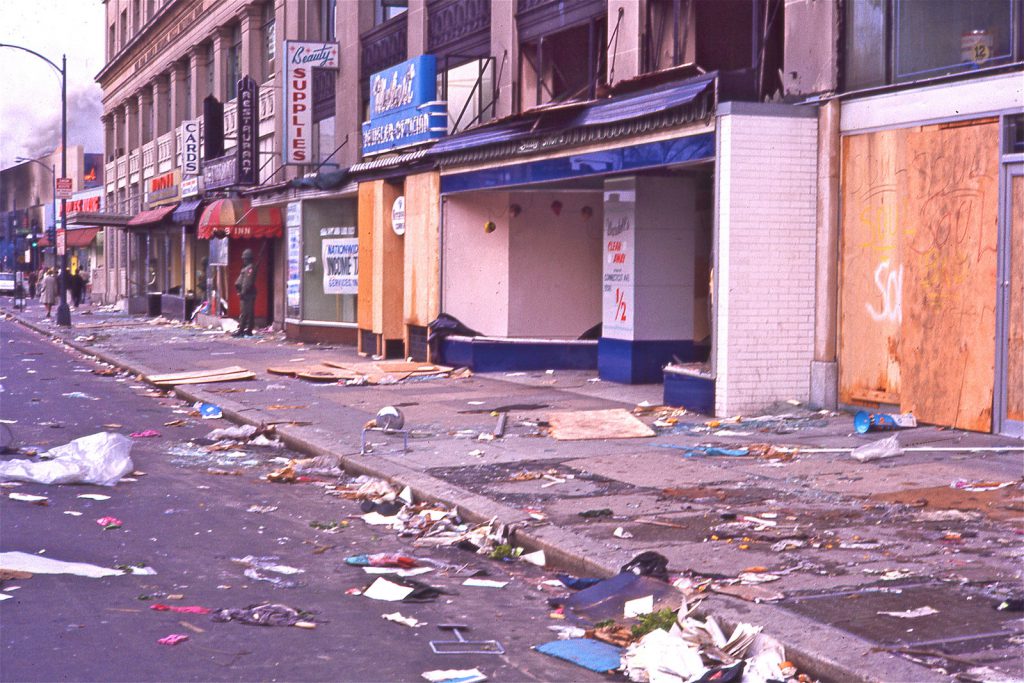
In 1972 I moved to Washington, DC for work, and barely three miles away whole city
blocks still lay in ruins from the riots that followed Martin Luther King’s
assassination four years before. My job
was in a comfortably white suburb, but there was nothing comfortable about those
burnt-out Black neighborhoods.
In April 1973 I flew to Chicago to scout the University of Chicago for my doctoral
studies. Riding the elevated train south
from the Loop would bring me west of the campus, so I planned to catch a bus
east to the school. I soon realized I
was the only white person on the train, and every station stop simply added
more Black passengers. Finally an older Black
woman got up and approach.
“Do you know where you’re
going, young man?” she asked.
I told her my plan to reach
the campus.
“Well, it’s best if you get
off this train as soon as possible. This
is not a safe train for you.”
I thanked her, thinking that
I was still not fully aware just how deeply divided our culture was--and had
been for generations.
That fall my wife and I move
to Hyde Park, the university enclave on Chicago’s South Side. We soon learned
that none of our neighbors dared to venture into the “ghetto” neighborhoods to
our north, west, and south.
The following summer my parents visited and I
offered to drive them to see the house they had lived in when my father was in
the navy in the 1940s. Thirty years
later, it was an all-Black neighborhood, and when we parked across the street
the Black gentleman rocking on the porch was clearly frightened by this car
full of white people staring at his house--and we were too frightened even to
explain our presence. We simply drove
off. To this day I regret I did not talk to the man.
In 1977 we moved to Dorchester, a rapidly changing inner-city Boston neighborhood with
its historic Irish and Italian population fleeing as Black families moved
in. We found our apartment by word of
mouth: it had been off the market for
two years for fear of Black tenants. Our suburban relatives were often
reluctant to visit our “tenement” home, but we stayed.

Our children eventually
enrolled in the Raphael Hernandez Bilingual School, where they acquired a
unique education as members of a white minority in a multiethnic student
body. This was, of course, fresh in the
wake of Boston’s busing crisis over segregated schools, and as we persisted we
witnessed most of our white neighbors moving away rather than subject their
kids to Boston’s public schools.
Citywide, schools became increasingly Black as white families abandoned a
school system they could no longer dominate.
We still live in Dorchester, and our once lily-white neighborhood now includes a
stable mix of Black families, Vietnamese, Cambodians, Haitians, gay couples,
and a remnant of the Irish and Italians.
But as late as the late 1990s, my daughter’s Holy Cross classmates were
often not allowed by their parents to spend weekends at our “inner city” home.
By now our own family includes people of color on both sides: my brother’s wife is Chinese-American,
and our nephew’s wife is African-American. Their wonderful bi-racial kids are
now our beloved kin.
Through all this time I’ve
met my share of overtly racist people, but for every person who spouted racist
sentiments there have been many more who were simply blind to, or even in
denial of, racism’s pervasive grip on American Life. Perhaps they have not benefited from
experiences like my own, which awakened me to the reality depicted by the
evocative imagery of Kareem Abdul-Jabbar:

African Americans have been living in a burning
building for many years, choking on the smoke as the flames burn closer and
closer. Racism in America is like dust in the air. It seems invisible — even if
you’re choking on it — until you let the sun in. Then you see it’s everywhere.
As long as we keep shining that light, we have a chance of cleaning it wherever
it lands. But we have to stay vigilant, because it’s always still in the air.
For me, the basic truth is
that slavery’s impact has never been eradicated. And this brings me back to the notion of
slavery as our Original Sin.
Most people’s worldview is
shaped by their view of human nature. People who think human nature is simply
good expect a world of happy human relations, and seek to blame any distress or
injustice on external forces. People who see human nature as basically evil
expect the worst of others, and seek to shield themselves from all
threats. But Christians have a more
complex view. For us, human nature is essentially good but factually flawed and wounded. We therefore
hope for the best but expect that humans, unaided by divine grace, will
typically fall into evil ways, not because of external forces alone, but
because there is a moral misery within us.
This idea is usually applied
to the whole human race. But what if we
apply it to a nation? Is it possible
that our national character is so rooted in our original enslavement of others
that we as a people are fatally
wounded and permanently incapable of goodness?
My own experience since 1969
until now has made me think so. Yes, we
have witnessed great gains since the civil rights movement of the 1960s. Since the 1968 assassination of Martin Luther
king, we have seen Blacks take leading roles in movies, television, sports,
business, and politics at all levels--including the presidency itself. Mixed-race couples and families and now more
widely accepted, and there are broad legal protections for Blacks in housing,
folding, employment, voting, and education.
But the Covid-19 crisis has
exposed how superficial some of these gains have been. Black Americans are harder hit by the
pandemic because Black Americans still lacked the privileges white Americans
enjoy in housing, health care, wealth, and education. It was Dr. King himself
who believed that America’s wounded nature would require more change than mere
civil rights:
The Black revolution is much more than a struggle for
civil rights of the Negroes. It is forcing America to face all its interrelated
flaws--racism, poverty, militarism, and materialism. It is exposing evils that
are rooted deeply in the whole structure of our society. It reveals systemic rather than superficial
flaws and suggests that radical reconstruction of society itself is the real
issue to be faced.
The moral ills King decried
in 1968 remain deep flaws in American Life.
One might even think that their persistence, despite all the activism and progress of the past 50 years, proves
that no treatment will ever heal our national scar, so deep is the wound. We might fear that slavery and racism comprise
not only our Original Sin but even our permanent moral defect.

But now the perfect storm of
pandemic and police killing has unleashed fresh healing forces. People pent up from confinement take to the
streets, unmindful of the health risks, to decry the death toll that both
police and pandemic have taken on Black America. We now see both the spread of virus and the
blight of brutality as symptoms of our deeper moral malady.
And now come polls suggesting
that, for the first time ever, a majority of Americans are finally awakening to
the historic reality of systemic racism.

So against all odds, amid all
the sickness and chaos, all the failed national leadership and the heroism of
frontline workers, all the patience of those staying home and the persistence
of protesters marching and kneeling and even lying in our streets--amid all
this rises the hope that now, at long last, we might be ready to shed our past,
to rip off that ancient scar and find true healing of our deep national wound
and, with God’s grace, get to our nation’s promised land where we can, finally
all together, breathe freedom’s fresh air.
© Bernard F. Swain PhD 2020